Use proper supports
Provide a sturdy trellis, netting, or vertical wires before vines start to climb so the young stems can attach early and form an even curtain of growth rather than a tangled mass on nearby plants.

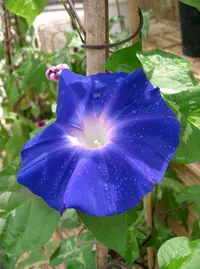
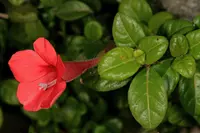
Whiteedge morning-glory (Ipomoea nil) is a fast-growing annual vine known for its showy funnel-shaped flowers and distinct white-edged leaves or petals. It is commonly grown as an ornamental climber on trellises, fences, and balcony railings.
In the wild, it occurs in parts of East Asia but is now widely cultivated and sometimes naturalized in warm-temperate and subtropical regions. Its rapid growth and self-seeding habit make it easy to establish but it can spread aggressively in mild climates.
This vine prefers full sun, moderate moisture, and well-drained soil, which makes it relatively straightforward to care for whiteedge morning-glory in typical garden conditions.

Care Difficulty
Moderate Care

Light Preference
Full Sun

Water Requirements
Moderate Water

Temperature Preference
Tropical / Frost Sensitive

Hardiness Zone
10–11

Soil Texture
Sandy, Loamy, Organic-rich

Soil pH
Acidic (5.5–6.5), Slightly acidic (6.5–7.0)

Soil Drainage
Well-drained

Fertilization
Light (every 4–6 weeks)
Scan your plant to receive care tips personalized for your specific plant
Available on iOS and Android
This annual vine thrives in strong light and responds quickly to changes in sun exposure.
This fast-growing climber prefers consistently moist but never waterlogged soil during its active season.
This warm-season vine grows best in stable, frost-free conditions from late spring through early fall.
Ipomoea nil grows well in typical household humidity but benefits from slightly moist air in heated homes.
Ipomoea nil prefers light, sharply drained, moderately fertile soil that does not stay wet for long.
This twining annual suits container growing when given adequate depth and stable support.
Ipomoea nil responds well to moderate feeding during its warm-season growth but does not need heavy fertilization.
Pruning helps manage the vigorous, twining growth of Ipomoea nil and encourages better flowering.
Ipomoea nil is usually grown as a seasonal vine, so transplanting seedlings correctly matters more than long-term repotting.
Propagation of Ipomoea nil is most commonly done from seed, which germinates quickly in warm conditions.
In most climates Ipomoea nil behaves as a frost-tender annual, so plants usually do not overwinter outdoors.

Plant Health Check
Not sure what's wrong with your plant? Check your plant's health inside the app.
Many cultivated forms of this species show strong white or cream variegation along the leaf margins and veins, which is genetically stable and has been selected over centuries in Japan for ornamental value.
Japanese breeders have developed hundreds of named morning-glory cultivars from this species alone, showing extreme variation in flower size, color patterns, and petal shapes due to mutations in genes controlling pigment production and floral development.
In Japan this species, known as asagao, has been a classic summer ornamental since at least the Edo period, with dedicated morning-glory markets and exhibitions that focus largely on Ipomoea nil care and unusual flower forms.

This species was one of the earliest ornamental plants used in Japanese genetics research, and unusual dwarf, variegated, or split-petaled forms of Ipomoea nil were historically maintained as living material for studying inheritance patterns long before DNA was understood.
This species is a twining climber. Stems wrap around trellises, fences, or other plants, typically reaching several meters if supported. Without support, it scrambles along the ground, forming trailing, somewhat tangled growth rather than a neat mound.
Keep your plants happy and healthy with plant identification, disease detection, and easy care guidance.