


Early support training
Install a sturdy trellis, arbor, or wire system before planting and loosely tie young shoots with soft plant ties so the vine learns the intended direction instead of grabbing gutters or nearby trees.

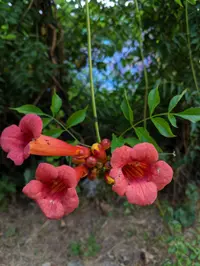
Trumpet vine, Campsis radicans, is a vigorous deciduous climber known for its large, trumpet-shaped orange to red flowers and fast growth. It attaches to walls, fences, and trees using aerial rootlets, forming dense vertical screens.
This species is native to the southeastern United States but is widely grown in many temperate regions for its showy blooms and strong attraction to hummingbirds. Its rapid growth and suckering habit can make it invasive if not controlled.
Trumpet vine is generally easy to grow, provided it has sturdy support and space to spread. It prefers full sun, moderately moist but well-drained soil, and benefits from thoughtful planning on how to care for Trumpet vine before planting.

Care Difficulty
Easy Care

Light Preference
Full Sun

Water Requirements
Moderate Water

Temperature Preference
Cold Hardy

Hardiness Zone
4–9

Soil Texture
Sandy, Loamy, Clay

Soil pH
Acidic (5.5–6.5), Slightly acidic (6.5–7.0)

Soil Drainage
Well-drained

Fertilization
Minimal (feed rarely)
Scan your plant to receive care tips personalized for your specific plant
Available on iOS and Android
Campsis radicans thrives in strong light and flowers best with full sun exposure.
Campsis radicans prefers evenly moist but not saturated soil once established outdoors.
This vine is cold-hardy yet grows most vigorously in warm, stable conditions.
This species handles a wide humidity range and usually does not need special humidity management outdoors.
Campsis radicans grows best in moderately fertile, well-structured mineral soil that drains freely but does not dry out instantly.
This vigorous climber can be grown in large, heavy containers if the pot is chosen and managed for stability and root space.
Campsis radicans is vigorous and often thrives in average soil with modest fertilization.
Pruning Campsis radicans directs its vigorous growth and supports heavy flowering on safe, well-managed structures.
Strong roots and permanent placement matter more than frequent repotting for Campsis radicans.
Campsis radicans is commonly propagated to expand plantings or replace older vines.
Campsis radicans is generally cold hardy in much of the US and needs minimal winter care once established.

Plant Health Check
Not sure what's wrong with your plant? Check your plant's health inside the app.
In much of its range, the ruby-throated hummingbird is the primary pollinator of Campsis radicans, and the long tubular flowers closely match the bird’s bill and tongue length, showing a classic example of coevolution between a plant and a specific pollinator.
This species spreads vigorously not only by seed but also through underground stolons and root sprouts, which allows a single plant to develop into a dense colony that can dominate fencerows, woodland edges, and disturbed sites.
Along streams and river margins in its native range, the extensive root system of Campsis radicans helps bind soil, so established colonies can reduce erosion on banks and steep slopes.

In parts of its introduced range, especially in Europe, Campsis radicans has become naturalized along railway lines, walls, and urban structures, using its aerial rootlets to cling to masonry and effectively turning human-built surfaces into vertical habitat for insects and birds.
This species spreads vigorously by underground runners and self-seeding. In many regions it is considered invasive. Use root barriers, regular pruning, and prompt removal of unwanted shoots and seedlings to keep it confined to the intended area.
Keep your plants happy and healthy with plant identification, disease detection, and easy care guidance.

winged bean
Psophocarpus tetragonolobus
-200x152.webp)
Blushing Philodendron
Philodendron erubescens 'Pink Princess'
 POPULAR
Philodendron melanochrysum
Philodendron melanochrysum
lesser yam
Dioscorea esculenta
ayahuasca
Banisteriopsis caapi
Lilac vine
Hardenbergia violacea
Split Leaf Climber
Philodendron radiatum
Chinese Pothos
Pothos chinensis