cypressvine Care (Ipomoea quamoclit)

Also known as: Cupid's Flower, Cardinal vine
cypressvine

About cypressvine

Cypressvine, Ipomoea quamoclit, is a fast-growing annual vine in the morning glory family, valued for its fine, feathery foliage and star-shaped flowers. It typically climbs by twining around supports, forming a light, lacy screen that attracts hummingbirds and butterflies in warm seasons.

This species is native to tropical regions of the Americas but is now grown in many warm and temperate gardens as an ornamental. It is generally easy to care for cypressvine where summers are warm, provided it has sun, well-drained soil, and regular moisture without waterlogging.

Main Plant Requirements

Care Difficulty

Moderate Care

Light Preference

Full Sun

Water Requirements

Moderate Water

Temperature Preference

Tropical / Frost Sensitive

Hardiness Zone

10–12

Soil Texture

Sandy, Loamy, Organic-rich

Soil pH

Acidic (5.5–6.5), Slightly acidic (6.5–7.0)

Soil Drainage

Well-drained

Fertilization

Light (every 4–6 weeks)

Get Personalized Care Plan

Scan your plant to receive care tips personalized for your specific plant

Available on iOS and Android

How to Care for the cypressvine

Ipomoea quamoclit thrives in strong sun for fast growth and abundant flowering.

  • Provide 6–8 hours of direct sun daily; morning to early afternoon sun is ideal for most climates.
  • Plant in a position with full sun, though light afternoon shade is helpful in very hot regions to limit leaf scorch.
  • Tolerates light partial shade (around 4–5 hours sun), but flowering drops and vines stretch when light is too low.

This annual vine prefers evenly moist, well-drained soil rather than constant wetness.

  • Water when the top 2–3 cm of soil feels dry, applying enough to moisten the root zone without leaving standing water.
  • In hot, windy weather, check soil daily; in cooler periods, intervals naturally lengthen as evaporation slows.
  • Signs of overwatering include limp, yellowing lower leaves and soft stems; underwatering shows as wilting that improves quickly after deep watering.

This warm-season vine grows best in stable, frost-free conditions.

  • Optimal growth occurs around 70–85°F (21–29°C), with steady warmth promoting fast climbing and flowering.
  • Plant outdoors only after nights stay above 55°F (13°C); frost or brief drops near 32°F (0°C) can kill vines outright.
  • Cypressvine tolerates short heat spikes up to about 95°F (35°C) if soil moisture is maintained, but growth slows in prolonged extreme heat.

This species handles a wide humidity range and rarely needs special moisture management outdoors.

  • Aim for 40–60% humidity; typical outdoor air in most regions suits cypressvine without adjustment.
  • Leaves may curl, brown at the tips, or drop prematurely if exposed to prolonged hot, very dry air.
  • In unusually arid climates, group plants near other vegetation or use a light mulch over the root zone to reduce moisture stress.

This fast-growing vine performs best in light, well-drained soil that does not stay waterlogged.

  • Use a sandy or loamy mix with moderate organic matter so roots receive both moisture and air; heavy clay restricts growth.
  • For containers, combine roughly 60% all-purpose potting mix with 20% coarse sand and 20% perlite to improve drainage and aeration.
  • Aim for slightly acidic to neutral pH, around 6.0–7.0, which supports nutrient uptake for Ipomoea quamoclit.
  • Avoid compacted, poorly drained sites; raise beds or use mounded rows if natural soil stays wet after rain.

This species adapts well to container growing when the pot supports its fast, climbing habit.

  • Choose a deep, at least 25–30 cm container so the vigorous root system can anchor and support rapid vine growth.
  • Select a heavier material like terracotta or ceramic to stabilize tall growth and reduce tipping in wind.
  • Position the pot so a trellis, fence, or railing is within immediate reach, preventing stems from kinking as they search for support.

Ipomoea quamoclit is a fast-growing annual vine that benefits from light, balanced feeding in nutrient-poor soils during the active season.

  • Use a balanced liquid fertilizer (such as 10-10-10) at 1/2 strength every 3–4 weeks in spring and summer for cypressvine in containers or poor ground soil.
  • On rich garden soil, limit feeding to a light dose at planting or 1–2 times in the season to avoid excessive foliage with fewer flowers.
  • Include compost or a mild slow-release fertilizer in the planting area to provide steady nutrients without strong surges.
  • Stop fertilizing in late summer to early fall so growth can slow naturally and the plant can complete its life cycle without soft, frost-tender growth.

Pruning Ipomoea quamoclit helps manage its vigorous vines, maintain airflow, and support abundant flowering.

  • Best time is during active growth in late spring and summer, trimming back overly long or tangled shoots as needed.
  • Remove dead, weak, or damaged stems with clean, sharp scissors or hand pruners to reduce disease risk.
  • Thin crowded vines along trellises or supports to improve light penetration and encourage more flowering side shoots.
  • Pinch soft tips lightly to promote bushier growth rather than long, sparse stems.

This vine is most often grown as an annual in the ground, so focus on correct transplanting rather than frequent repotting.

  • Transplant seedlings outdoors after frost danger passes and soil warms to at least 60°F for best establishment.
  • Plants in pots need shifting only if roots circle the container, growth stalls, or watering frequency becomes very high.
  • Move to a container 1–2 in wider with free-draining potting mix, handling the root ball gently to limit stress.
  • Water well after transplanting and shade lightly for 2–3 days to reduce transplant shock and help roots re-establish.

New plants are most commonly raised from seed, making Ipomoea quamoclit straightforward to multiply each season.

  • Sow fresh seeds in spring indoors 4–6 weeks before the last frost or directly outdoors after frost has passed.
  • Nick or lightly file the hard seed coat, then soak seeds 12–24 hours in lukewarm water to speed germination.
  • Provide 70–80°F warmth, bright light, and evenly moist but not waterlogged medium until seedlings emerge.
  • Transplant seedlings carefully once they have 2–3 true leaves, disturbing roots as little as possible.

This species is typically grown as a warm-season annual and does not survive freezing conditions outdoors.

  • Ipomoea quamoclit is frost-sensitive; even light frosts kill foliage and usually the entire plant.
  • In cool regions, allow vines to complete their life cycle, then remove dead growth after the first hard frost.
  • Container plants can be moved indoors to a bright, frost-free space, though performance often declines after one season.

Care Tips

Early trellis training

Install a sturdy trellis or netting before vines reach 15–20 cm, then gently wind young stems in the desired direction every few days so they climb vertically instead of tangling on nearby plants.

Pinch for branching

Once vines reach about 30–40 cm, pinch out the soft growing tip on the main stem to encourage side shoots and a denser, more floriferous screen rather than one long, sparse vine.

Timed sowing succession

Stagger sowing every 2–3 weeks in late spring and early summer so flowering continues over a longer period instead of peaking all at once.

Self‑seeding management

Remove most spent flower clusters before seed pods fully dry if you want to reduce volunteer seedlings next year, but leave a few pods on selected vines where self‑sowing is desired.

Support against wind

In exposed sites, secure main stems to their support with soft garden ties every 20–30 cm to prevent wind whip and stem breakage, which is especially helpful when growing cypressvine on light mesh or wires.

Common Pests and Diseases

Spider mites

This pest often appears in hot, dry conditions and feeds on the undersides of leaves, causing fine stippling and a dusty, webbed look on cypressvine foliage. Symptoms include pale, speckled leaves that may yellow and drop prematurely.

Solution

Rinse vines thoroughly with a strong but controlled stream of water, especially the undersides of leaves, and repeat several times over 7–10 days. If populations remain high, use insecticidal soap or a horticultural oil labeled for mites, applying in the early morning and improving humidity and airflow around the plant to reduce stress.

Leaf miners

These insects tunnel inside the leaves, leaving pale, winding trails that can distort the delicate, feathery foliage. Symptoms include thin, serpentine lines and blotches where the internal leaf tissue has been eaten away.

Solution

Remove and dispose of affected leaves as soon as mines are visible to break the life cycle. For repeated problems, use a neem oil spray or spinosad product labeled for leaf miners, applying to young foliage and avoiding treatment during high heat or full midday sun.

Aphids

This pest clusters on tender shoot tips, flower buds, and the undersides of leaves, sucking sap and excreting sticky honeydew. Symptoms include curled or distorted growth, sticky residue, and sometimes sooty black mold growing on the honeydew.

Solution

Spray the vines with a strong stream of water to dislodge aphids, repeating every few days as needed. If infestations persist, apply insecticidal soap or neem oil, making sure to coat new growth and the undersides of leaves, and limit high-nitrogen fertilization that encourages soft, aphid-attracting shoots.

Powdery mildew

This disease appears as white or grayish powdery patches on leaves and stems, often in warm conditions with poor air movement. Symptoms include dull, mottled foliage that may yellow, curl, and drop, reducing flowering and vigor.

Solution

Improve air circulation by spacing vines properly and training them on an open trellis, and avoid overhead watering late in the day. Remove heavily affected leaves and, if needed, apply a sulfur or potassium bicarbonate fungicide labeled for powdery mildew, following label directions and treating at the first sign of infection.

Fungal leaf spots

This disease causes brown, tan, or dark purple spots on the fine foliage, sometimes with yellow halos, especially in periods of warm, wet weather. Symptoms include scattered lesions that can merge, leading to partial leaf blight and early leaf drop.

Solution

Remove and discard infected leaves and any fallen debris around the base of the plant to reduce spore spread. Water at soil level in the morning, avoid wetting the foliage, and in persistent cases use a copper-based or chlorothalonil fungicide labeled for ornamental vines, applying at intervals recommended on the product during humid, rainy periods to support healthy growing cypressvine.

Interesting Facts

Hummingbird specialist

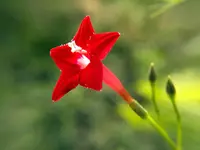
The red, tubular flowers are shaped and sized to match hummingbird beaks, and in much of its introduced range the plant is pollinated almost exclusively by hummingbirds rather than insects.

Deeply feathered foliage

Its leaves are divided into many fine, thread-like segments, giving a fernlike or feathery appearance that distinguishes it from most other morning glory relatives.

Hybrid fountain of colors

This species readily hybridizes with the closely related cypress vine morning glory, producing the so-called cardinal creeper, which shows a mix of foliage types and flower colors from both parents.

Botan icon

Did you know?

In some warm regions, this fast-growing climber escapes cultivation and naturalizes rapidly, forming dense tangles that can smother shrubs and fences, so gardeners are advised to monitor and remove volunteer seedlings to prevent it from becoming locally invasive.

FAQs about cypressvine

Lack of flowers usually comes from insufficient sun, too much nitrogen fertilizer, or plants that are still immature. Ensure strong light, avoid high-nitrogen feeds, and do not pinch too late in the season, which removes potential buds.

Grow Healthy Plants with Botan Care

Keep your plants happy and healthy with plant identification, disease detection, and easy care guidance.

Botan plant care app — identify plants on mobile

Explore More Plants