Provide climbing support
Install a sturdy trellis or rough stake early and gently tie young shoots as they elongate so the vine can climb vertically and produce more flowering and fruiting nodes.

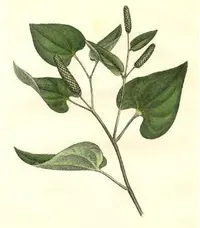
Indian long pepper (Piper longum) is a perennial climbing vine in the pepper family, grown for its elongated, spicy fruit spikes. It typically twines over supports or nearby plants, forming a dense, leafy cover with narrow, dark green leaves. Native to South and Southeast Asia, it prefers warm, humid conditions and a frost-free climate. The plant is moderately challenging for beginners, mainly because it dislikes cold, dry air and poorly drained soil. Those who want to learn how to care for Indian long pepper should focus on providing bright, filtered light, consistently moist but not waterlogged soil, and sheltered, warm conditions.

Care Difficulty
Moderate Care

Light Preference
Partial Shade

Water Requirements
Keep Soil Moist

Temperature Preference
Tropical / Frost Sensitive

Hardiness Zone
10–12

Soil Texture
Loamy, Organic-rich

Soil pH
Acidic (5.5–6.5), Slightly acidic (6.5–7.0)

Soil Drainage
Moist but well-drained

Fertilization
Moderate (every 2–4 weeks)
Scan your plant to receive care tips personalized for your specific plant
Available on iOS and Android
Piper longum grows best with bright, indirect light and protection from harsh midday sun.
Piper longum prefers evenly moist, well-drained soil without long periods of dryness or standing water.
This species thrives in consistently warm, frost-free conditions typical of tropical and subtropical climates.
This species prefers moderately high humidity to support healthy foliage and flowering.
This species grows best in loose, moisture-retentive but well-drained soil.
This species adapts well to container growing when root space and drainage are managed carefully.
Piper longum benefits from modest, consistent feeding during active growth in warm months.
Pruning Piper longum helps manage its vining habit and maintains healthy, compact growth.
Container-grown Piper longum benefits from periodic repotting to maintain root health and steady growth.
Piper longum is most commonly propagated from semi-ripe stem cuttings rather than seed for reliable results.
Piper longum is frost-sensitive and needs protection in regions with cool or cold winters.

Plant Health Check
Not sure what's wrong with your plant? Check your plant's health inside the app.
Piper longum was a major commodity in the early spice trade from at least classical Greek and Roman times, often commanding higher prices than black pepper due to its stronger, more complex flavor.
Unlike black pepper, which is harvested as individual berries, this species produces slender, club-shaped spikes made of many tiny fused fruits that are dried and used whole or ground as a spice.
The plant is a perennial, woody climber native to humid tropical forests of South and Southeast Asia, where it grows in partial shade, scrambling over shrubs and small trees rather than on exposed, sunny sites.

In several ancient medical and culinary texts from India and the Mediterranean region, long pepper is mentioned specifically by name as a prized, imported spice, and historical records show it reached Europe long before the widespread adoption of chili peppers from the Americas.
Yellowing leaves usually come from overwatering, compacted or poorly drained soil, or nutrient deficiency, especially nitrogen. Check drainage, let the top layer dry between waterings, and use a balanced fertilizer at low strength during active growth.
Keep your plants happy and healthy with plant identification, disease detection, and easy care guidance.