Leopard flower Care (Iris domestica)

Also known as: Blackberry Lily, Leopard Lily
Leopard flower

About Leopard flower

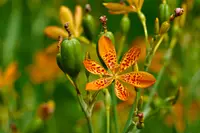
Leopard flower, Iris domestica, is a rhizomatous perennial grown for its bright orange flowers dotted with red spots that resemble a leopard’s coat. It forms upright fans of sword-like leaves and produces slender stems topped with many star-shaped blooms in succession. Native to East Asia, it adapts well to many temperate gardens and can self-seed, forming small colonies over time. This species is generally considered easy to grow, as it tolerates heat, short dry periods, and a range of garden soils that drain well. In suitable conditions, it rewards even beginner gardeners who want to learn how to care for Leopard flower.

Main Plant Requirements

Care Difficulty

Easy Care

Light Preference

Full Sun

Water Requirements

Moderate Water

Temperature Preference

Cold Hardy

Hardiness Zone

5–10

Soil Texture

Sandy, Loamy, Clay

Soil pH

Acidic (5.5–6.5), Slightly acidic (6.5–7.0)

Soil Drainage

Well-drained

Fertilization

Minimal (feed rarely)

Get Personalized Care Plan

Scan your plant to receive care tips personalized for your specific plant

Available on iOS and Android

How to Care for the Leopard flower

Iris domestica grows best with strong light exposure to support flowering and compact growth.

  • Provide 6–8 hours of direct sun daily; in hot climates, prioritize morning sun with light afternoon shade to prevent leaf scorch.
  • The plant tolerates light or dappled shade, but flowering decreases if it receives less than 4–5 hours of direct sun.
  • In summer, monitor for bleached or crispy leaves from intense afternoon sun; in spring and fall, full sun is usually safe for Leopard flower.

Iris domestica prefers evenly moist but not saturated soil, with brief drying between waterings.

  • Outdoors in well-drained soil, water when the top 3–5 cm feel dry, allowing water to soak the root zone, then drain away fully.
  • Reduce watering in fall and winter as growth slows; in hot, dry summers, increase frequency but avoid standing water around rhizomes.
  • Signs of overwatering include mushy rhizomes and yellowing, collapsing leaves, while dry, browning leaf tips and wilting indicate the plant needs water.

This species is a hardy perennial that handles a wide temperature range once established.

  • Active growth is strongest around 65–80°F (18–27°C), which supports sturdy foliage and reliable flowering.
  • Established plants usually tolerate down to about 0°F (−18°C) in the ground with good drainage; mulch crowns in colder regions to buffer soil temperature.
  • During heat waves above 90°F (32°C), provide extra water and some afternoon shade; young plants are more sensitive to extreme cold and heat stress.

Iris domestica handles a wide range of household humidity, so humidity management is rarely critical.

Iris domestica prefers moderately fertile, well-drained, slightly gritty soil for strong growth and flowering.

  • Use a loamy or sandy-loam base with 20–30% sharp sand or fine grit to keep the root zone open and free-draining.
  • Aim for a slightly acidic to neutral pH around 6.0–7.0, which supports nutrient uptake without increasing rot risk.
  • Mix in a modest amount of mature compost or leaf mold to add structure and nutrients without making the substrate heavy or waterlogged.
  • Avoid dense clay, peat-heavy mixes, or any soil that stays wet longer than 2–3 days after watering, which encourages rhizome rot.

This species grows reliably in containers if the pot is prepared to suit its rhizomatous root system.

  • Choose a pot that is wider than it is deep so rhizomes can spread horizontally without crowding too quickly.
  • Use a heavy or weighted container in windy spots to prevent tall flower stalks from tipping the pot over.
  • Top-dress with a thin layer of grit or coarse sand to keep rhizomes slightly exposed and discourage water from pooling around them.

Iris domestica responds well to light, balanced feeding during active growth in spring and summer.

  • Use a balanced, slow-release or liquid fertilizer (around 10-10-10) or a thin layer of compost in early spring for Leopard flower.
  • Feed every 4–6 weeks during the growing season at 1/2–1/4 the label strength to avoid soft, weak growth.
  • Water before and after applying fertilizer to reduce root burn and help nutrients move into the soil.
  • Stop feeding in late summer so the plant can harden off, and do not fertilize during fall and winter dormancy.

Pruning Iris domestica is simple and supports tidy growth and reliable flowering.

  • Use clean, sharp hand pruners to remove spent flower stalks at the base once blooming finishes to keep plants neat.
  • Cut back yellowing or dead leaves through the season to reduce disease risk and improve air flow.
  • In late fall or very early spring, trim old, dry foliage close to the crown to make room for new shoots.
  • Light thinning of crowded fans can maintain a balanced clump shape and encourage better flowering the following season.

Leopard flower grows best in the ground, with transplanting or division needed only every few years.

  • Plan to lift and divide clumps every 3–5 years, or when flowering declines, growth slows, or centers of clumps thin out.
  • Transplant in early spring or early fall, when temperatures are mild and the plant is not in peak bloom.
  • Dig widely around the clump, gently shake off soil, and separate rhizomes so each division has healthy roots and at least 1 fan.
  • Replant divisions at the same depth in well-drained soil, water thoroughly, and keep evenly moist for 1–2 weeks to limit transplant shock.

Iris domestica is commonly propagated by division and also grown from seed for larger numbers of plants.

  • Divide mature clumps in early spring or early fall, when growth is slower and temperatures are moderate.
  • Lift the clump, then separate rhizomes by hand or with a clean knife, keeping healthy roots and at least 1 strong fan per piece.
  • Replant divisions into well-drained soil, water in thoroughly, and maintain light, even moisture until new growth appears.
  • For seeds, collect ripe pods, sow in a well-draining seed mix, and provide cool stratification if recommended to improve germination.

Iris domestica is generally cold hardy in much of the US and needs only modest winter care in the ground.

  • In colder zones, apply a 5–8 cm layer of mulch over the root zone after the ground cools to cushion freeze–thaw cycles.
  • Allow foliage to die back naturally, then cut it close to the crown in late fall or early spring to reduce disease carryover.
  • Move container-grown plants into a sheltered, frost-free but cool spot, and water just enough to prevent the soil from fully drying.

Care Tips

Deadhead For Rebloom

Remove spent flower stalk tips as soon as petals fade, cutting just above a healthy leaf fan, to encourage more blooms and keep energy directed into flowering rather than seed production.

Selective Seed Saving

If seed is desired, leave only a few of the best-positioned stalks to ripen pods and cut the rest, which maintains plant vigor and prevents unwanted self-seeding into nearby beds.

Clump Renewal Division

Every 3–4 years lift and divide crowded rhizomes in late summer, replanting only firm, healthy sections with at least 1 fan of leaves to maintain strong flowering and reduce disease pressure.

Staking Tall Stems

In windy or exposed sites, insert discreet single stakes behind the tallest flowering stems and tie them loosely with soft ties so the display stays upright without cutting off stem circulation.

Winter Debris Hygiene

After the first hard frost, cut foliage down to a few inches and remove fallen leaves and seed pods from the crown area to reduce overwintering fungal spores and insect hiding places when growing Leopard flower.

Common Pests and Diseases

Iris leaf spot

This disease causes tan to brown spots with darker borders on leaves that can merge and lead to leaf blight, especially in humid or wet weather. Symptoms include premature yellowing and dieback of the foliage from the tips downward.

Solution

Remove and discard spotted or blighted leaves as soon as they appear and clean up all dead foliage at the end of the season to reduce fungal spores. Avoid overhead watering, space plants for good airflow, and if the problem is persistent, apply a labeled fungicide for foliar leaf spots early in the growing season according to Iris domestica care instructions on the product label, following all safety directions.

Iris rust

This disease produces small yellow to orange pustules on both sides of leaves, which may later turn brown and cause the foliage to dry out. Symptoms include weakened plants and reduced flowering over time.

Solution

Cut off and dispose of infected leaves promptly and keep the planting area free of old iris debris where spores can overwinter. Improve air circulation, avoid wetting foliage late in the day, and in severe or recurring cases use a rust-labeled fungicide applied at the first sign of symptoms, repeating as directed on the label.

Iris borer

This pest starts as tiny larvae that tunnel inside leaves, leaving water-soaked or streaked foliage, then move down into rhizomes where they create soft, foul-smelling tunnels. This damage weakens plants and opens the way for secondary rot.

Solution

Inspect foliage in spring for feeding streaks and crush any visible larvae inside leaves or remove affected leaves entirely. In late summer or fall, lift and inspect rhizomes, cut out any tunneled or mushy sections, discard heavily infested pieces, and replant only firm, healthy rhizomes; in areas with a known history of iris borers, consider using a timing-specific insecticide labeled for borers when new foliage is 10–15 cm tall.

Spider mites

These insects are tiny sap feeders that thrive in hot, dry conditions and cause fine speckling or bronzing on leaves. Symptoms include very fine webbing on the undersides of leaves and a dull, stressed appearance of the plant.

Solution

Rinse foliage thoroughly with a strong, gentle stream of water, focusing on leaf undersides, and repeat every few days to knock down populations. Increase ambient humidity if grown in very dry sites and, if needed, apply insecticidal soap or horticultural oil labeled for mites, ensuring full coverage of leaf surfaces and avoiding application in strong sun or high heat.

Interesting Facts

Misnamed as a lily

Iris domestica has long been known in horticulture as Belamcanda chinensis or blackberry lily, even though it is not a true lily but a member of the iris family Iridaceae, confirmed by modern molecular studies.

Fleshy iris-like roots

This species forms thick, fleshy rhizomes similar to bearded irises, which store water and nutrients and allow the plant to survive seasonal drought in its native East Asian habitats.

Blackberry-like seed clusters

After flowering, the dry capsules split open to reveal tight clusters of shiny black seeds that resemble a blackberry fruit, which gives rise to its common name blackberry lily.

Botan icon

Did you know?

In traditional Chinese ornamental gardening, this species has been cultivated for centuries along paths and courtyards not only for its spotted orange flowers but also for its long-lasting decorative seed clusters that persist through winter and are valued for dried flower arrangements.

FAQs about Leopard flower

Lack of flowers usually comes from insufficient sun, nutrient-poor or very rich soil, overcrowded clumps, or immaturity. Division every 3–4 years and balanced fertilization support reliable flowering in established plants.

Grow Healthy Plants with Botan Care

Keep your plants happy and healthy with plant identification, disease detection, and easy care guidance.

Botan plant care app — identify plants on mobile

Explore More Plants