Post-bloom marking
As soon as flowers fade, mark clumps with sturdy labels or small stakes so you can avoid disturbing the tiny dormant bulbs when working the bed later in the year.

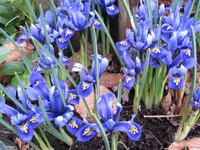
Netted iris, Iris reticulata, is a small bulbous perennial known for its early spring flowers and fine, grass-like foliage. It grows from reticulated, netted bulbs that give the plant its common name.
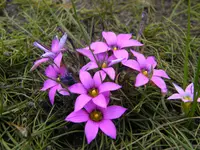
This iris typically produces short stems topped with vivid blue, purple, or occasionally yellow blooms, often marked with contrasting signals on the falls. It forms compact clumps that return yearly in suitable conditions.
Iris reticulata is native to rocky slopes and open areas in Turkey, the Caucasus, and nearby regions, where soils drain quickly. It is generally easy to grow if kept in well-drained soil with good light and relatively dry conditions after flowering.
Understanding how to care for Netted iris focuses on providing strong light, avoiding waterlogged soil, and allowing a natural dormant period after leaves die back.

Care Difficulty
Moderate Care

Light Preference
Full Sun

Water Requirements
Moderate Water

Temperature Preference
Cold Hardy

Hardiness Zone
4–9

Soil Texture
Sandy, Loamy, Organic-rich

Soil pH
Acidic (5.5–6.5), Slightly acidic (6.5–7.0)

Soil Drainage
Well-drained

Fertilization
Minimal (feed rarely)
Scan your plant to receive care tips personalized for your specific plant
Available on iOS and Android
Iris reticulata needs high light to flower well and store energy in its bulbs.
Water Iris reticulata so the soil is moist in active growth but never saturated.
This bulb prefers cool to mild temperatures and tolerates substantial winter cold when planted in the ground.
Humidity is rarely a concern for Iris reticulata grown outdoors in typical temperate climates.
Iris reticulata grows best in open, fast-draining mineral-based soil that never stays waterlogged.
This species is well suited to container growing when bulbs are kept in sharply drained, cool media.
Iris reticulata benefits from light feeding but performs well without heavy fertilizer inputs.
Iris reticulata needs minimal pruning focused on spent flowers and aging foliage.
Iris reticulata is usually grown as an outdoor bulb and only needs occasional lifting and transplanting.
Iris reticulata is most commonly propagated by dividing mature bulbs rather than from seed.
Iris reticulata is cold hardy in most temperate gardens and usually needs little special winter care.

Plant Health Check
Not sure what's wrong with your plant? Check your plant's health inside the app.
This small bulbous iris naturally flowers very early in the season, often pushing through partially frozen ground and light snow while many other perennials are still dormant.
Unlike many larger bearded irises that grow from rhizomes, this species forms compact, netted bulbs with a fibrous tunic, a structure that gives the species its name reticulata, meaning netted.
Native to the mountains of Turkey, the Caucasus, and northern Iran, it is adapted to cold winters and dry summers, entering summer dormancy underground after a brief spring growth period.

Many modern garden cultivars of this species, such as Iris reticulata 'Harmony' and 'Katharine Hodgkin', are the result of deliberate breeding to intensify the blue and violet pigments in the flowers while keeping the natural dwarf, early-flowering habit.
Lack of flowers usually comes from bulbs planted too deep, poor drainage, or overcrowding. Ensure shallow planting, well-drained soil, and full winter chill. After several years, lift and divide clumps to restore flowering.
Keep your plants happy and healthy with plant identification, disease detection, and easy care guidance.