Staking young columns
Provide a sturdy stake or vertical support for young plants until the root system is well established, especially in containers or windy sites, to prevent leaning or breakage at the base.

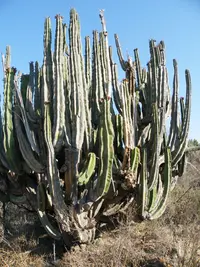
Isolatocereus dumortieri is a tall, columnar cactus native to arid and semi-arid regions of central Mexico. In habitat, it forms upright, blue‑green stems that can branch and create striking, tree-like clumps over time.
The stems are ribbed with short spines, giving a clean, architectural look that suits modern and minimalist spaces. Growth is relatively fast for a cactus when given warmth and strong light.
This species is considered moderately easy for growers who can provide bright sun, low humidity, and sharply draining, mineral-rich soil. Understanding how to care for Isolatocereus dumortieri mainly involves avoiding excess moisture and cold conditions.

Care Difficulty
Easy Care

Light Preference
Full Sun

Water Requirements
Low Water

Temperature Preference
Warm Climate

Hardiness Zone
9–11

Soil Texture
Sandy, Loamy, Rocky

Soil pH
Slightly acidic (6.5–7.0), Neutral (7.0)

Soil Drainage
Well-drained

Fertilization
Minimal (feed rarely)
Scan your plant to receive care tips personalized for your specific plant
Available on iOS and Android
This tall columnar cactus thrives in strong, direct light that mimics its native arid habitat.
This desert cactus needs infrequent, deep watering and excellent drainage to stay healthy.
This species prefers warm, arid conditions and is sensitive to prolonged cold and frost.
This cactus handles a wide humidity range and rarely needs special humidity management indoors.
This species needs a sharply draining, mineral-rich substrate that dries quickly after watering.
This tall, columnar cactus is suitable for container growing when stability and fast drainage are prioritized.
This desert columnar cactus has low nutrient needs, so fertilizing Isolatocereus dumortieri should stay light and infrequent.
Pruning Isolatocereus dumortieri is mainly corrective and hygiene-focused rather than shaping-focused.
Container-grown plants and young landscape specimens of Isolatocereus dumortieri sometimes need transplanting to support long-term column growth.
Isolatocereus dumortieri is most often propagated from stem cuttings, with seeds used mainly for larger-scale or breeding efforts.
This cactus is mildly frost tolerant when mature but benefits from thoughtful winter care in colder climates.

Plant Health Check
Not sure what's wrong with your plant? Check your plant's health inside the app.
In its native range in central Mexico, this tall columnar cactus often serves as a day roost and shelter structure for insectivorous and nectar-feeding bats, which rest within the dense branching clusters and use the plant as a landmark in arid landscapes.
Its large, funnel-shaped white flowers open at night and are pollinated primarily by nocturnal animals such as bats and large moths, an adaptation to hot, dry environments where daytime flowering would lead to rapid desiccation of floral tissues.
The fleshy, edible fruits provide an important seasonal food source for birds and mammals in semi-arid Mexican ecosystems, and the seeds are dispersed through their droppings, helping maintain local cactus populations and plant community structure while growing Isolatocereus dumortieri in the wild landscape.

Mature plants can form extensive, candelabra-like clumps that function as living structural elements in the landscape, altering wind flow and shade patterns and even acting as natural perches and nesting substrates for multiple bird species in central Mexican drylands.
In suitable outdoor conditions, this columnar cactus can reach 6–10 m over many years, sometimes taller in ideal arid landscapes. In containers it usually stays much shorter, often under 3 m due to restricted root space.
Keep your plants happy and healthy with plant identification, disease detection, and easy care guidance.