Sand mulch layer
Apply a 1–2 cm top layer of coarse sand or fine gravel around the crown to keep stems dry at the base, reduce rot risk, and visually mark where not to overwater.

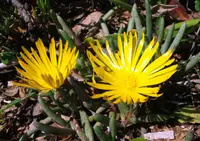
Strandveld beachfig (Jordaaniella dubia) is a low, spreading succulent groundcover from the coastal sands of South Africa’s Western Cape. It forms dense, bright green mats that help stabilize soil.
The plant has fleshy, finger-like leaves and produces showy yellow daisy-like flowers that attract pollinators. Its compact, trailing habit suits rock gardens, seaside landscapes, and drought-tolerant plantings.
Jordaaniella dubia is adapted to dry, windy, and salty conditions, which makes it relatively easy to grow in similar climates. It prefers sandy, fast-draining soil, plenty of light, and infrequent but deep watering.
Gardeners who learn how to care for Strandveld Beachfig often value it as a tough, low-maintenance option for difficult, sunny sites.

Care Difficulty
Easy Care

Light Preference
Full Sun

Water Requirements
Low Water

Temperature Preference
Warm Climate

Hardiness Zone
9–11

Soil Texture
Sandy, Loamy, Rocky

Soil pH
Slightly acidic (6.5–7.0), Slightly alkaline (7.0–7.5)

Soil Drainage
Well-drained

Fertilization
Minimal (feed rarely)
Scan your plant to receive care tips personalized for your specific plant
Available on iOS and Android
Jordaaniella dubia thrives in bright coastal-style light with plenty of direct sun.
This coastal succulent prefers infrequent, deep watering and fast-draining soil.
This species is adapted to mild coastal climates with moderate temperatures year-round.
Humidity is rarely a limiting factor for Jordaaniella dubia, which is adapted to dry, coastal air.
Jordaaniella dubia thrives in lean, sandy, very free-draining soil that mimics its coastal habitat.
This species is suitable for container growing, especially as a trailing or groundcover accent in sunny spots.
This coastal succulent needs only light feeding to stay compact and floriferous.
Pruning helps Jordaaniella dubia stay low, dense, and flowering well.
This species is most often used as a groundcover, so focus on careful transplanting rather than frequent repotting.
Jordaaniella dubia is commonly propagated from cuttings for uniform groundcover plantings.
This coastal succulent is only mildly frost tolerant and benefits from simple winter precautions in colder regions.

Plant Health Check
Not sure what's wrong with your plant? Check your plant's health inside the app.
This species is naturally restricted to the coastal strandveld of the Western Cape in South Africa, where it grows on sandy, often calcareous dunes just above the high-tide line and helps stabilize loose coastal sands.
It forms low, spreading mats that creep across the soil surface, an adaptation that reduces exposure to strong coastal winds and allows the plant to trap wind-blown sand around its stems.
The fleshy leaves store water for dry coastal periods, while the bright yellow, daisy-like flowers are produced in conspicuous flushes that attract a range of coastal pollinating insects.

In its native South African coastal habitat, this species has been used in formal dune rehabilitation projects because its fast, mat-forming growth and tolerance of salt-laden winds make it particularly effective for stabilizing eroding foredunes.
This species forms a low, mat-like ground cover that slowly spreads outward via trailing stems. It is not usually considered aggressive in gardens and is often used to stabilize sandy banks or fill gaps between larger shrubs.
Keep your plants happy and healthy with plant identification, disease detection, and easy care guidance.