Selective thicket management
Allow a few basal suckers to form a wildlife-friendly thicket, but remove extra shoots at ground level each spring to keep access paths clear and maintain the desired shrub width.

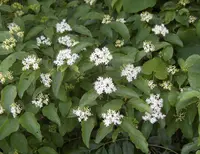
Roughleaf dogwood (Cornus drummondii) is a hardy, multi-stemmed deciduous shrub or small tree, valued for its toughness and wildlife appeal. It typically forms thickets with upright, irregular branches and rough-textured leaves that give the plant its common name.
This species is native to central and southern parts of North America, where it grows along woodland edges, prairies, and roadsides. Clusters of small white flowers in late spring are followed by white berries that attract birds.
Cornus drummondii adapts to many soil types and tolerates wind, drought, and urban conditions, which makes it relatively easy to establish. Understanding how to care for roughleaf dogwood mainly involves providing sun to light shade and moderately moist, well-drained soil.

Care Difficulty
Easy Care

Light Preference
Full Sun

Water Requirements
Moderate Water

Temperature Preference
Cold Hardy

Hardiness Zone
4–9

Soil Texture
Sandy, Loamy, Clay

Soil pH
Slightly acidic (6.5–7.0), Neutral (7.0)

Soil Drainage
Moist but well-drained

Fertilization
Minimal (feed rarely)
Scan your plant to receive care tips personalized for your specific plant
Available on iOS and Android
This deciduous shrub performs best in full sun to light shade, with enough light to support dense growth and flowering.
This species prefers consistently moist but not saturated soil, especially during establishment and in the first growing seasons.
This hardy shrub is adapted to outdoor conditions with cold winters and warm summers across much of North America.
This species tolerates a wide humidity range and usually does not need special humidity management outdoors.
This shrub adapts to many soils but performs best in moderately fertile, well-structured ground.
This species can be grown in containers for several years, mainly when young or maintained as a smaller specimen.
This native shrub needs minimal feeding, but light nutrition supports healthy growth in poor soils.
Pruning helps maintain structure and health in Cornus drummondii without heavy intervention.
This species is usually grown in the ground, so care focuses on correct transplanting rather than frequent repotting.
Cornus drummondii is commonly propagated from softwood cuttings and seeds under controlled conditions.
This shrub is cold hardy through much of its range and usually needs little specialized winter care outdoors.

Plant Health Check
Not sure what's wrong with your plant? Check your plant's health inside the app.
The leaves have a distinctly rough, sandpapery texture on both surfaces, which helps reduce herbivory and may limit water loss by slightly disrupting airflow over the leaf surface.
The shrub produces small white flowers followed by white drupes that are highly attractive to many bird species, while its dense branching offers reliable nesting and cover for wildlife.
This species is notably tolerant of heat, limestone-based soils, and periodic drought, which makes Cornus drummondii care instructions especially relevant for prairie edges and dry woodland sites in the central United States.

Roughleaf dogwood is one of the few native dogwoods that naturally forms large, clonal thickets by sending up root suckers, allowing it to stabilize eroding slopes and gradually expand across open ground without deliberate planting.
Poor flowering often comes from too much shade, heavy pruning at the wrong time, or nutrient imbalance. Preserve older stems, avoid hard pruning after midsummer, and ensure adequate light and moderate, not excessive, nitrogen to support bud formation.
Keep your plants happy and healthy with plant identification, disease detection, and easy care guidance.