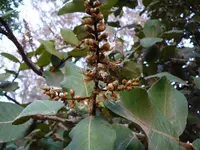
Wind-firm training
Stake young trees for the first 2–3 years and gradually loosen ties as the trunk thickens to encourage a wind-firm structure and reduce the risk of snapping once the canopy becomes heavy with nuts.

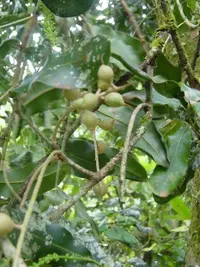
Macadamia integrifolia, commonly called macadamia nut, is an evergreen tree grown for its rich, oily nuts and glossy foliage. It forms a dense canopy with leathery, deep green leaves and produces small, creamy-white flowers on hanging clusters.
This species is native to the subtropical forests of eastern Australia but is now widely cultivated in warm regions. It prefers mild, frost-free climates, well-drained soil, and steady moisture, which can make it challenging in colder or very dry areas.
Gardeners who want to care for macadamia nut should be prepared for a long-lived tree that needs space, consistent conditions, and patience before it begins to produce nuts.

Care Difficulty
Hard Care

Light Preference
Full Sun

Water Requirements
Moderate Water

Temperature Preference
Tropical / Frost Sensitive

Hardiness Zone
10–11

Soil Texture
Sandy, Loamy, Organic-rich

Soil pH
Strongly acidic (4.5–5.5), Acidic (5.5–6.5)

Soil Drainage
Well-drained

Fertilization
Minimal (feed rarely)
Scan your plant to receive care tips personalized for your specific plant
Available on iOS and Android
This subtropical tree needs abundant light to flower and set nuts reliably.
Macadamia integrifolia prefers evenly moist, deep soil without prolonged saturation.
This species thrives in warm, frost-free climates with mild seasonal variation.
This species prefers moderately humid air but copes with typical household levels if roots are not waterlogged.
Macadamia integrifolia requires deep, well-aerated, free-draining soil to avoid chronic root problems.
This tree can be grown in large containers for several years if the pot is chosen to support its deep and spreading root system.
Macadamia integrifolia benefits from moderate, consistent nutrition to support foliage growth and nut set.
Macadamia integrifolia responds well to light structural pruning that maintains a strong, airy canopy.
Macadamia integrifolia is usually grown in the ground, with transplanting focused on young trees.
Macadamia integrifolia is most often propagated from seed or grafted nursery stock rather than at home.
This subtropical tree is frost sensitive and needs thoughtful winter care in cooler climates.

Plant Health Check
Not sure what's wrong with your plant? Check your plant's health inside the app.
This species is native to the coastal rainforests of southeastern Queensland, Australia, where it grows as an evergreen tree in warm, frost-free habitats on well-drained volcanic or sandy soils.
The edible nut is a seed enclosed in one of the hardest shells among cultivated food plants, which protects it from many seed predators and contributes to its high post-harvest storage quality.
The long, hanging racemes of small, pale flowers are rich in nectar and are primarily pollinated by insects such as bees, which are important for good nut set and commercial yields.

Modern commercial macadamia production worldwide, including in Hawaii and other major growing regions, is based largely on cultivars and selections derived from Macadamia integrifolia, making this species the primary genetic foundation of the global macadamia nut industry.
Yellowing leaves usually result from overwatering, waterlogged soil, or nutrient deficiencies, especially nitrogen or iron. Check drainage, reduce watering if soil stays wet, and apply a balanced fertilizer or chelated iron if needed.
Keep your plants happy and healthy with plant identification, disease detection, and easy care guidance.