Regular clump division
Every 2–3 years, lift and divide congested clumps in early spring, trimming older brown roots and replanting only the vigorous outer sections to keep growth dense and prevent die-out in the center.

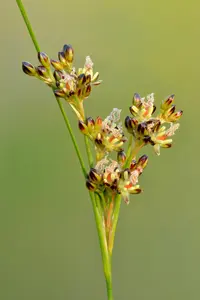
Round-fruited rush (Juncus compressus) is a small, clumping rush typically found in wet meadows, ditches, and riverbanks. It is a grass-like perennial with fine, upright stems and small rounded seed heads that give the plant its common name. Native to parts of Europe and Asia, it has become naturalized in North America, especially in disturbed, moist sites. Its compact size and tolerance of poor, compacted, or periodically flooded soils make it suitable for naturalistic plantings and restoration projects. For those learning how to care for Round-fruited Rush, it generally prefers consistent moisture, full sun to light shade, and open, not heavily shaded, conditions.

Care Difficulty
Moderate Care

Light Preference
Full Sun

Water Requirements
Aquatic

Temperature Preference
Cold Hardy

Hardiness Zone
4–8

Soil Texture
Loamy, Clay, Silty

Soil pH
Slightly acidic (6.5–7.0), Neutral (7.0)

Soil Drainage
Waterlogged tolerant

Fertilization
Minimal (feed rarely)
Scan your plant to receive care tips personalized for your specific plant
Available on iOS and Android
This rush prefers consistent sun exposure but tolerates some shade depending on climate.
This wetland rush prefers constantly moist to saturated conditions rather than drying out between waterings.
This hardy rush tolerates a wide temperature range, with strong cold resistance once established.
This wetland rush prefers very moist air but adapts to typical indoor humidity if kept consistently wet at the roots.
This species grows best in saturated, heavy, mineral-rich soil that stays wet rather than in light, fast-drying mixes.
This rush is suitable for containers if the pot is managed to keep the root zone consistently wet and stable.
Juncus compressus grows in relatively low-nutrient, wet soils and usually needs only light feeding in culture.
Pruning Juncus compressus focuses on keeping clumps tidy and preventing buildup of dead foliage.
This rush is more often transplanted in wetland beds than grown as a long-term container specimen.
Juncus compressus is most commonly propagated by division, with seed used for larger restoration or naturalistic projects.
This hardy rush usually overwinters outdoors without special measures in most temperate climates.

Plant Health Check
Not sure what's wrong with your plant? Check your plant's health inside the app.
This species is easily recognized in the field by its distinctly compressed, flattened stems, which are narrower and less cylindrical than those of many other rushes and give rise to the common name round-fruited rush.
Juncus compressus often occurs in nutrient-enriched, nitrate-rich damp soils such as those along ditches, livestock areas, and disturbed wet ground, and is considered an indicator of nitrogen loading in some European floristic surveys.
Its inflorescences bear nearly spherical, many-seeded capsules that appear clustered and somewhat congested near the upper stem, a feature used by botanists to distinguish it from similar Juncus species.
Poor flowering usually comes from insufficient light, nutrient-poor or very dry soil, or cutting stems too early. Allow growth to mature, keep soil consistently moist, and avoid heavy nitrogen fertilization, which can push leaves instead of flowers.
Keep your plants happy and healthy with plant identification, disease detection, and easy care guidance.