pinto peanut Care (Arachis pintoi)

pinto peanut

About pinto peanut

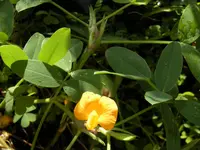
Pinto peanut (Arachis pintoi) is a low-growing, mat-forming legume often used as a living groundcover or between stepping stones and in orchards. It has small, rounded leaflets and bright yellow pea-like flowers that appear over a long season in warm conditions. Native to South America, it spreads by stolons, forming a dense, weed-suppressing carpet in suitable climates. This species fixes nitrogen in the soil, which can improve soil fertility and reduce the need for added fertilizer. It prefers sun to light shade, regular moisture, and well-drained soil, and many growers find it relatively easy to care for pinto peanut in frost-free areas.

Main Plant Requirements

Care Difficulty

Easy Care

Light Preference

Full Sun

Water Requirements

Regular Water

Temperature Preference

Tropical / Frost Sensitive

Hardiness Zone

9–12

Soil Texture

Sandy, Loamy, Organic-rich

Soil pH

Acidic (5.5–6.5), Slightly acidic (6.5–7.0)

Soil Drainage

Moist but well-drained

Fertilization

Minimal (feed rarely)

Get Personalized Care Plan

Scan your plant to receive care tips personalized for your specific plant

Available on iOS and Android

How to Care for the pinto peanut

This low-growing legume prefers warm, bright conditions to form a dense, flowering groundcover.

  • Provide 4–6 hours of direct sun daily, ideally with morning sun and light afternoon shade in hot climates, to keep pinto peanut compact and blooming.
  • Tolerates partial shade (2–4 hours sun) but may produce fewer flowers and a looser mat if light is consistently low.
  • In summer, protect from intense, reflected afternoon sun to reduce leaf scorch; in cooler months, choose the sunniest site available to maintain growth.

This species favors evenly moist, well-drained soil and reacts quickly to extremes in watering.

  • Water when the top 2–4 cm of soil feels dry, allowing deeper soil to stay slightly moist but never waterlogged, especially on heavy or compacted sites.
  • Increase watering frequency during hot, dry periods or on sandy soils, watching for wilting, folding leaves, or slow recovery after sun as signs of underwatering.
  • Reduce watering in cool or rainy seasons; yellowing leaves, soft stems, or a sour soil smell indicate overwatering and poor drainage for Arachis pintoi.

This tropical groundcover grows best in warm, frost-free conditions throughout the year.

  • Aim for 70–86°F (21–30°C) for active growth; plants usually slow markedly when temperatures stay below 65°F (18°C).
  • Tolerates brief drops to about 40°F (4°C) but foliage can burn or thin; repeated exposure below this range weakens the stand and may kill roots.
  • Avoid frost, as freezing damages leaves and stolons; in very hot weather above 95°F (35°C), maintain soil moisture to limit heat stress and leaf scorch.

Humidity is not a major concern for pinto peanut, which adapts well across typical outdoor ranges.

  • Target 40–60% humidity for fastest groundcover growth, though the plant continues to perform acceptably outside this range.
  • Dry, hot air combined with prolonged drought can cause marginal leaf browning and slower stolon spread rather than sudden collapse.
  • In very arid climates, reduce humidity stress by using organic mulch over the root zone and avoiding hot, reflective hardscape immediately around plantings.

Soil for Arachis pintoi should be loose, well-drained, and moderately fertile to support spreading roots and nitrogen-fixing nodules.

  • Use a sandy or sandy-loam structure with 20–40% coarse material such as sharp sand or fine gravel to prevent waterlogging.
  • Aim for a slightly acidic to neutral pH of 5.5–7.0, incorporating compost or well-rotted manure to supply organic matter.
  • Improve aeration by blending in chunky materials like pine bark fines or perlite so roots can spread laterally near the surface.
  • Avoid compacted clay, sites that stay wet for more than 24 hours, or heavy peat mixes that hold water and restrict oxygen.

This species can be grown in containers as a trailing or groundcover accent if drainage is carefully managed.

  • Select a wide, shallow container to match its surface-spreading habit and allow stolons to root along the soil surface.
  • Choose a heavier material such as ceramic when growing Arachis pintoi on exposed patios so the spreading foliage does not tip the pot.
  • Elevate the container slightly on feet or blocks so drainage holes remain unobstructed and excess irrigation water escapes quickly.

This nitrogen-fixing groundcover needs only light feeding to maintain steady growth.

  • Use a balanced, slow-release fertilizer (around 10-10-10) or a thin layer of mature compost at the start of the warm growing season.
  • Feed pinto peanut every 2–3 months in active growth if soil is poor; skip feeding on fertile soils.
  • Apply at half the label rate to avoid lush, weak growth, and water in well after application.
  • Stop fertilizing in late fall and do not feed during winter dormancy or when growth slows markedly.

Pruning Arachis pintoi helps control spread and maintain a dense, flowering groundcover.

  • Do light trimming in late spring or early summer once plants are actively growing.
  • Remove dead, diseased, or damaged runners and thin crowded patches to improve air flow and reduce fungal problems.
  • Shear or mow lightly above the foliage to keep a low, even carpet and encourage more lateral spread and flowers.
  • Use clean, sharp shears or a mower with a high blade setting, and collect clippings where disease has been present.

This species is mostly grown as a groundcover, so transplanting in the landscape is more common than repotting.

  • Transplant in late spring or early summer when soil is warm and plants establish fastest.
  • Move plants if growth becomes sparse, they are shaded out, or soil stays waterlogged, which can slow growth and yellow foliage.
  • If grown in containers, shift to a slightly larger pot every 2–3 years when roots circle the sides or drainage slows.
  • Water well before lifting, keep roots shaded and moist during the move, and irrigate consistently for 2–3 weeks to limit transplant shock.

Arachis pintoi is commonly propagated to expand groundcover plantings or fill bare spots.

  • Use stolon cuttings or divisions in late spring to summer when plants are actively growing.
  • Cut rooted runners into small sections with at least 2–3 nodes and some attached roots.
  • Plant divisions into loose, well-drained soil, keep evenly moist, and provide bright light without intense midday sun for fast rooting.
  • Seed propagation is possible but slower; sow fresh seed into warm soil (70–85°F) and keep consistently moist until germination.

In mild, frost-free climates this groundcover needs minimal winter care but is sensitive to hard freezes.

  • It performs best in USDA zones 9–11; foliage may burn or die back after frost but roots can survive light freezes.
  • Apply a 2–5 cm layer of organic mulch over the root zone in late fall in marginal climates to moderate soil temperature.
  • In containers, move plants indoors or into a bright, frost-free area when temperatures approach 32°F.
  • Reduce watering in cool weather, keeping soil just lightly moist to prevent root rot in slow, winter growth.

Care Tips

Regular mowing integration

In lawns or mixed turf, mow the stand at 5–8 cm height to encourage dense, low growth and quickly remove any upright weeds that try to overtop the mat.

Targeted stolon pegging

When new runners appear, gently pin them to bare soil with U-shaped wire or biodegradable landscape pins so they root faster and close gaps in the groundcover.

Nodulation checkup

Once or twice a year, gently dig up a small section and inspect roots for pinkish nitrogen nodules, re-inoculating with a compatible rhizobium product if nodulation is poor to maintain good nitrogen fixation.

Seasonal competition control

During the first growing season, suppress aggressive grasses and broadleaf weeds with shallow hand weeding or a selective, legume-safe herbicide so the mat can establish and outcompete unwanted species long term.

Low-traffic planning

Design planting zones so main footpaths or play areas bypass the densest patches, since repeated heavy traffic can thin the cover and create openings for weeds when growing pinto peanut.

Common Pests and Diseases

Groundnut leaf spots

This disease causes small brown to dark-purple spots on leaflets that may merge, leading to yellowing and premature leaf drop, especially in warm, humid conditions.

Solution

Remove heavily spotted foliage to reduce inoculum, avoid overhead irrigation, and provide good air circulation; in persistent cases, apply a labeled copper or chlorothalonil fungicide during wet periods, following local guidelines for Arachis pintoi care.

Rhizoctonia web blight

This disease produces brown, water-soaked patches on leaves and stolons that quickly turn tan and dry, often accompanied by fine web-like fungal growth in very humid, shaded groundcover stands.

Solution

Reduce irrigation frequency, improve drainage and light penetration by thinning dense mats, remove blighted patches, and, if spread continues, use a registered fungicide for Rhizoctonia on forage or groundcover legumes according to label directions.

Root‑knot nematodes

This pest causes galls or swellings on roots, leading to stunted growth, patchy thinning in the groundcover, and poor recovery after mowing or grazing.

Solution

Rotate with non-host grasses, avoid moving contaminated soil or tools between areas, and improve soil organic matter to support beneficial organisms; in severe cases, consider resistant companion species or fallow periods rather than relying on chemical nematicides.

Armyworms

These insects feed on foliage in groups, rapidly skeletonizing leaves and creating irregular bare patches in the planting, especially during warm, wet seasons.

Solution

Inspect foliage and soil surface regularly, hand-pick or mow to disrupt young larvae, encourage natural predators by avoiding broad-spectrum insecticides, and if defoliation is heavy, use a targeted product such as Bacillus thuringiensis (Bt) or a selective insect growth regulator according to label instructions.

White grubs

These insects are larvae of scarab beetles that feed on roots, causing yellowing, wilting, and patches of loose turf-like groundcover that lift easily from the soil.

Solution

Confirm presence by digging and inspecting roots, reduce thatch and excess organic debris that shelter adults, encourage birds and beneficial nematodes as biological control, and, if damage is extensive, apply a soil-applied grub control product at the correct timing for your region.

Interesting Facts

Nitrogen-fixing groundcover

This species forms root nodules with Rhizobium bacteria, allowing it to fix atmospheric nitrogen and enrich the soil, which makes it valuable in pastures and perennial cropping systems.

High shade tolerance

Compared to many forage legumes, it tolerates relatively low light levels and can persist and spread under partial shade, for example beneath orchards and plantation crops.

Soil erosion control

Its dense, low-growing, stoloniferous mat binds the soil surface effectively, so it is widely used to reduce erosion on slopes, in pastures, and under tree crops in humid tropical regions.

Botan icon

Did you know?

The flowers of Arachis pintoi, like those of the cultivated peanut, undergo geocarpy: after pollination the flower stalk elongates and bends, pushing the developing pod into the soil where the seeds mature below ground.

FAQs about pinto peanut

This species spreads steadily by stolons, forming a dense mat 5–15 cm tall. It is not typically invasive in managed lawns or orchards, but can edge into nearby beds if not periodically edged or mowed.

Grow Healthy Plants with Botan Care

Keep your plants happy and healthy with plant identification, disease detection, and easy care guidance.

Botan plant care app — identify plants on mobile

Explore More Plants