Salinity acclimation
If moving young plants from freshwater to brackish conditions, increase salinity gradually over 2–3 weeks to avoid root shock and leaf drop.

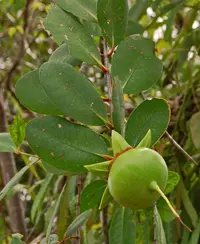
Apple mangrove (Sonneratia caseolaris) is a fast-growing mangrove tree found along tropical estuaries, riverbanks, and brackish shorelines. It forms a broad crown with thick, opposite leaves and showy, brush-like flowers that open mainly at night.
The tree develops distinctive aerial roots that help it cope with waterlogged, low-oxygen soils. Its buoyant fruits are apple-shaped, which inspires the common name.
In nature it thrives in full sun, warm temperatures, and waterlogged, salty or brackish mud. In cultivation, it is considered challenging, so it helps to study how to care for apple mangrove before attempting it away from its natural habitat.

Care Difficulty
Hard Care

Light Preference
Full Sun

Water Requirements
Aquatic

Temperature Preference
Tropical / Frost Sensitive

Hardiness Zone
11–12

Soil Texture
Sandy, Loamy, Organic-rich

Soil pH
Slightly acidic (6.5–7.0), Neutral (7.0)

Soil Drainage
Waterlogged tolerant

Fertilization
Minimal (feed rarely)
Scan your plant to receive care tips personalized for your specific plant
Available on iOS and Android
Sonneratia caseolaris is a sun-loving mangrove tree that thrives in strong coastal light.
This mangrove is adapted to saturated, brackish conditions but still responds to clear moisture cues.
This tropical mangrove requires warm conditions and does poorly in cold climates.
This mangrove requires very high humidity and is unsuitable for dry indoor air.
Sonneratia caseolaris needs constantly wet, oxygen-poor substrates that mimic tidal mudflats, not standard garden soil.
This species can be grown in large containers only under specialized, very wet conditions.
This mangrove species grows in nutrient-rich mud and usually needs only light, targeted feeding in cultivation.
Pruning Sonneratia caseolaris is mainly done to maintain structure, safety, and access rather than to stimulate heavy flowering.
This mangrove tree is usually established directly in wet ground, so management focuses on careful transplanting of young plants rather than frequent repotting.
New Sonneratia caseolaris plants are typically raised from seeds or young nursery stock adapted to brackish, waterlogged sites.
This tropical mangrove is frost-sensitive and needs protection in regions with cool or cold winters.

Plant Health Check
Not sure what's wrong with your plant? Check your plant's health inside the app.
This species develops dense vertical root projections called pneumatophores that stand above the mud surface and allow gas exchange in oxygen-poor, waterlogged mangrove soils.
Its large, brush-like flowers open at dusk and produce abundant nectar that attracts nectar-feeding bats, which act as primary pollinators in much of its native range.
The rounded, apple-like fruits have air-filled tissue that lets them float and disperse by water, an adaptation to estuarine and tidal river habitats with brackish conditions.

In some traditional coastal communities across South and Southeast Asia, the buoyant fruits of this mangrove are used as simple fishing aids or floats, taking advantage of their natural ability to remain on the water surface for long periods.
In suitable coastal or estuarine conditions, this species is relatively fast-growing, often adding 50–100 cm of height per year. Growth slows in suboptimal salinity, cooler water, poor aeration, or when root space is restricted.
Keep your plants happy and healthy with plant identification, disease detection, and easy care guidance.