

Rocky Mountain Juniper Identification (Juniperus scopulorum)

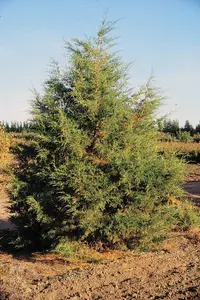
Recognize Rocky Mountain Juniper by its narrow, columnar to pyramidal form, fibrous bark that shreds in thin strips, and tight scale-like leaves pressed to the twigs in opposite pairs.

At first glance, look for dense branchlets and berry-like seed cones about 1/4 inch (6 mm) wide, usually blue with a pale waxy coating.

Juniperus scopulorum Identification

Is This Rocky Mountain Juniper?

Take or upload a photo to confirm your plant ID with Botan.

Clear images work best. Avoid photos taken too close or too far away

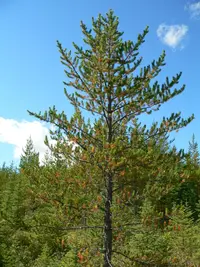
Start with the narrow crown and tight, scale-like foliage of Juniperus scopulorum.

  • Usually a dense, columnar to narrowly pyramidal evergreen, often 20-50 feet (6-15 m) tall.
  • Leaves are tiny overlapping scales, about 1/16-1/8 inch (1.5-3 mm) long, pressed close to the twigs.
  • Branchlets are slender and not strongly flattened, giving sprays a rounded, threadlike look.
  • Berry-like seed cones are nearly round, blue to blue-purple with a pale whitish coating, about 1/4 inch (6 mm) wide.

Check several branch tips and cones together, since the overall habit and foliage texture are especially useful.

Juniperus scopulorum shows useful age-related shifts in foliage type, crown shape, bark, and cones.

  • Seedling: First growth carries sharp, awl-shaped juvenile leaves in opposite pairs or whorls, giving a prickly look unlike the tighter scale foliage of older plants.
  • Young plant: Saplings are usually narrow and columnar to conical, with dense branchlets and mostly scale-like leaves, though some juvenile needle leaves may persist on vigorous shoots.
  • Mature plant: Older trees develop a distinct trunk, fibrous shredding bark, and a broader crown; in exposed sites they may reach 30-60 feet (9-18 m) with irregular branching.
  • Fruiting stage: Female plants show rounded, berry-like seed cones that become blue to bluish purple with a pale waxy coating, about 1/4 inch (6 mm) across.

Rocky Mountain juniper has several cultivars that are easy to separate by crown shape and foliage color.

  • 'Skyrocket': Very narrow and columnar, often 12 to 20 feet tall (3.7 to 6 m) but only 2 to 3 feet wide (0.6 to 0.9 m), with blue-green foliage held tightly upright.
  • 'Blue Arrow': Even slimmer than 'Skyrocket', with a pencil-like column and steely blue foliage that reads bluer than the typical green to blue-green form.
  • 'Moonglow': Broader and denser, usually forming a pyramidal tree with bright silvery blue foliage instead of the usual duller blue-green.
  • 'Wichita Blue': Wide conical habit with rich blue foliage and a fuller, more spreading outline than the species typical form.

Rocky Mountain Juniper stays evergreen, so there is no leaf drop to mark the seasons. The clearest visual shift is from late summer into fall, when berry-like seed cones turn from green to dark blue with a pale, waxy bloom. In winter, those blue cones often stand out more against the dense scale foliage and narrow, upright branching.

A few other junipers are often mistaken for Juniperus scopulorum.

eastern redcedar(Juniperus virginiana)

Often confused because both are narrow evergreens with mostly scale-like foliage and blue berry-like cones. Eastern redcedar usually has a broader crown and more obvious awl-like juvenile leaves on sprays; Rocky Mountain juniper stays tidier, with finer sprays.

Utah juniper(Juniperus osteosperma)

Similar color and habit can cause confusion in dry western landscapes. Utah juniper usually has a stouter, more irregular form and larger seed cones, often about 1/4 inch (6 mm) wide, while J. scopulorum is typically slimmer with smaller cones.

Juniperus scopulorum is native to western North America, from British Columbia and Alberta south through the Rocky Mountain region into the southwestern United States and northern Mexico. It naturally occurs in foothills, canyons, mesas, and mountain slopes, often on dry, rocky ground in open woodland or scrub, commonly at about 1,600 to 8,900 feet (500 to 2,700 m). This setting helps separate it from eastern junipers and from species of wetter lowland habitats.

Check Your Plant ID

Upload a photo to Botan to identify the plant or confirm your guess before you label it.

FAQ

The clearest feature is its mostly scale-like foliage held in tight sprays on a narrow, often columnar tree. Mature seed cones are berry-like, blue to bluish purple, usually with a pale whitish coating.

More Plant Identification Guides

Identify Your Plant with Botan

Upload a photo to identify it, then see plant details, care information, and common problems for that species.

Botan app identifying a plant from a photo
20 Funny Plant Names That Make You Laugh

8 min read · 16 Oct 2026

20 Funny Plant Names That Make You Laugh

Some plants carry names that sound like jokes. This guide explains the origins of 20 funny plant names. You will also see which of these plants you can grow at home.

Plant Recommendations

20 Funny Plant Names That Make You Laugh
12 Best Cold-Hardy Vegetables for Cold Weather

7 min read · 13 Oct 2026

12 Best Cold-Hardy Vegetables for Cold Weather

Cold-hardy vegetables can keep a garden productive through chilly fall, winter, and early spring weather. This guide covers 12 reliable crops, their frost tolerance, and practical growing tips for better cold-season harvests.

Plant Recommendations
12 Best Cold-Hardy Vegetables for Cold Weather
20 Most Popular Fruits Around the World

7 min read · 22 Jul 2026

20 Most Popular Fruits Around the World

Curious which fruits the world actually eats the most? Here's the top-20 by production volume, an overview of what people choose in each region, and a few figures that defy common assumptions.

Plant Recommendations
20 Most Popular Fruits Around the World