Flower spike management
Cut spent flower spikes down to the base as soon as they fade to direct energy into root and crown strength instead of seed production, which helps maintain vigorous clump growth year after year.

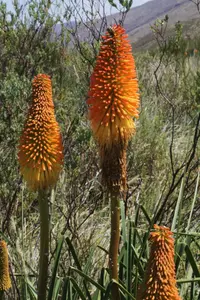
Red hot pokers (Kniphofia uvaria) are sun-loving, clump-forming perennials known for their tall spikes of tubular flowers that shift from red to orange and yellow. The bold flower stalks rise above narrow, grass-like foliage, giving strong vertical accents in mixed borders or gravel gardens.
This species comes from South Africa, where it grows in open, sunny sites with well-drained soil. In gardens, it is generally robust and long-lived when planted in the right place, though it dislikes waterlogged conditions. Gardeners who learn how to care for Red hot pokers usually find them reliable, drought-tolerant focal plants.

Care Difficulty
Easy Care

Light Preference
Full Sun

Water Requirements
Moderate Water

Temperature Preference
Cool Climate

Hardiness Zone
5–9

Soil Texture
Sandy, Loamy, Rocky

Soil pH
Slightly acidic (6.5–7.0), Neutral (7.0)

Soil Drainage
Well-drained

Fertilization
Minimal (feed rarely)
Scan your plant to receive care tips personalized for your specific plant
Available on iOS and Android
This sun-loving perennial performs best with strong, consistent light exposure.
This drought-tolerant perennial prefers infrequent, deep watering in free-draining soil.
This hardy perennial tolerates a wide temperature range but flowers best in moderate conditions.
This species suits typical outdoor humidity in most temperate gardens without special adjustment.
This plant prefers sharply drained, moderately fertile soil that stays on the drier side.
This species can be grown in containers if the pot is prepared for its tall, clumping growth and drainage needs.
Kniphofia uvaria benefits from light, targeted feeding rather than heavy fertilization.
Pruning Kniphofia uvaria focuses on deadheading and tidying to support flowering and plant health.
These perennials are usually grown in the ground, so transplanting mature clumps is more common than repotting.
Propagation of Kniphofia uvaria is most reliable by division, with seeds used mainly for breeding or variation.
Kniphofia uvaria is moderately cold hardy but may need extra winter care in colder or wetter regions.

Plant Health Check
Not sure what's wrong with your plant? Check your plant's health inside the app.
Individual flower spikes change color from orange-red at the top to yellow or cream at the base as they age, creating the classic torch-like effect that inspired the common name red hot poker.
This species naturally occurs on rocky, well-drained slopes in South Africa and is adapted to nutrient-poor, often gravelly soils, which is why it performs well in lean garden beds without heavy fertilization.
The tubular flowers produce abundant nectar and are visited by sunbirds in their native range and by hummingbirds and bees in cultivation, making the plant a valuable nectar source over an extended blooming period.

The species was introduced to European gardens in the 18th century and quickly became a popular ornamental, serving as the parent for many modern hybrids that extend the color range and flowering season far beyond the original wild form.
Lack of flowering usually comes from insufficient maturity, overcrowded clumps, or nutrient imbalance. Division every 3–5 years, adequate phosphorus, full outdoor exposure, and avoiding heavy shade or waterlogged soil are central to Kniphofia uvaria plant care.
Keep your plants happy and healthy with plant identification, disease detection, and easy care guidance.