Mark Dormant Clumps
After the foliage dies back in early summer, mark clump locations with discreet labels or stones so you avoid disturbing the crowns when digging, mulching, or planting later in the season.

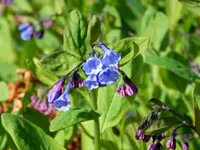
Virginia bluebells (Mertensia virginica) is a spring-blooming woodland perennial known for its nodding clusters of tubular flowers that open pink and mature to soft blue. Plants form loose clumps of smooth, oval leaves that die back soon after flowering, making them classic spring ephemerals.
This species is native to moist woodlands and floodplains in eastern North America, where it spreads gently in rich, humus-heavy soil. Once established, it is relatively low-maintenance, though consistent moisture and partial shade improve vigor.
Gardeners who learn how to care for virginia bluebells find them reliable if soil stays cool and undisturbed, since their roots dislike frequent transplanting or dry, compacted conditions.

Care Difficulty
Easy Care

Light Preference
Partial Shade

Water Requirements
Regular Water

Temperature Preference
Cold Hardy

Hardiness Zone
3–8

Soil Texture
Loamy, Silty, Organic-rich

Soil pH
Acidic (5.5–6.5), Slightly acidic (6.5–7.0)

Soil Drainage
Moist but well-drained

Fertilization
Minimal (feed rarely)
Scan your plant to receive care tips personalized for your specific plant
Available on iOS and Android
This spring ephemeral prefers cool, dappled light similar to an open woodland edge.
This woodland perennial prefers consistently moist but not saturated soil, especially during spring growth.
This species is adapted to cool spring conditions and a dormant summer period.
This spring ephemeral woodland plant prefers moderately moist air but usually adapts to typical outdoor humidity.
This species grows best in loose, moist, humus-rich soil that mimics a deciduous woodland floor.
This plant can be grown in containers, but it performs more reliably in the ground over multiple years.
This woodland perennial usually needs little or no fertilizer when grown in humus-rich soil.
Mertensia virginica needs minimal pruning, mainly for tidiness and plant health.
Transplanting is more common than repotting, since this species is typically grown in garden beds.
Propagation of this spring ephemeral is possible but somewhat slow and best suited to patient gardeners.
This hardy perennial dies back naturally after flowering and generally requires little winter care in most temperate climates.

Plant Health Check
Not sure what's wrong with your plant? Check your plant's health inside the app.
The flowers open as pink buds and shift to blue as they mature because pigments in the petals respond to changes in cell sap pH as the flower ages.
This species is a classic spring ephemeral, completing most of its growth and flowering before the tree canopy fully leafs out, then going dormant underground by early summer.
Its tubular flowers provide an important early-season nectar source for emerging queen bumblebees and several long-tongued bee species in deciduous woodlands.

The species was first described scientifically in the 18th century and named in honor of the German botanist Franz Karl Mertens, and it has since become a classic model plant in North American field guides for illustrating the concept of spring ephemerals.
This species spreads slowly by self-seeding and short rhizomes, forming loose clumps over time rather than dense, choking mats. It is usually easy to manage by lifting extra seedlings or dividing clumps if space becomes limited.
Keep your plants happy and healthy with plant identification, disease detection, and easy care guidance.