watermelon nightshade Care (Solanum citrullifolium)

watermelon nightshade

About watermelon nightshade

Watermelon nightshade, Solanum citrullifolium, is a spiny, upright shrub in the nightshade family grown mainly as an ornamental or curiosity plant. It is valued for its striking foliage that resembles watermelon leaves and its small, round fruits that change color as they mature.

This species is native to parts of South America and is usually grown outdoors in warm, frost-free climates. It prefers sunny, open sites with well-drained soil and moderate moisture.

Many gardeners find it relatively easy to manage once established, but the sharp spines and potential toxicity require careful placement and handling. Understanding how to care for watermelon nightshade helps reduce risks and keep the plant healthy.

Main Plant Requirements

Care Difficulty

Moderate Care

Light Preference

Full Sun

Water Requirements

Moderate Water

Temperature Preference

Warm Climate

Hardiness Zone

9–11

Soil Texture

Sandy, Loamy, Organic-rich

Soil pH

Acidic (5.5–6.5), Slightly acidic (6.5–7.0)

Soil Drainage

Well-drained

Fertilization

Light (every 4–6 weeks)

Get Personalized Care Plan

Scan your plant to receive care tips personalized for your specific plant

Available on iOS and Android

How to Care for the watermelon nightshade

Solanum citrullifolium thrives in strong light and performs best with consistent direct sun outdoors.

  • Provide 6–8 hours of direct sun daily, ideally with morning sun and light afternoon shade in very hot, dry regions.
  • Plant in an open, unshaded spot; it tolerates light partial shade but flowering and fruiting decline with less than 4–5 hours of sun.
  • When caring for watermelon nightshade, watch for pale, leggy growth as a sign of insufficient light and for leaf scorch in extreme midday summer sun.

Solanum citrullifolium prefers infrequent, deep watering and well-drained soil.

  • Allow the top 3–5 cm of soil to dry before watering again; soil should feel dry to the touch, not just at the surface.
  • Increase watering slightly in hot, active growth periods and reduce it in cooler seasons when growth slows and evaporation drops.
  • Yellowing, soft leaves and a sour soil smell suggest overwatering and poor drainage, while drooping, crisp leaf edges and very light soil indicate underwatering.

This species favors warm, frost-free conditions and shows strongest growth in stable, moderate heat.

  • Aim for 70–85°F (21–29°C) during active growth; plants tolerate short spikes to 90°F (32°C) if soil moisture is not extreme.
  • Protect from frost, as damage occurs near 32°F (0°C); sustained exposure below 40°F (4°C) can stunt or kill tender growth.
  • In hot regions, growth remains acceptable up to about 95°F (35°C) when roots are mulched and soil is not allowed to swing between waterlogged and bone-dry.

This species handles typical indoor humidity but benefits from slightly moist air in heated homes.

  • Aim for 40–60% humidity to keep foliage turgid and reduce stress, especially in warm rooms.
  • Tolerates drier air for short periods, but prolonged levels under 30% can lead to leaf edge browning and drop.
  • If caring for watermelon nightshade in a dry room, group plants together or place the pot on a pebble tray with water below the pot base.

Solanum citrullifolium prefers a loose, well-drained mineral-rich substrate that does not stay wet for long.

  • Use a sandy or loamy mix with clear structure, such as 50–70% potting mix blended with coarse sand or fine grit for sharper drainage.
  • Incorporate 20–30% compost or well-rotted organic matter to improve nutrient content without creating a heavy, compacting texture.
  • Keep pH slightly acidic to neutral, around 6.0–7.0, and avoid highly alkaline substrates that can limit nutrient uptake.
  • Avoid dense clay, peat-heavy mixes without added grit, or any soil that feels soggy for more than 24 hours after watering.

This species is suitable for container growing when the pot is chosen to match its deep, somewhat sprawling root and shoot system.

  • Select a pot at least 25–30 cm deep to allow strong taproot development and reduce wilting between waterings.
  • Choose a heavier material such as ceramic or thick terracotta to stabilize the plant against wind and top-heavy growth outdoors.
  • Place the container where it cannot tip easily and, if needed, anchor a stake or support directly in the pot to counter lateral stem spread.

Solanum citrullifolium benefits from moderate feeding during active growth but does not need heavy fertilization.

  • Use a balanced NPK fertilizer (such as 10-10-10) or a thin layer of well-rotted compost in spring to support growing watermelon nightshade.
  • Apply liquid fertilizer every 4–6 weeks during the growing season at 1/2 strength to prevent salt buildup and leaf burn.
  • Reduce feeding in late summer and stop during winter dormancy, especially in cooler climates.
  • Water thoroughly before and after fertilizing to distribute nutrients evenly and limit root stress.

Pruning Solanum citrullifolium is useful for maintaining structure, safety, and flowering performance.

  • Carry out main pruning in late winter or very early spring before strong new growth starts.
  • Remove dead, diseased, or storm-damaged stems first, then thin crowded or crossing branches to improve light and airflow.
  • Shorten overly long shoots to shape the plant and encourage bushier growth with more flowering sites.
  • Use clean, sharp bypass pruners and make cuts just above a healthy bud or side shoot.

This species is more often grown in the ground, so focus on careful transplanting rather than frequent repotting.

  • Transplant seedlings or young plants in spring after frost when soil is workable and warming.
  • Look for signs such as roots circling the pot, water running off quickly, or slowed growth to decide when to shift container plants up 1 pot size.
  • Prepare a free-draining soil or mix, water the plant well, then slide it out gently and loosen outer roots without breaking the root ball heavily.
  • Replant at the same depth, firm soil lightly, water thoroughly, and shade from intense sun for 3–5 days to reduce transplant shock.

Solanum citrullifolium is most commonly propagated from seed, which offers reliable and economical increase.

  • Collect ripe berries, extract seeds, and clean off pulp to reduce fungal problems.
  • Sow seeds in late winter to early spring in a sterile, free-draining seed mix, covering them lightly.
  • Maintain 70–75°F, bright indirect light, and evenly moist (not wet) conditions for steady germination.
  • Transplant seedlings to individual pots once they have 2–3 true leaves, handling roots gently.

This plant has limited frost tolerance and benefits from basic winter protection in colder climates.

  • In regions with freezing winters, treat it as an annual or replant from seed each year.
  • In mild climates, apply a 5–8 cm mulch around the root zone in late fall, keeping mulch slightly away from stems.
  • Grow container plants in a well-drained mix and move them to a bright, frost-free space if temperatures drop below 32°F.

Care Tips

Use sturdy staking

Install a solid stake or short cage early in the season to support the spiny, branching stems and prevent wind damage or stem breakage as the plant gains height and side weight.

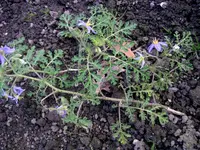
Glove-safe handling

Always handle this plant with thick gloves and long sleeves when transplanting, pruning, or weeding around it to avoid injury from the dense spines and to make routine work faster and safer.

Targeted pest scouting

Inspect the undersides of leaves and young shoots every 7–10 days during warm weather for spider mites, aphids, and whiteflies, and treat early with a strong water spray or a labeled insecticidal soap before infestations build up.

Seed management strategy

Deadhead or remove fruiting clusters before seeds fully mature if self-sowing is not desired, collecting and disposing of them in the trash rather than compost to limit unwanted volunteers when growing watermelon nightshade.

Root-zone weed control

Use a 3–5 cm layer of clean, seed-free mulch around but not touching the stem to suppress weeds near the root zone, which reduces competition and makes maintenance around the spiny plant much easier.

Common Pests and Diseases

Spider mites

This pest is attracted to Solanum species with hairy foliage and can build dense colonies on the undersides of leaves, especially in hot, dry conditions. Symptoms include fine webbing, yellow stippling, and gradual leaf drop.

Solution

Rinse foliage thoroughly with a firm stream of water, focusing on leaf undersides, and increase humidity around the plant while keeping leaves able to dry. For persistent infestations, apply insecticidal soap or horticultural oil every 7–10 days, ensuring full coverage, and remove heavily damaged leaves to reduce mite numbers.

Whiteflies

These insects often colonize solanaceous plants in greenhouse or sheltered outdoor conditions, feeding on sap and excreting sticky honeydew. Symptoms include leaf yellowing, reduced vigor, and a cloud of tiny white insects flying up when foliage is disturbed.

Solution

Use yellow sticky traps to monitor and reduce adult numbers, and regularly shake or tap plants to dislodge insects. Treat leaf undersides with insecticidal soap or horticultural oil in repeated applications, and remove heavily infested leaves to break the life cycle; good airflow and spacing lower the risk of ongoing problems and support reliable Solanum citrullifolium plant care.

Tomato hornworm

This pest is a large green caterpillar that readily feeds on Solanum foliage, leaving ragged leaf damage and sometimes chewing young stems. Symptoms include sudden defoliation on individual branches and dark droppings (frass) on lower leaves or soil.

Solution

Hand-pick hornworms in early morning or evening and drop them into soapy water; this is usually the most effective and immediate control. Encourage natural predators such as parasitic wasps, and if defoliation is severe, use a targeted biological product containing Bacillus thuringiensis (Bt) on foliage according to label directions.

Early blight

This disease, caused by the fungus Alternaria solani, affects many Solanum species and produces brown leaf spots with concentric rings, beginning on older leaves. Symptoms include yellowing that moves upward through the canopy and premature defoliation in wet or humid weather.

Solution

Promptly remove and discard affected leaves, avoid overhead watering, and water at soil level early in the day so foliage dries quickly. Improve spacing and airflow, rotate planting areas when grown in the ground, and, if disease pressure is high, use a preventive fungicide labeled for early blight on Solanum, applied at recommended intervals.

Bacterial spot

This disease is caused by Xanthomonas bacteria and produces small, water-soaked leaf spots that turn dark and may develop a yellow halo. Symptoms include distorted leaves, minor shot-hole effects, and sometimes spotting on young stems or fruit if present.

Solution

Remove and dispose of infected leaves, avoid handling plants when foliage is wet, and irrigate only at soil level to prevent splash spread. Do not save seed from infected plants, rotate planting sites, and in high-pressure situations consider a copper-based bactericide, applied carefully to minimize phytotoxicity and according to label instructions.

Interesting Facts

Watermelon-like foliage

This species gets its common name from its deeply lobed leaves, which resemble the foliage of watermelon vines more than that of typical nightshades.

Defensive star-shaped hairs

Its leaves and young stems are covered with dense stellate hairs, a type of star-shaped plant hair that helps reduce herbivore damage and water loss in its dry native habitats.

Showy yet seedy berries

The plant produces small, round purple to violet berries that are visually ornamental but packed with many small seeds and belong to a genus known for containing toxic alkaloids, so they are not considered edible.

FAQs about watermelon nightshade

All parts of this species contain toxic alkaloids. Ingestion may cause nausea, vomiting, diarrhea, abdominal pain, and neurological signs in pets and people. Treat it as an ornamental only and keep children and animals from chewing any part.

Grow Healthy Plants with Botan Care

Keep your plants happy and healthy with plant identification, disease detection, and easy care guidance.

Botan plant care app — identify plants on mobile

Explore More Plants