Mark Dormant Clumps
Insert discreet labels or short bamboo canes around clumps right after flowering so you know exactly where the bulbs are when the foliage dies back and you want to divide or plant around them.

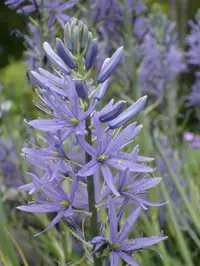
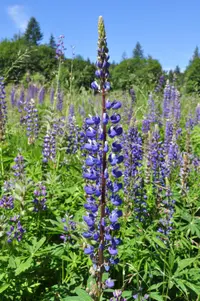
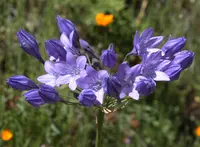
Large camas (Camassia leichtlinii) is a bulb-forming perennial from moist meadows and open woodlands of the Pacific Northwest. It belongs to the asparagus family and grows from fleshy underground bulbs. Plants form upright clumps of narrow, arching leaves and tall flower spikes carrying many star-shaped blossoms, typically blue to violet, sometimes white. Flowers open in sequence up the stem, giving a long visual display in late spring to early summer. In gardens, it suits naturalistic plantings, meadows, and damp borders. It prefers sun to light shade, consistently moist but not waterlogged soil, and benefits from a cool winter period, which shapes how to care for large camas.

Care Difficulty
Easy Care

Light Preference
Full Sun

Water Requirements
Regular Water

Temperature Preference
Cold Hardy

Hardiness Zone
4–9

Soil Texture
Loamy, Sandy, Clay

Soil pH
Acidic (5.5–6.5), Slightly acidic (6.5–7.0)

Soil Drainage
Moist but well-drained

Fertilization
Minimal (feed rarely)
Scan your plant to receive care tips personalized for your specific plant
Available on iOS and Android
This bulb thrives in bright outdoor locations with cool roots and moderate sun on its foliage.
This species prefers consistent soil moisture in spring, then drier conditions as foliage dies back.
This hardy bulb tolerates cool winters and mild to warm summers when soil drainage is good.
Camassia leichtlinii tolerates a wide humidity range and usually does not need special humidity management outdoors.
Camassia leichtlinii prefers deep, moisture-retentive but free-draining soil that stays evenly moist during spring growth.
This species can grow in containers if given a deep, stable setup that mimics open-ground moisture and root space.
Camassia leichtlinii benefits from light, balanced feeding in nutrient-poor soils but often performs well in reasonably fertile ground without much input.
Camassia leichtlinii requires minimal pruning, mainly to keep plantings tidy and support bulb health.
This bulb is usually grown in the ground, so focus on occasional lifting and transplanting rather than frequent repotting.
Camassia leichtlinii is most commonly propagated by bulb division, with seed used mainly for larger, long-term projects.
This bulb is generally cold hardy in temperate climates and requires little winter care in the ground.

Plant Health Check
Not sure what's wrong with your plant? Check your plant's health inside the app.
Its tall flowering stems carry dozens of star-shaped blossoms arranged in a loose raceme, but each individual flower opens and fades at a slightly different time, creating a long, staggered bloom period in late spring to early summer.
This species is naturally adapted to seasonally moist to wet meadows and open woodlands of the Pacific Northwest, tolerating winter and spring saturation yet requiring drier conditions in summer when the bulbs go partially dormant.
Wild populations most often bear deep blue to violet flowers, while naturally occurring pale and white forms were selected into named garden cultivars such as 'Alba', illustrating considerable genetic variation in flower color within the species.

Indigenous peoples of the Pacific Northwest traditionally distinguished this edible species from the similar-looking but toxic death camas (Toxicoscordion venenosum) by its taller stature, different flowering time, and characteristic bluish flowers, knowledge that was critical for safe harvesting of camas bulbs as a staple food.
Lack of flowers often comes from bulbs planted too shallowly, overcrowding, or insufficient winter chill. Excess nitrogen fertilizer can also favor leaves over blooms. Allow foliage to die back naturally so bulbs recharge for the next season.
Keep your plants happy and healthy with plant identification, disease detection, and easy care guidance.