Staggered Planting Rows
Plant in loose rows with 20–30 cm between plants and offset each row slightly so tall flower spikes support each other in wind without needing individual stakes.

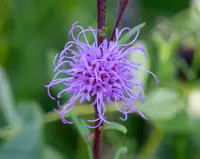
Rocky Mountain blazing star, Liatris ligulistylis, is a clump-forming perennial wildflower known for its tall spikes of bright purple, fuzzy flower heads. The blooms open from the top downward, creating a distinct vertical accent in garden beds and prairie-style plantings.
It is native to the central and northern Great Plains and Rocky Mountain regions, where it grows in open meadows and dry grasslands. This species attracts butterflies, especially monarchs, and other pollinators.
The plant prefers full sun, well-drained soil, and moderate to low moisture, which makes it relatively easy to manage once established. Gardeners who understand how to care for Rocky Mountain blazing star usually find it long-lived and resilient in suitable climates.

Care Difficulty
Easy Care

Light Preference
Full Sun

Water Requirements
Moderate Water

Temperature Preference
Cold Hardy

Hardiness Zone
3–7

Soil Texture
Sandy, Loamy, Rocky

Soil pH
Acidic (5.5–6.5), Slightly acidic (6.5–7.0)

Soil Drainage
Well-drained

Fertilization
Minimal (feed rarely)
Scan your plant to receive care tips personalized for your specific plant
Available on iOS and Android
Liatris ligulistylis thrives in open, sunny conditions that mimic its native prairie habitat.
Liatris ligulistylis prefers moderately dry conditions and is sensitive to waterlogged soil.
This hardy perennial tolerates a wide temperature range once established in the garden.
This species handles typical outdoor humidity and stays healthiest in relatively dry air.
Liatris ligulistylis prefers lean, well-drained soil that never stays waterlogged.
This species can be grown in containers if given a deep, very free-draining setup.
Liatris ligulistylis grows well in lean soils and usually needs only light fertilization.
Liatris ligulistylis benefits from simple, light pruning to maintain tidy growth and encourage blooms.
This species is usually grown in garden beds; focus on careful transplanting rather than frequent repotting.
Liatris ligulistylis is commonly propagated by seed and by division of mature clumps.
This species is cold hardy in most temperate climates and usually needs minimal winter care.

Plant Health Check
Not sure what's wrong with your plant? Check your plant's health inside the app.
This species is unusually attractive to monarch butterflies, which often favor its tall, loosely arranged purple flower spikes over other nearby nectar sources during migration.
It is naturally native to moist prairies, fens, and stream margins of the northern Great Plains, where its late-summer flowering adds vertical structure and supports many native pollinators.
The flower heads characteristically open from the top of the spike downward, a less common pattern among tall prairie forbs and a useful field clue for accurate identification.

This species shows strong adaptation to cold continental climates, including deep, overwintering corm-like storage organs that let it survive freezing prairie soils while resprouting reliably each spring in regions that experience long, harsh winters.
Lack of flowers usually comes from too much shade, nutrient‑rich or wet soil, or plants that are still immature. Avoid high‑nitrogen fertilizer, keep soil well drained, and allow 2–3 years for full blooming performance.
Keep your plants happy and healthy with plant identification, disease detection, and easy care guidance.