Mark Dormant Sites
After flowering, place small, durable labels where each stem emerges so you do not disturb the shallow bulbs when digging or weeding in late fall and winter.

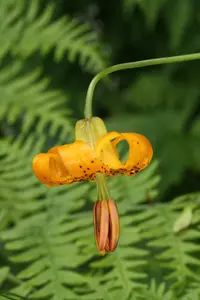
Columbia lily, Lilium columbianum, is a perennial bulbous wildflower native to the Pacific Northwest of North America. It typically grows in open woodlands, meadows, and mountain slopes.
The plant forms tall, slender stems with whorled leaves and nodding, orange to yellow, strongly spotted flowers in early to midsummer. Its bulbs slowly multiply, so clumps expand over time rather than spreading aggressively.
It is considered moderately challenging for beginners because it dislikes disturbance, needs consistent moisture, and prefers cool roots in well-drained, humus-rich soil. Understanding these natural conditions helps gardeners know how to care for Columbia lily and keep it long-lived in cultivation.

Care Difficulty
Moderate Care

Light Preference
Partial Sun

Water Requirements
Moderate Water

Temperature Preference
Cold Hardy

Hardiness Zone
4–8

Soil Texture
Sandy, Loamy, Rocky

Soil pH
Acidic (5.5–6.5), Slightly acidic (6.5–7.0)

Soil Drainage
Moist but well-drained

Fertilization
Minimal (feed rarely)
Scan your plant to receive care tips personalized for your specific plant
Available on iOS and Android
This species thrives in bright, cool conditions that mimic open woodland edges.
Moist, well-drained soil is essential for healthy growth and long-lived bulbs.
This lily is adapted to cool to mild climates with distinct winters.
This species handles a wide humidity range but grows best in moderately moist air.
Lilium columbianum prefers loose, moist, sharply drained soil that mimics a forest edge or open woodland.
This lily can be grown in containers if the pot is deep, stable, and drains very efficiently.
This native lily needs only light, targeted feeding in typical garden soil.
Lilium columbianum needs minimal pruning, mainly to maintain health and support next year’s flowering.
This species is usually grown in the ground, so care focuses on careful transplanting of bulbs rather than frequent repotting.
Lilium columbianum is usually propagated by bulb division or seed, both requiring patience and stable conditions.
This lily is cold hardy in much of its native range and usually needs only light winter care in the garden.

Plant Health Check
Not sure what's wrong with your plant? Check your plant's health inside the app.
This species is naturally found from British Columbia south into northern California and east into parts of Idaho and Montana, typically in open woods, moist meadows, and along forest edges at low to mid elevations.
Its bright orange flowers curve strongly backward into a turk’s-cap shape and are heavily spotted with dark purple to brown markings, an adaptation that helps guide pollinators toward the nectar.
The nodding, open flowers with protruding stamens are frequently visited and pollinated by hummingbirds, which can easily reach the nectar while dusting their foreheads and bills with pollen.

Indigenous peoples of the Pacific Northwest traditionally harvested the starchy bulbs as a food source, usually roasting or steaming them, and sometimes trading the dried bulbs, which indicates the plant once held notable value in local subsistence and exchange systems.
Lack of flowering often comes from too much shade, depleted bulbs, or stress from transplanting or overcrowding. Ensure enough light, allow foliage to die back naturally, and divide congested clumps every few years to restore bloom strength.
Keep your plants happy and healthy with plant identification, disease detection, and easy care guidance.