Staggered Succession Planting
Plant small groups of corms 10–14 days apart in late spring to create a longer, continuous flowering period rather than one short flush.

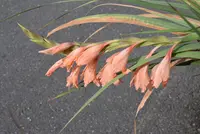
Salmon gladiolus (Gladiolus oppositiflorus) is a corm-forming flowering plant known for its tall, upright spikes of soft salmon to pink funnel-shaped blooms. It produces narrow, sword-like leaves that grow in fans from the base, giving a vertical, architectural look in borders and cutting gardens.
This species is native to parts of southern Africa, where it grows in open, sunny habitats with well-drained soils. It is considered moderately easy to grow if kept frost-free, protected from waterlogged conditions, and given bright light.
Gardeners often care for Salmon Gladiolus as a seasonal bulb, lifting or protecting the corms in colder climates to ensure reliable flowering year after year.

Care Difficulty
Moderate Care

Light Preference
Full Sun

Water Requirements
Moderate Water

Temperature Preference
Tropical / Frost Sensitive

Hardiness Zone
8–11

Soil Texture
Sandy, Loamy, Organic-rich

Soil pH
Acidic (5.5–6.5), Slightly acidic (6.5–7.0)

Soil Drainage
Well-drained

Fertilization
Light (every 4–6 weeks)
Scan your plant to receive care tips personalized for your specific plant
Available on iOS and Android
Gladiolus oppositiflorus needs strong sun to flower well but benefits from some protection in very hot climates.
Gladiolus oppositiflorus prefers evenly moist, well-drained soil during active growth, then drier conditions when dormant.
This species grows best in warm, frost-free conditions and is sensitive to prolonged cold or hard freezes.
Gladiolus oppositiflorus handles a wide humidity range and rarely needs special humidity management.
Gladiolus oppositiflorus grows best in loose, sharply drained soil that dries a bit between waterings.
This species is suitable for container growing when the pot and drainage are chosen carefully.
Gladiolus oppositiflorus benefits from moderate feeding to support strong spikes and flowering.
Gladiolus oppositiflorus needs simple pruning focused on spent flowers and tired foliage.
This species is usually grown in beds or borders, so transplanting corms matters more than repotting.
Gladiolus oppositiflorus is most commonly propagated from corm division and small cormels.
Gladiolus oppositiflorus needs protection in cold climates but can remain in the ground where winters are mild.

Plant Health Check
Not sure what's wrong with your plant? Check your plant's health inside the app.
Unlike many other gladiolus species, this plant bears its flowers in an unusual opposite pattern along the spike, which is the origin of the name oppositiflorus. The flowers appear in more or less paired positions rather than all on one side of the stem.
The pale, often salmon to pink flowers release a stronger fragrance in the evening and at night. This timing is associated with attracting nocturnal pollinators such as moths in its native habitats of eastern and southern Africa.
In the wild, this species is typically found in grasslands, rocky slopes, and open woodland edges, often in well-drained but seasonally moist soils. It is adapted to climates with a distinct dry period, which aligns with its natural dormancy cycle.

Historical records and herbarium specimens show that Gladiolus oppositiflorus has been in cultivation in European gardens since at least the 19th century, where its distinctive opposite flower arrangement made it an important parent in early gladiolus breeding efforts.
Lack of blooms usually comes from insufficient sun, depleted soil nutrients, overcrowded corms, or planting too shallow or deep. Allow foliage to mature fully each season so corms recharge, and replant or divide if clumps become congested.
Keep your plants happy and healthy with plant identification, disease detection, and easy care guidance.