Discreet staking system
Install two or three slim stakes and soft ties early in the season to support the tall, brittle flower stems before summer winds can snap them.

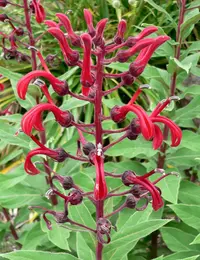
Devil's tobacco (Lobelia tupa) is a tall, herbaceous perennial grown mainly for its bold structure and striking flower spikes. It forms upright clumps with large, soft, gray‑green leaves that give it a slightly tropical look.
In summer, it produces tall stems topped with tubular red flowers that attract hummingbirds and other pollinators in mild climates. The plant is native to central Chile, where it grows on sunny, open hillsides with well‑drained soils.
In gardens, it suits mixed borders or a sunny, sheltered spot and needs reasonably fertile, free‑draining soil to thrive. Understanding these natural preferences helps gardeners care for Devil's Tobacco more successfully.

Care Difficulty
Moderate Care

Light Preference
Full Sun

Water Requirements
Regular Water

Temperature Preference
Warm Climate

Hardiness Zone
8–10

Soil Texture
Loamy, Sandy, Organic-rich

Soil pH
Acidic (5.5–6.5), Slightly acidic (6.5–7.0)

Soil Drainage
Moist but well-drained

Fertilization
Light (every 4–6 weeks)
Scan your plant to receive care tips personalized for your specific plant
Available on iOS and Android
Lobelia tupa performs best with strong light but benefits from some protection from intense afternoon sun.
This species prefers evenly moist but never waterlogged soil with slight drying between waterings.
This plant thrives in mild conditions and dislikes both hard frost and extreme heat.
Lobelia tupa handles a wide humidity range but prefers moderately moist air.
Lobelia tupa prefers deep, well-drained yet moisture-retentive soil that does not stay waterlogged.
This species can be grown in large outdoor containers if they are stable and drain well.
Lobelia tupa benefits from moderate feeding during its active growing season, especially in poorer soils.
Pruning Lobelia tupa is mainly about maintaining plant health and shape rather than heavy reshaping.
This species is usually grown in the ground, so management centers on transplanting established clumps rather than frequent repotting.
Lobelia tupa is usually propagated by division or seeds, with success depending on stable moisture and mild temperatures.
In mild regions, Lobelia tupa behaves as a hardy perennial but benefits from basic winter preparation in colder climates.

Plant Health Check
Not sure what's wrong with your plant? Check your plant's health inside the app.
Lobelia tupa produces piperidine alkaloids in its tissues, chemically related to compounds found in tobacco and other lobelias, which make the plant unpalatable and potentially toxic to grazing animals if ingested in quantity.
Its tall spikes carry tubular, blood-red flowers with copious nectar that are morphologically adapted for pollination by hummingbirds in its native Chilean range, matching their beak shape and foraging behavior.
In central Chile, this species often grows in open, dry, and sometimes fire-prone shrublands, tolerating seasonal drought and poor soils better than many other lobelias due to its thick, woody rootstock and robust stems.

Ethnobotanical records from central and southern Chile describe indigenous Mapuche people historically using carefully prepared parts of this species as a potent ritual narcotic, reflecting its strong physiological activity and the cultural significance that led to the common name Devil's Tobacco.
All parts contain toxic alkaloids that affect the nervous system. Ingestion can cause vomiting, diarrhea, weakness, irregular heartbeat, and potentially serious poisoning in pets and people. Contact the poison control center or veterinarian immediately after suspected ingestion.
Keep your plants happy and healthy with plant identification, disease detection, and easy care guidance.