Early framework training
Install a sturdy trellis, fence, or wires early and fan out the young stems horizontally, tying them loosely with soft ties to create a permanent framework that will carry heavier flowering growth in later years.

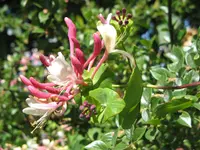
Italian woodbine, Lonicera caprifolium, is a deciduous climbing honeysuckle grown mainly for its fragrant, tubular flowers. It twines around supports, forming a dense vertical screen of oval green leaves.
This species is native to southern and central Europe, where it grows in woodlands, hedgerows, and along sunny edges. Its strong scent and nectar are attractive to night-flying moths and other pollinators.
Italian woodbine is generally considered easy to grow, as it tolerates a range of soils and moderate neglect once established. Understanding how to care for Italian woodbine starts with providing a support to climb and avoiding very dry or waterlogged ground.

Care Difficulty
Easy Care

Light Preference
Full Sun

Water Requirements
Moderate Water

Temperature Preference
Cold Hardy

Hardiness Zone
5–9

Soil Texture
Sandy, Loamy, Clay

Soil pH
Acidic (5.5–6.5), Slightly acidic (6.5–7.0)

Soil Drainage
Moist but well-drained

Fertilization
Minimal (feed rarely)
Scan your plant to receive care tips personalized for your specific plant
Available on iOS and Android
This twining honeysuckle flowers best with strong light but tolerates some shade in most gardens.
This honeysuckle prefers evenly moist, well-drained soil rather than extremes of drought or saturation.
This hardy climber tolerates a wide temperature range but performs best in moderate conditions.
This honeysuckle handles typical outdoor humidity and usually does not need special adjustment.
This species grows best in deep, moderately moist, well-structured soil that stays aerated.
This honeysuckle can be grown in containers if the pot is large, stable, and drains efficiently.
Lonicera caprifolium benefits from modest feeding to support flowering but does not need heavy fertilization.
Pruning Lonicera caprifolium helps maintain a manageable framework and encourages flowering wood.
This honeysuckle is usually grown in the ground, so focus on transplanting and occasional container up-potting.
Lonicera caprifolium is commonly propagated by cuttings and simple layering for reliable cloning of desired plants.
This species is generally cold hardy in temperate climates and needs only modest winter care in the ground.

Plant Health Check
Not sure what's wrong with your plant? Check your plant's health inside the app.
Italian woodbine flowers open in the evening and release a strong sweet scent at night, which specifically attracts hawkmoths and other nocturnal moths that act as its main pollinators in its native range.
The tubular flowers are typically pale cream when they first open and then age to yellow, a visual signal that often correlates with reduced nectar availability and helps guide pollinators toward the freshest blooms.
This species is naturally adapted to scramble through hedgerows and light woodland edges in southern and central Europe, using its twining stems to climb shrubs and small trees rather than relying on tendrils or adhesive roots.

The species name caprifolium, meaning goat leaf, reflects an old observation that goats readily browse its foliage, and this association with browsing livestock is recorded in several European vernacular names and historical botanical texts.
This honeysuckle is highly attractive to night-flying moths and many bees due to its tubular, fragrant flowers rich in nectar. Planting it supports local pollinators and increases overall garden biodiversity and pollination success.
Keep your plants happy and healthy with plant identification, disease detection, and easy care guidance.