Support heavy vines
Install a sturdy hook, trellis, or wall-mounted support early, as the thick, twisting vines become heavy over time and can snap if they hang unsupported from a small plastic hanger.

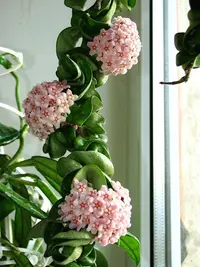
Hoya carnosa 'Compacta', often called wax plant or rope hoya, is a vining tropical houseplant known for its thick, twisted, glossy leaves. The foliage coils and drapes, creating a sculptural, almost rope-like appearance that suits hanging baskets or high shelves.
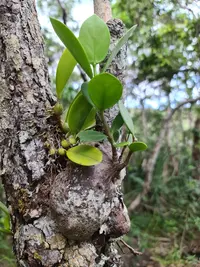
This species is native to Southeast Asia and Australia, where it grows as an epiphyte, living on trees rather than in deep soil. It often produces clusters of star-shaped, waxy flowers with a sweet fragrance when mature and well settled.
Hoya carnosa 'Compacta' is generally slow-growing but long-lived and resilient, which makes it appealing for those learning how to care for Wax Plant. It prefers bright, indirect light, a well-draining mix, and light, infrequent watering between thorough soakings.

Care Difficulty
Moderate Care

Light Preference
Bright Indirect Light

Water Requirements
Low Water

Temperature Preference
Tropical / Frost Sensitive

Hardiness Zone
10–12

Soil Texture
Sandy, Loamy, Organic-rich

Soil pH
Acidic (5.5–6.5), Slightly acidic (6.5–7.0)

Soil Drainage
Well-drained

Fertilization
Light (every 4–6 weeks)
Scan your plant to receive care tips personalized for your specific plant
Available on iOS and Android
This plant prefers bright, indirect light with some gentle direct sun for best growth and flowering.
Watering should balance between preventing rot and avoiding prolonged drought in this slow-growing hoya.
Stable, warm conditions support steady growth and flowering for this species.
This plant prefers moderately humid air but usually adapts to typical indoor conditions.
Hoya carnosa 'Compacta' grows best in a very airy, sharply draining mix that mimics an epiphytic environment.
This species is very suitable for container growing due to its compact, trailing habit.
Hoya carnosa 'Compacta' benefits from light, controlled feeding during the active growing season.
Pruning Hoya carnosa 'Compacta' is useful for controlling length and removing weak growth but should be done with care.
This plant prefers to be slightly rootbound, so repotting is infrequent and should be done only when clearly needed.
Propagation of Hoya carnosa 'Compacta' is commonly done from stem cuttings taken during the warmer months.
Hoya carnosa 'Compacta' is not frost tolerant and needs indoor winter care in most temperate climates.

Plant Health Check
Not sure what's wrong with your plant? Check your plant's health inside the app.
The leaves are naturally contorted into tight curls and coils, caused by uneven growth along the leaf margins and midrib, which is a stable genetic trait rather than a response to stress.
Compared with standard Hoya carnosa, the 'Compacta' cultivar typically shows noticeably slower vine and leaf development, likely due to its thicker, tightly folded foliage requiring more resources to produce.
The thick, succulent, rope-like leaves have a high water-storage capacity, an adaptation that allows this cultivar, like the species, to tolerate short dry periods better than many non-succulent houseplants.

This cultivar is believed to have arisen as a spontaneous mutation of typical Hoya carnosa and was stabilized through vegetative propagation, so nearly all plants sold today are clonal descendants of a small number of original mutant vines.
Lack of blooms often comes from insufficient light, overfertilizing with high nitrogen, or pruning off the older spurs where flowers form. Keeping the plant slightly root-bound and avoiding frequent repositioning usually improves flowering over time.
Keep your plants happy and healthy with plant identification, disease detection, and easy care guidance.