Hoya Care (Hoya 'Mathilde')

Also known as: Wax Plant, Porcelain Flower
Hoya

About Hoya

Hoya 'Mathilde' is a compact vining houseplant known for its small, round, speckled leaves and clusters of fragrant, star-shaped flowers. It is a hybrid Hoya, usually grown indoors on trellises, hoops, or hanging planters.

In nature, Hoyas are often epiphytes, growing on trees in warm, humid forests of Southeast Asia and surrounding regions. This background explains its preference for airy soil mixes and good drainage.

Hoya 'Mathilde' is generally considered moderate in difficulty, as it tolerates some neglect but dislikes overwatering and low light. Understanding how to care for Hoya improves growth, flowering, and long-term health under typical indoor conditions.

Main Plant Requirements

Care Difficulty

Moderate Care

Light Preference

Bright Indirect Light

Water Requirements

Low Water

Temperature Preference

Tropical / Frost Sensitive

Hardiness Zone

11–12

Soil Texture

Sandy, Loamy, Organic-rich

Soil pH

Acidic (5.5–6.5), Slightly acidic (6.5–7.0)

Soil Drainage

Well-drained

Fertilization

Light (every 4–6 weeks)

Get Personalized Care Plan

Scan your plant to receive care tips personalized for your specific plant

Available on iOS and Android

How to Care for the Hoya

This plant prefers bright, indirect light with brief, gentle direct sun for compact growth.

  • Provide 6–8 hours of bright, filtered light daily, such as near an east or bright north window, or under sheer curtains in stronger exposures.
  • Allow 1–3 hours of soft morning sun; avoid harsh midday or afternoon sun that can scorch leaves, causing yellow or brown patches and faded variegation on Hoya 'Mathilde'.
  • In winter, move the plant closer to the light source or supplement with a grow light to maintain daylight length and prevent weak, stretched growth.

This plant prefers thorough but infrequent watering that allows the roots to breathe.

  • Water only when the top 3–5 cm of soil feels dry, then water deeply until excess drains away, ensuring no prolonged standing water around the roots.
  • Use a loose, fast-draining mix; consistently wet soil leads to yellowing, soft leaves and possible root rot, especially in cooler seasons.
  • In spring and summer, drying will be slightly faster, while in fall and winter allow a bit more drying time between waterings; wilted, wrinkled leaves signal that Hoya 'Mathilde' is too dry.

This plant prefers warm, stable temperatures without sudden swings or drafts.

  • Aim for 65–80°F (18–27°C) for steady growth, with best performance around the middle of this range during the active growing season.
  • Protect from cold; brief exposure down to about 55°F (13°C) is usually tolerated, but growth slows and damage occurs near 40°F (4°C) or with any frost.
  • In hot periods above 85°F (29°C), increase air movement and check soil moisture more often, as heat stress can cause leaf drop if roots are either waterlogged or bone dry.

This plant prefers moderately humid air but copes with typical home conditions.

  • Aim for 50–70% humidity to support steady leaf and root growth.
  • It tolerates 35–40% for short periods, but very dry air slows growth and may crisp leaf edges.
  • Low humidity stress shows as curling, papery leaves and stalled vines; increase humidity with a nearby tray of damp pebbles or a small room humidifier.

This species prefers a loose, airy, organic-rich mix that drains quickly yet holds light moisture.

  • Use a base of peat or coco coir with plenty of orchid bark and perlite to create a chunky, well-aerated structure.
  • Keep pH roughly 6.0–7.0, which suits nutrient uptake without risking micronutrient lockout.
  • Avoid dense garden soil or mixes dominated by fine peat that stay wet and exclude oxygen around the roots.
  • For reliable Hoya 'Mathilde' plant care, ensure large, irregular particles (bark, pumice, perlite) make up at least half the mix so excess water can drain rapidly.

This species is very suitable for container growing due to its compact, vining habit.

  • Choose a pot only 2–4 in wider than the root ball so the mix does not stay wet for too long after watering.
  • Select a stable, heavier container or use a cachepot if training vines upward so the plant does not tip over as it gains mass.
  • Use a potting container with large, unobstructed drainage holes so water exits quickly and salts do not accumulate around the roots.

This compact Hoya benefits from light, consistent nutrition during active growth.

  • Use a balanced liquid fertilizer (around 10-10-10 or 20-20-20) diluted to 1/4–1/2 strength for Hoya indoor care.
  • Feed every 4–6 weeks in spring and summer when growth is active.
  • Skip or reduce feeding to 1 light application for the whole period in fall and winter.
  • Avoid heavy compost or strong slow-release pellets that can burn roots in small pots.

Pruning Hoya 'Mathilde' is mainly done to manage size and remove unhealthy growth.

  • Prune in late winter or early spring before strong new growth starts.
  • Use clean, sharp scissors or snips to remove dead, damaged, or very tangled stems.
  • Trim back overly long vines to shape the plant but leave the short spurs that carry flower clusters.
  • Disinfect tools between plants to reduce the spread of pests and diseases.

This plant prefers slightly snug pots and only occasional repotting.

  • Plan to repot Hoya 'Mathilde' every 2–3 years or when roots circle the pot and growth slows.
  • Choose late spring as the best time, when days are longer and temperatures are stable.
  • Move into a pot only 2–3 cm wider, using airy, fast-draining mix to limit root disturbance.
  • Water lightly after repotting, keep in bright shade for 5–7 days, and avoid fertilizer until new growth appears.

New Hoya 'Mathilde' plants are most often grown from stem cuttings.

  • Take 1–2 node cuttings in late spring or summer, including at least 1 healthy leaf.
  • Allow cut ends to dry for 30–60 minutes, then place nodes in moist, airy mix or water.
  • Keep cuttings at 70–80°F with bright, indirect light and high humidity for rooting.
  • Avoid deep planting; ensure the node just touches the medium to reduce rot risk.

This tropical houseplant needs mild indoor conditions through winter.

  • Keep Hoya 'Mathilde' above 55°F, ideally 60–70°F, as it is not frost tolerant.
  • If grown outdoors in summer, move containers indoors before night temperatures drop near 50°F.
  • Place in bright, indirect light and reduce watering, allowing the mix to dry more between waterings.
  • Keep away from cold drafts, single-glazed windows, and heating vents that cause leaf stress.

Care Tips

Support trailing vines

Provide a small trellis, hoop, or mesh panel and gently clip or tie young vines to it so internodes receive even light, which encourages fuller growth and more potential flowering sites.

Do not remove spurs

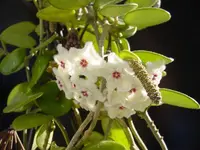
After blooms fade, leave the small knobby flower spurs in place instead of cutting them off, since Hoya 'Mathilde' reliably reblooms from the same spurs for many years.

Acclimate before moving

When shifting the plant closer to a brighter window or outdoors for summer, increase light exposure over 7–10 days to prevent leaf scorch and sudden bud drop.

Use overhead airflow

Place a small fan on a low, indirect setting aimed above the foliage to keep air moving, which reduces fungal issues around dense leaves and helps flowers dry quickly after watering.

Inspect leaf undersides

Check the undersides of leaves and along leaf nodes every 1–2 weeks for early signs of mealybugs or spider mites, so you can treat pests quickly and avoid deformed new growth when growing Hoya.

Common Pests and Diseases

Mealybugs

This pest feeds on Hoya sap and hides in leaf axils, along stems, and under leaves, often appearing as white cottony clusters. Symptoms include sticky honeydew, distorted new growth, and slowed vine development.

Solution

Isolate the plant, then wipe or dab visible mealybugs with cotton swabs dipped in 70% isopropyl alcohol and rinse the foliage with lukewarm water. Follow up with 2–3 applications of insecticidal soap or a light horticultural oil at 7–10 day intervals, making sure to reach leaf nodes and the pot rim where pests shelter.

Spider mites

These insects favor the relatively dry, warm conditions often used for Hoya indoor care and can cause stippled, dull leaves and fine webbing between leaves and stems. Symptoms include yellow speckling, reduced vigor, and premature leaf drop.

Solution

Increase humidity around the plant, then thoroughly shower the foliage, especially the undersides of leaves, to physically remove mites. Repeat strong water rinses every few days and use insecticidal soap or neem oil sprays on both leaf surfaces until new growth appears clean.

Soft scale

This pest appears as small, rounded or oval bumps on stems and leaf veins, sucking sap and weakening vines over time. Symptoms include sticky honeydew, black sooty mold on leaves, and poor flowering.

Solution

Manually remove scale with a soft cloth or cotton swab dipped in 70% isopropyl alcohol, focusing on stems and leaf midribs. After mechanical removal, apply horticultural oil thoroughly to stems and both leaf surfaces, repeating every 10–14 days until no new scale appears.

Sooty mold

This disease is a dark, powdery fungal growth that develops on the sugary honeydew excreted by mealybugs, scale, or aphids. Symptoms include blackened leaf surfaces that look dirty and can reduce light reaching the leaf, slowing growth.

Solution

Address the underlying sap-sucking pests first, then gently wipe leaves with a damp cloth or rinse under lukewarm water to remove fungal deposits. Improve airflow, avoid crowding plants, and keep foliage dry after cleaning so the leaf surface can recover and photosynthesis improves.

Botrytis blight

This disease is favored by cool, stagnant air and high humidity around dense Hoya vines, leading to gray mold on old blooms, peduncles, and sometimes leaves. Symptoms include mushy flower clusters, spotting on nearby leaves, and fuzzy gray spores on affected tissue.

Solution

Remove and discard all affected flowers and leaves, then increase air movement and avoid water sitting on the foliage or blooms. Allow the top of the substrate to dry slightly between waterings and, in severe or recurring cases, apply a targeted ornamental fungicide labeled for botrytis, following label rates and keeping sprays off fully open flowers when possible.

Interesting Facts

Hybrid of two species

This cultivar is a man-made hybrid between Hoya carnosa and Hoya serpens, combining the thicker, more robust foliage of H. carnosa with the smaller, softer leaves and vining habit of H. serpens.

Distinct speckled foliage

Its leaves are characteristically small, round to oval, and heavily flecked with silvery variegation, a trait valued by collectors because the speckling pattern is relatively stable and consistent compared with many other hoya hybrids.

Compact flowering clusters

The plant produces relatively small, dense umbels of white to pale pink, star-shaped flowers with a darker pink to red center, which are proportionally sized to its compact foliage and give it a delicate, miniature appearance when blooming.

FAQs about Hoya

Lack of blooms usually comes from insufficient light, frequent repotting, or removing old flower spurs. Provide bright, indirect light, avoid major root disturbance, keep temperatures stable, and never cut the small stubby spurs after flowers fade.

Grow Healthy Plants with Botan Care

Keep your plants happy and healthy with plant identification, disease detection, and easy care guidance.

Botan plant care app — identify plants on mobile

Explore More Plants