white-lipped oncidium Care (Oncidium leucochilum)

white-lipped oncidium

About white-lipped oncidium

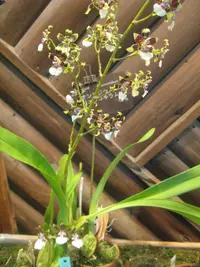
White-lipped oncidium (Oncidium leucochilum) is an epiphytic orchid, meaning it naturally grows attached to trees rather than in soil. It forms compact clumps of pseudobulbs with arching stems that carry many small, dancing flowers.

The blooms are usually yellow and brown with a striking white lip, creating a cloud of color when in full flower. It is native to Central America, where it grows in warm, bright, airy forests.

This species is considered moderately easy if its needs for bright filtered light, regular moisture, and good air movement are met. Understanding how to care for white-lipped oncidium mainly comes down to managing light and avoiding constantly wet roots.

Main Plant Requirements

Care Difficulty

Moderate Care

Light Preference

Partial Sun

Water Requirements

Moderate Water

Temperature Preference

Tropical / Frost Sensitive

Hardiness Zone

Unknown

Soil Texture

Organic-rich, Peaty, Rocky

Soil pH

Acidic (5.5–6.5)

Soil Drainage

Well-drained

Fertilization

Moderate (every 2–4 weeks)

Get Personalized Care Plan

Scan your plant to receive care tips personalized for your specific plant

Available on iOS and Android

How to Care for the white-lipped oncidium

This orchid prefers bright, filtered light that mimics high, lightly shaded tree canopies.

  • Provide 6–8 hours of bright, indirect light daily, such as dappled shade under 30–50% shade cloth or a lightly shaded greenhouse bench.
  • Allow gentle early morning sun but protect from strong midday and afternoon sun, which can scorch leaves and cause yellowing or dry brown patches.
  • If growth is weak and leaves are dark, increase light slightly; if leaves turn pale or reddish, reduce light, especially in summer at lower latitudes.

Oncidium leucochilum prefers evenly moist but never soggy roots with brief drying between waterings.

  • Water thoroughly when the medium is almost dry, letting the top 2–3 cm feel dry to the touch while the lower layer remains slightly moist.
  • Reduce watering in cooler months and after flowering, but never allow pseudobulbs to shrivel severely or leaves to flop, which indicates underwatering.
  • Use a very free-draining orchid mix and avoid standing water; constant wetness, leaf yellowing from the base, and black, mushy roots indicate overwatering.

This species is a warm- to intermediate-growing orchid that dislikes temperature extremes and frost.

  • Aim for 65–80°F (18–27°C) by day and 58–65°F (14–18°C) at night for steady growth and flowering.
  • Protect from cold below 50°F (10°C), as prolonged exposure can stunt growth and damage roots; never expose to frost.
  • In hot spells above 85°F (29°C), increase air movement and humidity and shade slightly to prevent heat stress, leaf scorch, and bud blast.

This orchid prefers moderately humid air to support active growth and flowering.

  • Aim for 50–70% humidity, using a hygrometer to track levels near the plant.
  • Tolerates short dry spells, but prolonged air below 40% can cause wrinkled pseudobulbs and crisp leaf tips.
  • Increase humidity with a pebble tray, grouping plants, or a small humidifier while keeping leaves well ventilated to prevent fungal issues.

Oncidium leucochilum grows best in a coarse, airy orchid substrate rather than standard potting soil.

  • Use a mix of medium bark, perlite, and a small amount of sphagnum moss to create a loose, open structure.
  • Ensure very rapid drainage so roots never sit in water, which greatly reduces the risk of rot.
  • Keep pH slightly acidic to neutral (pH 5.5–7.0), which supports nutrient uptake for healthy roots.
  • Avoid dense, peat-heavy or garden soil mixes that compact, restrict air movement, and hold water around the roots.

This species is well suited to container culture, including baskets and pots.

  • Choose a pot just large enough for 1–2 years of growth so the root mass can stabilize the plant without leaving cold, wet empty spaces.
  • Select slotted or net-style orchid containers to speed evaporation and keep the mix from staying saturated in the center.
  • Use a heavier pot material or add weight to the base if flower spikes make the plant top-heavy, to prevent tipping over during watering or air movement.

This orchid benefits from light, consistent feeding during active growth.

  • Use a balanced orchid fertilizer (around 20-20-20) diluted to 1/4–1/2 strength for the white-lipped oncidium.
  • Apply every 2–3 weeks in spring and summer when new roots and leaves develop.
  • Reduce feeding to once a month or stop entirely in late fall and winter.
  • Flush the pot with plain water monthly to prevent fertilizer salt buildup.

Pruning Oncidium leucochilum focuses on hygiene rather than shaping the plant.

  • Cut spent flower spikes back to the base once blooms fade, using disinfected scissors or snips.
  • Remove only dead, shriveled, or rotted pseudobulbs and leaves to limit disease spread.
  • Avoid cutting healthy green pseudobulbs, as they store water and nutrients.
  • Inspect while pruning to spot pests, rot, or overcrowding early.

Repotting helps this epiphytic orchid maintain healthy roots and aerated growing media.

  • Repot every 2–3 years or when roots circle the pot, grow over the rim, or media breaks down.
  • Choose late winter to early spring, just before new root growth, to minimize stress.
  • Use a snug pot with fresh, chunky orchid mix; position pseudobulbs near one side to allow forward growth.
  • Gently loosen old media, trim dead roots, then keep humidity high and watering light for 1–2 weeks.

Propagation of this species is usually done by careful division of mature clumps.

  • Divide only well-established plants with at least 6–8 healthy pseudobulbs.
  • Best time is late winter to early spring, when new roots begin to emerge.
  • Cut the rhizome into sections with 3–4 pseudobulbs each, using a sterile, sharp blade.
  • Pot divisions in fresh orchid mix, maintain high humidity, and provide bright, indirect light until growth resumes.

This tropical orchid is not frost hardy and needs warm, sheltered conditions in winter.

  • Keep temperatures above 55–60°F; avoid cold drafts and sudden temperature drops.
  • Move container plants indoors or into a heated greenhouse before nights fall below 50°F.
  • Provide bright, indirect light and slightly drier media, but do not allow complete desiccation.
  • Ensure good air movement to prevent fungal problems in cooler, slower-growing conditions.

Care Tips

Mounting for airflow

Consider growing plants on cork or hardwood mounts with a thin pad of sphagnum, as this increases airflow around the roots and reduces the risk of rot compared to tight plastic pots.

Fine-tune pot size

Use a very snug, shallow pot or basket and repot only when new growths reach the pot edge, since oversizing the container slows drying and often leads to root loss in Oncidium leucochilum care.

Targeted stake support

Stake new pseudobulb spikes with thin, flexible stakes and soft ties placed loosely, which keeps tall inflorescences upright without constricting the stems or damaging developing buds.

Flush to reduce salts

Once a month, irrigate with plain, low-mineral water at 2–3 times the pot volume to leach built-up fertilizer salts that can burn the fine root system.

Post-bloom grooming

After flowering, remove only the completely dry flower spike and old, shriveled sheaths while keeping green pseudobulbs, which continue to store energy and support future growth when caring for white-lipped oncidium.

Common Pests and Diseases

Spider mites

This pest thrives on Oncidium leaves kept in warm, dry air, causing pale stippling, silvery patches, and fine webbing on the undersides of leaves and around pseudobulbs.

Solution

Increase humidity to 50–70%, rinse foliage and pseudobulbs thoroughly under a gentle stream of lukewarm water, and wipe leaves with a soft cloth; for persistent infestations, use repeated applications of insecticidal soap or horticultural oil, ensuring good air movement so leaves dry within a few hours.

Scale insects

These insects attach along leaf midribs, sheaths, and pseudobulbs, appearing as small brown or whitish bumps that cause yellowing, shriveling pseudobulbs, and sticky honeydew.

Solution

Physically remove visible scale with a cotton swab dipped in isopropyl alcohol, trim heavily infested sheaths, then treat remaining plants and pot surfaces with insecticidal soap or horticultural oil every 7–10 days while improving light and airflow to strengthen plant resilience.

Mealybugs

This pest hides in leaf axils, under sheaths, and around roots, forming white cottony masses that sap plant vigor and distort new growth.

Solution

Uncover and peel away loose, dead sheaths, flush crown and root area with lukewarm water, then spot-treat colonies with isopropyl alcohol on a cotton swab; follow with 2–3 rounds of insecticidal soap or systemic insecticide labeled for orchids, keeping the plant isolated until no new insects appear.

Fungal leaf spot

This disease causes small yellow areas on leaves that develop into brown or black spots, often starting on crowded plants with poor air circulation and frequent leaf wetting.

Solution

Remove affected leaves or cut out spotted sections with a sterile blade, improve spacing and airflow around plants, avoid water sitting on foliage, and apply a broad-spectrum fungicide labeled for orchids according to label directions, continuing until no new spots form.

Bacterial soft rot

Symptoms include rapidly spreading, water-soaked, foul-smelling lesions in leaves or pseudobulbs, often triggered by standing water in leaf axils and warm conditions.

Solution

Immediately remove and discard all infected tissue with sterilized tools, dust or dab cut surfaces with cinnamon or a bactericide, keep the plant drier around the crown with strong air movement, and avoid overhead watering; discard the entire plant if rot continues to spread despite these measures, as part of careful Oncidium leucochilum care instructions.

Interesting Facts

Cloud forest native

This species occurs naturally from southern Mexico through Central America, where it grows as an epiphyte in warm, moist cloud forests at mid to higher elevations on mossy tree branches.

Contrasting white lip

The species name leucochilum means white lip and refers to its distinctive broad white labellum that strongly contrasts with the yellow to brown spotted petals and sepals, a trait used by taxonomists to separate it from closely related Oncidium species.

Seasonal blooming pattern

In its native range, it typically flowers once a year in a distinct seasonal flush, producing many long, branched inflorescences with numerous small flowers that can cover the plant in bloom.

FAQs about white-lipped oncidium

Lack of blooms often comes from insufficient light, no distinct cool, drier rest after flowering, or low nutrition. Provide bright filtered light, a slight night temperature drop, and regular but light feeding to trigger spikes next season.

Grow Healthy Plants with Botan Care

Keep your plants happy and healthy with plant identification, disease detection, and easy care guidance.

Botan plant care app — identify plants on mobile

Explore More Plants