Control Rhizome Spread
Install a deep root barrier or plant into a large sunken container without a base before backfilling to keep the rhizomes from encroaching into nearby planting areas or small ponds.

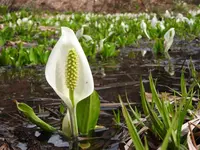
White skunk cabbage, Lysichiton camtschatcensis, is a hardy, moisture-loving perennial from wet meadows, stream edges, and bogs in northeastern Asia. It forms clumps of broad, bright green leaves that emerge in early spring. Showy white spathes surround a central flower spike, creating a bold focal point in cool, damp gardens. The plant prefers consistently wet, organic-rich soil and cool conditions, which makes it well suited to pondsides and naturalistic water gardens. Once planted in a suitable site, it is long-lived and low maintenance, though moving or dividing it can be challenging. Understanding how to care for White Skunk Cabbage mainly involves matching its need for constant moisture and avoiding dry or hot locations.

Care Difficulty
Moderate Care

Light Preference
Partial Shade

Water Requirements
Aquatic

Temperature Preference
Cold Hardy

Hardiness Zone
4–8

Soil Texture
Loamy, Silty, Organic-rich

Soil pH
Strongly acidic (4.5–5.5), Acidic (5.5–6.5)

Soil Drainage
Waterlogged tolerant

Fertilization
Minimal (feed rarely)
Scan your plant to receive care tips personalized for your specific plant
Available on iOS and Android
This bog-loving perennial prefers cool, moist sites with soft, filtered light rather than strong sun.
This species is adapted to saturated soils and even shallow standing water throughout the growing season.
This cold-hardy wetland plant thrives in cool to mild climates and tolerates significant winter chill.
This species prefers consistently moist air, especially in warm weather, and does best in 60–80% humidity.
Soil for Lysichiton camtschatcensis must mimic a cool, boggy edge with high organic matter and constant moisture.
This species can be grown in containers if the pot is managed like a mini bog with stable, cool moisture.
Lysichiton camtschatcensis is a bog plant that generally needs minimal fertilizer when grown in rich, organic, consistently wet soil.
Lysichiton camtschatcensis needs only light pruning to keep plants tidy and healthy.
This species is usually grown in the ground near water, so transplanting is more common than container repotting.
Lysichiton camtschatcensis is usually propagated by seed or division, both best done with patience and consistent moisture.
This cold-hardy wetland plant tolerates freezing temperatures in much of its range and usually needs little winter care.

Plant Health Check
Not sure what's wrong with your plant? Check your plant's health inside the app.
This species naturally occurs from northeastern Asia into parts of the Russian Far East and the Aleutian Islands, making it one of the few aroid family members adapted to cold, subarctic climates and snowmelt-fed wetlands.
Its large white spathe, which looks like a petal, is actually a modified leaf that helps attract early-season pollinators to the central yellow-green spadix where the true flowers are densely packed.
In native habitats, plants often emerge and flower as snow is receding, taking advantage of saturated, cold soils and high light levels before surrounding vegetation leafs out and creates shade.

Unlike its North American relative western skunk cabbage, this species has only a faint or even pleasant fragrance, which is why it is often grown ornamentally in cool-climate water gardens despite being a true skunk cabbage relative.
This species spreads steadily by rhizomes and self-seeding where soil stays consistently wet. In suitable boggy ground it can form large clumps, but it is slower and less invasive than the related yellow skunk cabbage.
Keep your plants happy and healthy with plant identification, disease detection, and easy care guidance.