Sink Container Edges
When planting in tubs or half-barrels, submerge the container rim 2–5 cm below the pond or water surface to hide hardware and keep rhizomes confined while still allowing natural-looking growth.

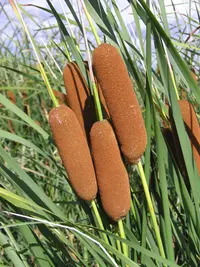
Graceful cattail, Typha laxmannii, is a compact aquatic or bog plant known for its slender, upright leaves and small, narrow brown flower spikes. It forms neat clumps that give a refined, vertical look to ponds, water features, and wet garden edges.
This species occurs naturally in wetlands across parts of Europe and Asia, adapted to shallow water or consistently damp soils. It is generally hardy and resilient if given steady moisture and enough sun, so learning how to care for Graceful Cattail focuses mainly on providing the right wet conditions.
Typha laxmannii suits smaller water gardens better than larger cattail species because of its modest size and controlled spread.

Care Difficulty
Easy Care

Light Preference
Full Sun

Water Requirements
Aquatic

Temperature Preference
Cold Hardy

Hardiness Zone
3–9

Soil Texture
Loamy, Silty, Organic-rich

Soil pH
Slightly acidic (6.5–7.0), Neutral (7.0)

Soil Drainage
Waterlogged tolerant

Fertilization
Minimal (feed rarely)
Scan your plant to receive care tips personalized for your specific plant
Available on iOS and Android
This marginal aquatic plant thrives in strong natural light typical of open ponds and wetland edges.
This species is adapted to saturated soils and shallow standing water rather than periodically dry ground.
This hardy wetland plant tolerates a wide temperature range but grows best in mild to warm conditions.
This wetland species prefers constantly moist air but tolerates a wide range of ambient humidity.
Typha laxmannii grows best in permanently wet, heavy, organic-rich substrates rather than standard potting mixes.
This species is suitable for containers when grown in heavy, water-filled setups that prevent tipping.
This wetland species needs only modest feeding when grown in containers or nutrient-poor ponds.
Pruning helps keep Typha laxmannii stands tidy and prevents excessive self-seeding.
Typha laxmannii is usually managed by transplanting clumps in ponds rather than frequent repotting.
This species is most commonly propagated by division, with seed used where naturalization is desired.
Typha laxmannii is cold hardy in most temperate climates and usually needs minimal winter attention.

Plant Health Check
Not sure what's wrong with your plant? Check your plant's health inside the app.
This species forms notably slimmer and shorter flower spikes than common cattails, often under 80 cm tall, giving it a more delicate, dwarf-like appearance in comparison to its robust relatives.
It naturally occupies shallow, slow-flowing or still waters with fine substrates, and often appears along the edges of irrigation canals and man-made ponds in its native Eurasian range.
Compared with larger cattail species, its compact, short spikes typically produce less conspicuous seed fluff, which can make identification easier when several cattail species grow in the same wetland.

This species hybridizes less frequently than some other cattails, so its stands can remain relatively genetically distinct in mixed-species wetlands where close relatives are also present.
This species spreads by rhizomes and self-seeding, but is usually less aggressive than larger cattails. In small ponds, use containers or edging to confine roots and remove stray seedlings annually to prevent overcrowding.
Keep your plants happy and healthy with plant identification, disease detection, and easy care guidance.