Root flare check
Ensure the uppermost main roots sit just at or slightly above soil level after planting, then gently remove excess mulch or soil from the trunk base so the root flare stays exposed and resists rot and girdling roots.

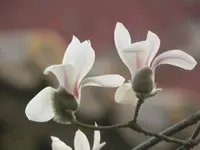
Yulan magnolia (Magnolia denudata) is a deciduous flowering tree valued for its early, showy blooms. It usually grows with a rounded crown and smooth gray bark.
The plant produces large, cup-shaped white flowers on bare branches before the leaves emerge, creating a distinct late winter to early spring display. Its foliage is medium green and forms a dense canopy later in the season.
Magnolia denudata originates from eastern and central China and is often used as a specimen tree in temperate gardens. It is moderately easy to grow if planted in a suitable climate and protected from harsh drying winds.
To care for Yulan Magnolia, provide a sunny to lightly shaded site with evenly moist, well-drained, slightly acidic soil to support healthy growth and flowering.

Care Difficulty
Moderate Care

Light Preference
Full Sun

Water Requirements
Regular Water

Temperature Preference
Cold Hardy

Hardiness Zone
5–9

Soil Texture
Loamy, Silty, Organic-rich

Soil pH
Acidic (5.5–6.5), Slightly acidic (6.5–7.0)

Soil Drainage
Moist but well-drained

Fertilization
Minimal (feed rarely)
Scan your plant to receive care tips personalized for your specific plant
Available on iOS and Android
This deciduous tree prefers bright exposure with some protection from harsh afternoon conditions.
This species likes evenly moist but not waterlogged soil, especially while establishing.
This magnolia prefers temperate climates with cool winters and mild to warm summers.
This species grows well in typical outdoor humidity but benefits from slightly moist air in hot, dry regions.
Magnolia denudata prefers deep, moist, well-drained, slightly acidic soil to support long-term health and flowering.
This species can be grown in large containers for some years, especially in smaller gardens or patios.
Magnolia denudata benefits from light, targeted feeding rather than heavy fertilization.
Magnolia denudata needs only light structural pruning to stay healthy and well-shaped.
This magnolia is usually grown in the ground; focus on careful transplanting rather than frequent repotting.
Magnolia denudata is usually propagated by semi-hardwood cuttings or layering rather than home-sown seed.
Yulan Magnolia is fairly cold hardy but young trees benefit from basic winter protection in colder regions.

Plant Health Check
Not sure what's wrong with your plant? Check your plant's health inside the app.
Magnolia denudata belongs to one of the oldest surviving lineages of flowering plants, with floral structures that lack clear separation between petals and sepals, reflecting a very early stage in angiosperm evolution.
This species often flowers on bare branches before leaf-out, producing large, white, tulip-shaped blossoms in late winter to early spring, which makes it especially sensitive to late frosts compared with many other magnolias.
Its thick, waxy tepals and robust reproductive structures are adapted for pollination by beetles rather than bees, an evolutionary trait that aligns with the ancient origin of the magnolia family.

In traditional Chinese horticulture and art, Magnolia denudata (yulan or Yulan Magnolia) has been cultivated for many centuries as a symbol of purity and nobility, and historical records indicate its use in imperial palace gardens as early as the Tang and Song dynasties.
Lack of flowers often comes from immature age, pruning at the wrong time, or stress from transplanting, root disturbance, or late frosts. Excessive nitrogen fertilizer and deep shade can also divert energy into foliage instead of buds.
Keep your plants happy and healthy with plant identification, disease detection, and easy care guidance.