Root flare check
At planting and every few years, gently remove excess mulch and soil from the trunk base so the root flare is visible and slightly above grade, which reduces risk of rot and improves long-term stability when growing eastern redbud.

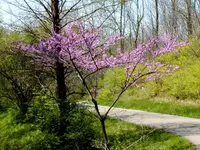
Eastern redbud, Cercis canadensis, is a small deciduous tree or large shrub valued for its early spring flowers and graceful branching. It typically grows with a rounded crown and heart-shaped leaves that turn yellow in fall.
In nature, it occurs along woodland edges and streams across eastern and central North America. Pink to magenta blossoms appear on bare branches before the foliage, creating strong seasonal interest.
This species is generally considered easy to grow when planted in suitable climates. It prefers full sun to light shade, moderately moist, well-drained soil, and benefits from some shelter from harsh wind when you care for eastern redbud.

Care Difficulty
Moderate Care

Light Preference
Full Sun

Water Requirements
Moderate Water

Temperature Preference
Cold Hardy

Hardiness Zone
4–9

Soil Texture
Sandy, Loamy, Clay

Soil pH
Acidic (5.5–6.5), Slightly acidic (6.5–7.0)

Soil Drainage
Well-drained

Fertilization
Minimal (feed rarely)
Scan your plant to receive care tips personalized for your specific plant
Available on iOS and Android
This species thrives as a small landscape tree in sites with strong light but some daily shade.
Watering should support deep root development while avoiding prolonged soggy conditions.
This deciduous tree is adapted to temperate climates with cold winters and warm summers.
Humidity is not a significant factor for Cercis canadensis, which adapts well to typical outdoor air conditions in its range.
Cercis canadensis prefers moderately fertile, well-structured soil that stays evenly moist but never waterlogged.
This species can be grown in containers for several years, but only when given ample root space and careful moisture management.
Cercis canadensis usually thrives in average garden soil and needs only modest fertilization once established.
Pruning Cercis canadensis is mainly done to maintain structure, remove defects, and support safe branching near walkways or buildings.
Eastern redbud is usually grown in the ground, so focus on careful transplanting of young trees rather than frequent repotting.
Propagation of Cercis canadensis is possible but somewhat technical, especially from cuttings, so it is often left to nurseries.
Cercis canadensis is cold hardy in much of the US and usually needs minimal winter care once established in the ground.

Plant Health Check
Not sure what's wrong with your plant? Check your plant's health inside the app.
Eastern redbud flowers emerge directly from older trunks and branches (a trait called cauliflory), allowing dense clusters of blossoms along the woody framework before leaves appear.
Although not a legume, eastern redbud associates with soil microorganisms that can improve nitrogen availability, which helps it perform relatively well on poorer soils compared with many other small ornamental trees.
In natural habitats, eastern redbud usually grows as an understory tree at woodland edges and clearings and often has a comparatively short life span of about a few decades, especially under urban or high-stress conditions.

The flowers of eastern redbud are edible and have a mild, slightly sour taste, and have been traditionally used fresh in salads or as a garnish, adding both color and a light acidic note.
Lack of flowers usually comes from immature age, heavy shade, or stress from drought, root damage, or recent transplanting. Avoid heavy pruning of young branches, support steady moisture, and allow several years for reliable flowering.
Keep your plants happy and healthy with plant identification, disease detection, and easy care guidance.