Fruit thinning strategy
Once young fruits reach marble size, remove clusters so that only 1–2 fruits remain per spur, leaving about 10–15 cm between fruits along each branch to improve fruit size and reduce limb stress.

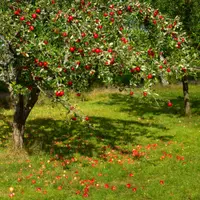
The common apple, Malus domestica, is a temperate fruit tree grown for its edible fruit and attractive spring blossoms. It is typically medium-sized with a rounded crown and dense branching.
This species originated from Central Asia and is now widely cultivated in orchards and home gardens across many cool and mild regions. Its growth and yield depend strongly on proper pollination, winter chill, and regular pruning.
Apple trees prefer full sun, moderate moisture, and well-drained, fertile soil. Understanding how to care for common apple early on helps keep trees productive and healthy over many years.

Care Difficulty
Moderate Care

Light Preference
Full Sun

Water Requirements
Moderate Water

Temperature Preference
Cold Hardy

Hardiness Zone
4–8

Soil Texture
Loamy, Sandy, Clay

Soil pH
Acidic (5.5–6.5), Slightly acidic (6.5–7.0)

Soil Drainage
Well-drained

Fertilization
Minimal (feed rarely)
Scan your plant to receive care tips personalized for your specific plant
Available on iOS and Android
This tree performs best in open, bright conditions suited to fruit production.
Consistent soil moisture supports healthy growth and fruit quality in this species.
Temperature strongly influences flowering, fruit set, and overall vigor in this tree.
This species tolerates a wide humidity range and rarely needs special humidity management outdoors.
Malus domestica grows best in deep, loose, well-aerated soil that drains efficiently but retains moderate moisture.
This species can be grown in containers when using dwarf or semi-dwarf rootstocks.
Malus domestica benefits from moderate, targeted feeding to support fruiting rather than lush, weak growth.
Pruning Malus domestica shapes the framework, improves light penetration, and maintains fruit quality.
Malus domestica is usually grown in the ground, so care focuses on transplanting young trees and managing root stress.
Most Malus domestica trees for fruit production are propagated by grafting onto selected rootstocks.
Malus domestica is generally cold hardy, but young and container-grown trees benefit from some winter protection in harsh climates.

Plant Health Check
Not sure what's wrong with your plant? Check your plant's health inside the app.
Modern cultivated apples descend mainly from the wild species Malus sieversii from Central Asia, with additional genetic contributions from European crabapples through historical hybridization and selection.
Despite being one species, cultivated apples include thousands of genetically distinct cultivars, which differ strongly in traits such as texture, flavor, storage life, and disease resistance due to centuries of selective breeding.
This species has a genetic self-incompatibility mechanism, meaning most trees cannot fertilize themselves and require pollen from a genetically different apple tree for successful fruit set.

Long-lived specimens of this species can remain productive for many decades, and some traditional orchard apple trees are documented to continue bearing fruit for more than a century under suitable conditions.
Growth is moderate. Young trees typically add 30–60 cm in height per year under good conditions. With a suitable rootstock, most start fruiting in 3–5 years, though full cropping usually takes several more seasons.
Keep your plants happy and healthy with plant identification, disease detection, and easy care guidance.