Canopy height planning
Decide early whether the tree will be kept as a low-headed fruiting tree or a taller shade tree, and establish the main scaffold branches at the desired height in the first 3–5 years to avoid later heavy cuts.

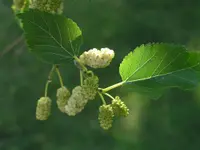
White mulberry, Morus alba, is a fast-growing deciduous tree commonly used for shade, windbreaks, and wildlife value. It is best known as the traditional food source for silkworms.
The tree typically has a broad, irregular crown with variable, often lobed leaves and small, sweet fruits that range from white to deep purple when ripe. It originates from China but is now widely naturalized in many temperate regions, including parts of North America.
It adapts to a wide range of soils and urban conditions, which makes it relatively easy to establish and maintain. Understanding how to care for white mulberry mainly involves managing its vigorous growth and choosing a suitable planting site.

Care Difficulty
Easy Care

Light Preference
Full Sun

Water Requirements
Moderate Water

Temperature Preference
Cold Hardy

Hardiness Zone
4–9

Soil Texture
Sandy, Loamy, Clay

Soil pH
Acidic (5.5–6.5), Slightly acidic (6.5–7.0)

Soil Drainage
Well-drained

Fertilization
Minimal (feed rarely)
Scan your plant to receive care tips personalized for your specific plant
Available on iOS and Android
This deciduous tree needs abundant direct light to fruit and grow well.
This species prefers deep, infrequent watering once established, with soil allowed to dry slightly between soakings.
This hardy tree tolerates a wide temperature range but grows best in warm, temperate conditions.
Morus alba handles a wide humidity range and usually does not need special humidity management outdoors.
Morus alba grows best in deep, well-structured, moderately moist soil with free drainage.
This species can be grown in large containers when given adequate root space and stability.
Morus alba benefits from moderate feeding but often grows acceptably in reasonably fertile soil without extra input.
Pruning Morus alba helps manage size, canopy shape, and fruiting wood.
Morus alba is usually grown in the ground, so focus on careful transplanting rather than frequent repotting.
Morus alba is commonly propagated by hardwood cuttings, softwood cuttings, and seeds.
Morus alba is generally cold hardy in much of the US and needs minimal winter care once established.

Plant Health Check
Not sure what's wrong with your plant? Check your plant's health inside the app.
Leaves of this species are the traditional and preferred food for the domesticated silkworm Bombyx mori, which made the tree foundational to silk production for more than 2,000 years, especially in China and later across Eurasia.
The species name alba means white, but the fruits actually ripen to colors ranging from white and pink to deep purple-black, depending on the cultivar and genetic variation within the species.
Male trees release large amounts of lightweight pollen from small catkins, which contributes to wind pollination but can be a notable seasonal allergen source in urban areas where this species is widely planted.

White mulberry was intentionally introduced to North America in the 18th century in an effort to establish a domestic silk industry, and although the industry largely failed, the tree naturalized in many regions and now hybridizes with native red mulberry (Morus rubra), threatening the genetic integrity of the native species.
This tree is generally fast-growing. Under good conditions, young specimens may add 30–90 cm per year, sometimes more. Growth slows with age. Rate depends on water, soil fertility, climate, and available root space.
Keep your plants happy and healthy with plant identification, disease detection, and easy care guidance.