
white mulberry Identification (Morus alba)

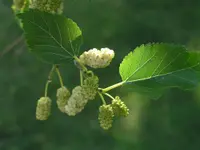
Recognize white mulberry by its alternate leaves, usually 2-6 inches (5-15 cm) long, with toothed edges and a glossy surface; many leaves are unlobed, while others on the same branch are deeply lobed.

Also check for smooth gray bark on younger stems and short, cylindrical fruiting spikes hanging from the leaf axils.

Morus alba Identification

Check Your Plant ID

Take or upload a photo to confirm your plant ID with Botan.

Clear images work best. Avoid photos taken too close or too far away

  • 1 free identification
  • No sign-up
  • 30,000+ plants in database

Use a few visible traits to check for Morus alba.

  • Leaves are alternate, simple, and very variable on one plant: unlobed, mitten-shaped, or with 3 lobes.
  • Leaf blades are usually 2-6 inches (5-15 cm) long, broadly oval with pointed tips and toothed edges.
  • The leaf base is often uneven, with one side attaching slightly lower than the other.
  • Fruits hang singly or in small groups and look like 1/2-1 inch (1-2.5 cm) blackberry-like clusters.

Check several leaves on the same branch, since shape can vary a lot.

White mulberry shows clear visual shifts from seedling leaves to mature fruiting branches.

  • Seedling: Seedlings show alternate leaves that are often strongly lobed, with thin green stems and a simple upright form lacking the broad branching seen later.
  • Young plant: Young plants often carry the most variable leaves, from unlobed to mitten-shaped or deeply lobed, and produce long, flexible shoots with wide spacing between leaves.
  • Mature plant: Mature plants form a rounded, spreading crown and furrowed gray-brown trunk; leaves are usually less lobed and commonly 3-6 inches (8-15 cm) long.
  • Fruiting stage: Fruiting branches carry many elongated, blackberry-like multiple fruits that hang singly or in small groups, shifting the outline with dangling clusters absent earlier.

Several white mulberry selections can be recognized by leaf color pattern or growth habit.

  • Morus alba 'Pendula': A strongly weeping form, with arching branches that hang downward and create a dome-shaped crown unlike the upright typical tree.
  • Morus alba 'Nana': A dwarf, densely branched form that stays much smaller, often shrub-like or a small standard rather than a full-sized tree.
  • Morus alba 'Variegata': Leaves are irregularly marked with cream to white patches or margins, instead of being plain green.
  • Morus alba 'Laciniata': Leaves are deeply cut into narrow lobes, giving a fernlike outline rather than the broad, variable blades of the typical form.

In spring, Morus alba leafs out early with glossy, variable leaves, and small catkins appear with or just before the foliage. By early summer, mulberry fruits become visible and ripen from green to white, pink, red, or purple. In fall, leaves turn yellow before dropping, exposing the twiggy winter branching.

A few trees are regularly mistaken for white mulberry.

red mulberry(Morus rubra)

It shares variable, often lobed leaves and blackberry-like fruits. The quickest check is the leaf underside: red mulberry is usually densely hairy, while Morus alba is often smoother or only lightly hairy. Red mulberry leaves also tend to feel rougher and thicker.

paper mulberry(Broussonetia papyrifera)

This species can mimic the broad, sometimes mitten-lobed leaves. A fast difference is leaf arrangement: paper mulberry often has opposite leaves on young shoots, while mulberries are alternate. Its leaves are also distinctly fuzzy beneath, and the fruits form round orange-red balls rather than elongated clusters.

Morus alba is native to China and parts of eastern Asia. In its native range, it occurs in lowland to lower montane areas, often along forest edges, in open woodland, scrub, streamside ground, and other disturbed places. That setting helps with identification because this species often appears where light is good and disturbance is common, rather than deep forest. A mulberry found naturalized along roadsides, fencerows, vacant lots, or woodland margins fits that pattern well.

  • Sap contact: The milky sap can irritate skin in some people. This is a skin-contact concern for humans when leaves, stems, or unripe fruit are broken.
  • Unripe fruit and plant parts: Unripe fruit and some other parts of Morus alba have been reported to cause stomach upset if eaten. This is an ingestion concern for humans and pets.

Confirm the Species with Botan

Upload a photo to help identify the plant or verify your conclusion before labeling, buying, or removing it.

FAQ

Look for glossy, variable leaves on the same plant, often unlobed and lobed together, plus milky sap when a leaf stem is broken. Mature trees have a broad, rounded crown, useful for white mulberry identification.

More Plant Identification Guides

From Plant ID to Plant Info

Identify a plant from a photo with Botan, then get plant details, care information, and common problems for that species.

Botan app identifying a plant from a photo
Dill Companion Plants – What to Grow Next to Dill

9 min read · 17 Jul 2026

Dill Companion Plants – What to Grow Next to Dill

Dill is an easy-to-grow plant that gets along well with many vegetables. This guide describes 15 plants that can be planted alongside it, a few to avoid, and mistakes that can quietly sabotage the entire process.

Plant Recommendations
Dill Companion Plants – What to Grow Next to Dill
How to Water Houseplants: Watering Guide

7 min read · 24 Aug 2026

How to Water Houseplants: Watering Guide

Learn how often to water indoor plants, key factors for proper watering, and how to adjust the care routine by plant type, season, pot size, light, and indoor conditions.

Plant Care
How to Water Houseplants: Watering Guide
20 Most Popular Fruits Around the World

7 min read · 22 Jul 2026

20 Most Popular Fruits Around the World

Curious which fruits the world actually eats the most? Here's the top-20 by production volume, an overview of what people choose in each region, and a few figures that defy common assumptions.

Plant Recommendations
20 Most Popular Fruits Around the World