


Olive tree Identification (Olea europaea)

To recognize Olive tree, look for narrow, opposite leaves about 1 to 3 inches (2.5 to 7.5 cm) long, with a gray-green upper surface and a distinctly paler underside.

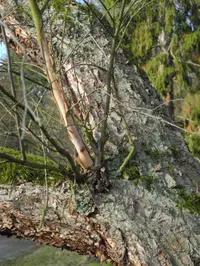
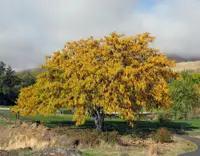
It usually grows as a small tree with a short trunk that becomes gnarled and furrowed, and a dense crown of many rigid branchlets.

Olea europaea Identification

Check Your Plant ID

Take a photo and use Botan to confirm your plant identification.

Clear images work best. Avoid photos taken too close or too far away

Use these quick checks for Olea europaea.

  • Leaves are opposite, narrow, and lance-shaped, usually 1.5 to 4 inches (4 to 10 cm) long, with smooth edges.
  • Leaf surfaces differ strongly: dark gray-green above, much paler and silvery below.
  • Twigs and older branches create a dense, rounded crown; the trunk often looks gnarled, furrowed, and twisted with age.
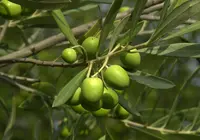
  • Fruits are smooth, oval drupes with a single hard pit, often about 0.5 to 1.5 inches (1.3 to 3.8 cm) long.

Check both the silvery leaf undersides and the single-pit fruit for the most useful visual confirmation.

Olea europaea shows clear visual shifts from sapling structure to flowering and fruiting branches.

  • Young plant: Young plants are upright and twiggy, with a narrow outline, smooth gray stems, and opposite leaves that look relatively larger, often 1-3 inches (2.5-7.5 cm) long.
  • Mature plant: Mature plants form a broader, denser crown with heavier branching; trunks become stout, rough, and furrowed, often twisted rather than straight.
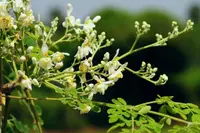
  • Flowering stage: Flowering branches carry many small creamy white blossoms in short clustered panicles from leaf axils, making branch tips look lightly speckled.
  • Fruiting stage: After flowering, the same axillary clusters hold oval drupes that turn from green to purple-black, adding distinct hanging fruit among the gray-green leaves.

Several Olea europaea selections are easy to separate by foliage pattern and growth habit.

  • 'Montra': Forms a narrow, upright crown, often 4 to 8 feet (1.2 to 2.4 m) wide, much slimmer than the typical broad olive tree.
  • 'Little Ollie': Stays distinctly dwarf and rounded, usually remaining a dense shrub rather than developing the typical small-tree form.
  • 'Variegata': Leaves show irregular cream to pale yellow margins or patches, instead of the usual solid gray-green blades.
  • 'Pendolino': Branchlets arch and droop, giving the canopy a clearly weeping outline compared with the usual spreading habit.

In late spring to early summer, Olea europaea shows many small, creamy white flower clusters against its narrow gray-green leaves. The bloom is subtle from a distance but noticeable up close. By fall, flowers give way to oval drupes, the olive fruits, which enlarge and shift from green to purple-black as they ripen. Because the tree is evergreen, the silvery leaf color stays visible through winter rather than dropping away.

A few shrubs and small trees can be mistaken for Olea europaea at a glance.

Russian olive(Elaeagnus angustifolia)

Often confused because both have narrow, gray-green leaves and a silvery cast. Russian olive leaves are alternate, not opposite, and stems often bear thorns. Its bark is usually shaggier on older plants.

Mock privet(Phillyrea latifolia)

Confusion happens because it is an evergreen in the olive family with opposite leaves and dark fruits. It differs by having broader, shorter leaves with a glossier green surface and no silvery underside.

Olea europaea is native to the Mediterranean Basin, extending into parts of Macaronesia, North Africa, and western Asia. In identification, that range helps separate true olive from unrelated silver-leaved shrubs and small trees found outside Mediterranean-type regions. In the wild, it occurs in dry evergreen woodland, scrub, rocky hillsides, and coastal slopes, often on limestone. Seeing a plant naturalized in these habitats, especially in Mediterranean climates, adds useful context when judging whether it is Olea europaea.

Not Sure About the ID?

Use Botan to identify or verify the plant from a photo, which helps avoid mix-ups before you label or buy it.

FAQ

Yes. Small creamy white flowers in branched clusters from leaf axils are a useful clue in spring. Each flower usually has four petals, which helps with Olive tree identification when paired with the narrow gray-green leaves.

More Plant Identification Guides

Identify First. Learn What Comes Next.

Identify a plant from a photo with Botan, then review its profile, care information, and common problems.

Botan app identifying a plant from a photo
How to Increase Humidity for Plants – 8 Simple Ways That Work

8 min read · 14 Aug 2026

How to Increase Humidity for Plants – 8 Simple Ways That Work

Dry indoor air stresses a lot of houseplants. You usually notice it first in the browning leaf tips. This guide describes 8 simple ways to raise the moisture around your plants, from humidifiers to pebble trays.

Plant Care

How to Increase Humidity for Plants – 8 Simple Ways That Work
Best Bedroom Plants – Top 10 to Grow in Your Space

8 min read · 8 Jul 2026

Best Bedroom Plants – Top 10 to Grow in Your Space

Discover the top 10 houseplants that are suitable for growing in your bedroom. Compare their light and water needs, pet safety, and benefits. Find out where best to place greenery in your relaxation space and what species to avoid.

Plant Recommendations
Best Bedroom Plants – Top 10 to Grow in Your Space
Best Time to Mow Lawn – A Complete Guide

5 min read · 10 Aug 2026

Best Time to Mow Lawn – A Complete Guide

Explore when to mow your lawn for its health and a pleasant green color. Find out the best time for this task during the summer heat, and follow practical tips for correctly cutting the grass, and learn common mistakes to avoid.

Plant Care
Best Time to Mow Lawn – A Complete Guide