


American holly Identification (Ilex opaca)

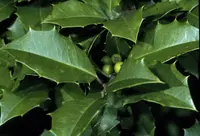
Recognize American holly by its thick, alternate evergreen leaves, each 2 to 4 inches (5 to 10 cm) long, with a few sharp spines along the margins and a single pointed tip.

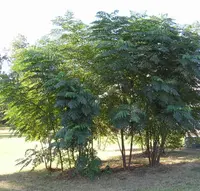
It typically forms a dense, narrowly pyramidal tree with a straight trunk and smooth, light gray bark.

Ilex opaca Identification

Check Your Plant ID

Take or upload a photo to confirm your plant ID with Botan.

Clear images work best. Avoid photos taken too close or too far away

  • 1 free identification
  • No sign-up
  • 30,000+ plants in database

Check the leaves, branching, and berries on American holly.

  • Leaves are simple, alternate, and usually 2 to 4 inches (5 to 10 cm) long, oval to oblong with a few sharp spines along the margins.
  • The foliage is thick, stiff, and glossy dark green above, with a paler underside.
  • Twigs and branches form a dense, narrow-pyramidal crown, especially on mature trees.
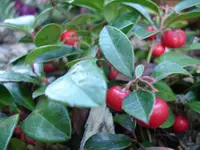
  • Fruits are round red berries, about 1/4 inch (6 mm) wide, held close along the stems.

A combination of spiny evergreen leaves and red berries is the quickest visual check.

Ilex opaca shows clear visual shifts from spiny juvenile foliage to fruiting adult branches.

  • Juvenile plant: Young plants are dense and shrubby, with stiff evergreen leaves bearing sharper, more obvious spines than on older branches.
  • Mature plant: Mature trees develop a single trunk and narrow pyramidal crown, often reaching 30-50 feet (9-15 m), with lower branches persisting.
  • Fruiting stage: Female branches carry round red berries about 1/4 inch (6 mm) wide in leaf axils, standing out against darker evergreen foliage.

Several named selections of American holly are recognizable by foliage pattern, plant shape, or berry color.

  • 'Satyr Hill': Leaves are nearly spineless or have very few spines, giving the plant a smoother-textured outline than the typical sharply spined form.
  • 'Canary': Fruit ripens yellow instead of the usual red, a clear difference in fall and winter.
  • 'Golden King': Leaves have irregular yellow margins, creating a variegated look rather than solid dark green foliage.
  • 'Maryland Dwarf': Growth is distinctly low and dense, often staying much shorter and broader than the typical tree form.

In spring, small white flowers appear in the leaf axils of Ilex opaca, adding a brief identification clue on otherwise evergreen branches. By fall into winter, female trees carry bright red berries that often persist after nearby broadleaf trees have dropped their leaves, making the dense, spiny evergreen canopy especially recognizable.

A few broadleaf evergreens are often mistaken for American holly.

English holly(Ilex aquifolium)

Often confused because both have glossy, spiny evergreen leaves and red berries. English holly usually has shinier, darker leaves with more regular marginal spines; its leaves are often more rectangular than the broader, duller leaves of Ilex opaca.

Chinese holly(Ilex cornuta)

Similar from a distance because it is evergreen with red fruit and spiny leaves. The quickest check is the leaf shape: Chinese holly commonly has 3 main terminal spines, giving a horned look, while Ilex opaca leaves have several smaller spines along the edges.

Ilex opaca is native to the eastern and south-central United States, from southern New England west to eastern Texas and Missouri, and south into Florida. This range helps separate it from similar hollies more often planted outside that region. In the wild it is most often found in upland woods, mixed hardwood forests, forest edges, and moist bottomland forests. Seeing it in shaded to partly open woodland settings, rather than coastal dunes or dry scrub, can help narrow the identification.

  • Berries: The red berries are poisonous if eaten. Ingestion can cause stomach upset in humans and pets, especially children and dogs.
  • Leaves: Leaves are also considered toxic if eaten by humans or pets, though berries are the main concern because they are more likely to be sampled.

Scan. Check. Confirm.

Use Botan to compare a photo and quickly verify whether the plant in front of you matches your identification.

FAQ

Look for a dense evergreen tree with thick, glossy, dark green leaves, each usually bearing several sharp spines along the margins. Red berries on female plants and smooth, light gray bark also help recognize American holly.

Everything About American holly

More Plant Identification Guides

Identify It. Learn More About It.

Use Botan to identify a plant from a photo, then see plant details, care information, and common problems.

Botan app identifying a plant from a photo
How to Mulch in the Fall and When to Wait Until Spring

5 min read · 12 Nov 2026

How to Mulch in the Fall and When to Wait Until Spring

In the fall, mulch gives the roots of trees and shrubs insulation and more stable conditions through winter. In the spring, it mainly suppresses weeds and keeps moisture in the soil during the growing season.

Beginner Guides
How to Mulch in the Fall and When to Wait Until Spring
15 Best Scary Halloween Plants and Fungi for a Spooky Garden

8 min read · 9 Oct 2026

15 Best Scary Halloween Plants and Fungi for a Spooky Garden

Want a garden that looks eerie in October? Here are 15 Halloween plants and fungi, from carnivorous traps to bleeding mushrooms. For each species, we cover its appearance, care requirements, and potential uses in your landscape.

Plant Recommendations
15 Best Scary Halloween Plants and Fungi for a Spooky Garden
Is Sugar Water Good for Plants?

4 min read · 14 Sept 2026

Is Sugar Water Good for Plants?

Sugar water may sound like an easy boost, but most rooted plants do not need extra sucrose. This guide explains how green tissues produce carbohydrates, when a sweetened solution can be useful, and why too much can cause problems.

Plant Care
Is Sugar Water Good for Plants?