Shelter From Wind
Plant young trees where larger shrubs or structures break strong prevailing winds, since flexible but shallow-rooted saplings can rock in storms and develop loose, unstable root systems.

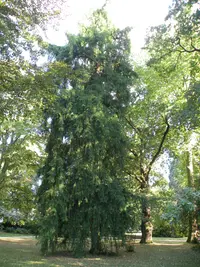
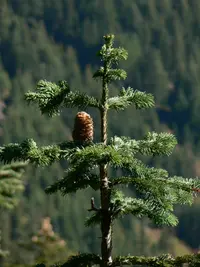
California nutmeg (Torreya californica) is an evergreen conifer native to shaded canyons and mountain slopes of California. It forms a dense, slow-growing tree with stiff, sharp needles and irregular branching.
The tree produces olive-like fruits containing a large seed that resembles a nutmeg, though it is not related to true nutmeg. Its slow growth, sensitivity to heat and drought, and need for cool, moist, well-drained sites make it more challenging than common landscape conifers.
Gardeners who want to care for California nutmeg should provide shelter from hot sun, consistent moisture, and protection from drying winds.

Care Difficulty
Moderate Care

Light Preference
Partial Shade

Water Requirements
Moderate Water

Temperature Preference
Cold Hardy

Hardiness Zone
7–9

Soil Texture
Loamy, Sandy, Organic-rich

Soil pH
Acidic (5.5–6.5), Slightly acidic (6.5–7.0)

Soil Drainage
Moist but well-drained

Fertilization
Minimal (feed rarely)
Scan your plant to receive care tips personalized for your specific plant
Available on iOS and Android
This slow-growing conifer prefers bright, gentle light that mimics its native understory habitat.
This species prefers consistently moist but not saturated soil, especially while establishing.
This conifer is adapted to mild climates with cool winters and moderate summers.
This conifer tolerates a wide humidity range and usually does not need special humidification outdoors.
Torreya californica prefers cool, moist, well‑aerated soil that drains freely but does not dry out quickly.
This species can be grown in containers when young, but long‑term growth is challenging due to its eventual size and deep root system.
This slow-growing conifer generally needs minimal feeding, especially in the ground.
Pruning Torreya californica is usually light and focused on maintaining health and a natural form.
This species is usually grown in the ground, so focus on careful site planting and occasional transplanting of young trees.
Torreya californica is slow and somewhat challenging to propagate, mainly by seed and semi-hardwood cuttings.
Established Torreya californica is generally cold hardy in its suitable climate and needs limited winter care.

Plant Health Check
Not sure what's wrong with your plant? Check your plant's health inside the app.
This species is one of a small group of torreya conifers considered paleoendemics, meaning they are remnants of a much wider prehistoric distribution that has contracted to limited areas in California’s Coast Ranges and Sierra Nevada foothills.
Its large, fleshy, nut-like seeds were likely dispersed historically by now-absent large mammals; today, animals such as squirrels and rodents move and cache the seeds, influencing how new plants establish in the wild.
Unlike many conifers that require high light, it can persist for long periods as a suppressed understory tree in mixed evergreen and oak woodlands, showing strong adaptation to low light and competition under closed canopies.

The toxic, turpentine-scented leaves and seeds of this species contain strong defensive compounds that can cause severe digestive upset if ingested, which helps protect the tree from herbivory while also giving fresh foliage a distinctive sharp resinous odor when crushed.
This species grows slowly, often only 15–30 cm per year under garden conditions. Growth is faster in deep, cool, consistently moist but well-drained soil. Seedlings and young trees grow more slowly than established specimens.
Keep your plants happy and healthy with plant identification, disease detection, and easy care guidance.