Rotate pot quarterly
Turn the pot 90° every 3 months so the clump develops evenly and does not lean or elongate toward the light source.

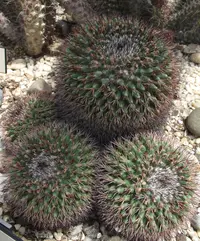
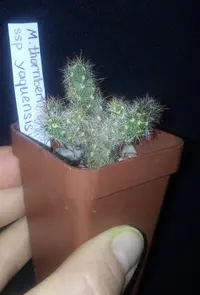
Mammillaria bocensis is a small globular cactus from arid regions of Mexico, often forming tight clusters of rounded stems. It belongs to the Mammillaria group, known for dense spines and small funnel-shaped flowers.
Plants typically stay compact, with white to yellowish spines that can give the surface a textured, almost woolly look. In good conditions, it produces small ringed blooms near the crown.
This species is adapted to bright, dry environments with strong light, rapid drainage, and minimal moisture. Its drought tolerance and slow growth make it suitable for patient growers learning how to care for Cactus.

Care Difficulty
Easy Care

Light Preference
Full Sun

Water Requirements
Low Water

Temperature Preference
Warm Climate

Hardiness Zone
9–11

Soil Texture
Sandy, Loamy, Rocky

Soil pH
Slightly acidic (6.5–7.0), Neutral (7.0)

Soil Drainage
Well-drained

Fertilization
Minimal (feed rarely)
Scan your plant to receive care tips personalized for your specific plant
Available on iOS and Android
Mammillaria bocensis prefers bright, direct sun typical of arid habitats, but benefits from some protection during peak heat.
Mammillaria bocensis needs sparse, controlled watering that mimics brief desert rains followed by dry periods.
This species prefers warm, dry conditions with a marked cool, dry rest period in winter.
This small desert cactus prefers dry air and rarely needs humidity adjustment indoors.
This species needs a very fast-draining, mineral-based substrate that dries quickly between waterings.
This compact cactus is well suited to container culture when drainage and pot choice are managed carefully.
Mammillaria bocensis grows well with light, controlled feeding during the warm growing season.
Pruning Mammillaria bocensis is minimal and mainly for health or appearance, not size control.
This small cactus prefers infrequent repotting in a fast-draining mineral substrate.
Mammillaria bocensis is commonly propagated from offsets, with seeds used for larger-scale growing.
Winter care focuses on keeping Mammillaria bocensis cool, dry, and frost-free.

Plant Health Check
Not sure what's wrong with your plant? Check your plant's health inside the app.
This species is naturally restricted to rocky limestone slopes in Baja California Sur, Mexico, where it grows in cracks and shallow pockets that provide excellent drainage and strong reflected light.
Its central spines are strongly hooked and darker than the radial spines, which helps trap small debris around the plant body and may slightly reduce herbivory by making the stems harder to bite.
Over time it forms dense clusters of many small stems, an adaptation that stabilizes the plant on steep, eroding slopes and creates a shared root system for accessing limited moisture in its habitat.
Flowering depends on maturity, bright light, cool and dry winter rest, and avoiding excess nitrogen fertilizer. If conditions are too warm, poorly lit, or watered regularly in winter, buds often fail to form or may drop prematurely.
Keep your plants happy and healthy with plant identification, disease detection, and easy care guidance.