


Pot depth choice
Use a wider, shallow pot rather than a deep one so the relatively shallow root system fills the container quickly and the plant remains stable as the cephalium forms and gains weight.

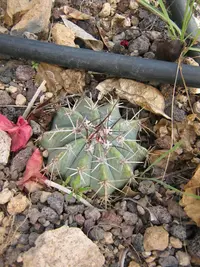
Turk's cap cactus, Melocactus azureus, is a slow-growing desert cactus known for its spherical blue-green body and dense rows of short spines. Mature plants develop a woolly, reddish cap structure, called a cephalium, where small pink to red flowers and later fruits appear.
This species is native to rocky, sun-exposed habitats in eastern Brazil, adapted to high light, heat, and very sharp drainage. Its sensitivity to overwatering and root disturbance makes it more demanding than many common cacti, so it suits growers who already know how to care for Turk's Cap Cactus.
It generally prefers bright light, low to moderate moisture, and a very free-draining, mineral-rich cactus mix.

Care Difficulty
Hard Care

Light Preference
Full Sun

Water Requirements
Low Water

Temperature Preference
Tropical / Frost Sensitive

Hardiness Zone
11–12

Soil Texture
Sandy, Rocky, Loamy

Soil pH
Slightly acidic (6.5–7.0), Neutral (7.0)

Soil Drainage
Well-drained

Fertilization
Minimal (feed rarely)
Scan your plant to receive care tips personalized for your specific plant
Available on iOS and Android
Melocactus azureus needs strong, consistent light to maintain its compact blue-gray body and healthy cephalium.
Watering for Melocactus azureus must be careful and sparse to protect its shallow roots and cephalium from rot.
This cactus prefers warm, stable conditions and is sensitive to both frost and prolonged cold.
This cactus prefers fairly dry air and rarely needs extra humidity control.
This species needs a very fast-draining, mineral-dominated substrate to prevent root and stem rot.
This cactus is well suited to container culture when the pot controls excess moisture and supports its top-heavy form.
Melocactus azureus benefits from light, controlled feeding, as its roots are sensitive to excess salts.
Melocactus azureus needs almost no structural pruning and should be trimmed only for health reasons.
This cactus dislikes frequent disturbance, so repot Melocactus azureus only when clearly necessary.
Propagation of Melocactus azureus is specialized and usually done from seeds rather than offsets.
Melocactus azureus is frost-sensitive and requires careful indoor winter conditions in most climates.

Plant Health Check
Not sure what's wrong with your plant? Check your plant's health inside the app.
The blue to bluish‑gray color of the stem comes from a waxy coating on the epidermis that reflects harsh sunlight and reduces water loss in its exposed rock outcrop habitat in eastern Brazil.
Compared with many other Melocactus species, this plant often develops its cephalium, a dense wool-and-spine flowering structure on top of the stem, when the body is still relatively small, marking the permanent switch from vegetative growth to mainly reproductive growth.
In nature it is strongly associated with white quartz gravel and rocky quartzite outcrops in Bahia, Brazil, where the highly reflective substrate and excellent drainage create a bright, dry microhabitat that favors this species over less specialized cacti.

Melocactus azureus is considered one of the most threatened species in its genus because its narrow range on quartz outcrops in Bahia, Brazil is heavily impacted by mining, habitat fragmentation, and illegal plant collection, and some wild populations have already disappeared.
Growth is slow. In good conditions, this species usually adds only a few millimeters of height and width per year and may take many years to form its characteristic cephalium, the woolly flowering cap.
Keep your plants happy and healthy with plant identification, disease detection, and easy care guidance.

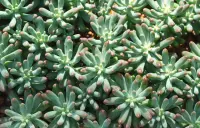
Jelly Beans
Sedum pachyphyllum
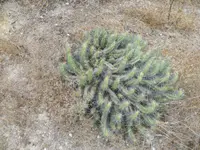
ladyfinger cactus
Echinocereus pentalophus
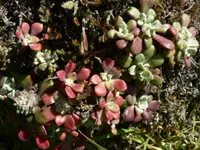
Broadleaf stonecrop
Sedum spathulifolium
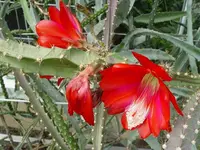
sun cactus
Disocactus speciosus
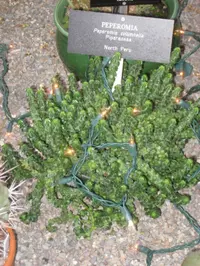
Columnar Peperomia
Peperomia columella
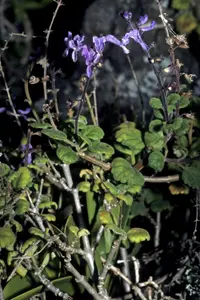
bonsai mint
Plectranthus ernstii

Cane Cactus
Austrocylindropuntia cylindrica
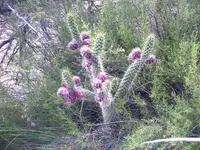
Austrocylindropuntia shaferi
Austrocylindropuntia shaferi