Seasonal Succession Sowing
Stagger sowing every 2–3 weeks in late winter and early spring so plants reach peak bloom at slightly different times, extending both flowering and seed production windows when growing Lindley's Silverpuffs.

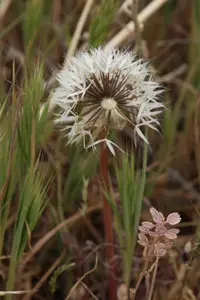
Lindley's silverpuffs (Microseris lindleyi) is a small annual wildflower from western North America, often found in open grasslands and disturbed sites. It belongs to the daisy family and forms low rosettes of narrow leaves with upright flowering stems.
The yellow, dandelion-like flower heads develop into distinctive puffball seed clusters, which give the plant its common name. This species usually has a short life cycle and reseeds itself where conditions suit it.
It prefers full sun, relatively dry conditions, and well-drained, often lean soils. These traits make it fairly easy to grow in suitable climates, and understanding how to care for Lindley's Silverpuffs mainly involves matching its natural, sunny, low-water habitat.

Care Difficulty
Easy Care

Light Preference
Full Sun

Water Requirements
Low Water

Temperature Preference
Warm Climate

Hardiness Zone
6–10

Soil Texture
Sandy, Loamy, Rocky

Soil pH
Slightly acidic (6.5–7.0), Neutral (7.0)

Soil Drainage
Well-drained

Fertilization
Minimal (feed rarely)
Scan your plant to receive care tips personalized for your specific plant
Available on iOS and Android
This annual wildflower prefers open, sunny sites similar to its native grassland habitat.
This species prefers dry to moderately dry soil and is sensitive to prolonged saturation.
This plant is adapted to mild, Mediterranean-type climates with cool, moist winters and dry, warm springs.
This annual wildflower handles a wide humidity range and rarely needs special adjustment in homes.
Microseris lindleyi prefers lean, fast-draining soil that mimics dry, open habitats.
This species can be grown in containers if the pot setup respects its deep, drought-adapted root system.
This annual wildflower usually grows well in lean soils and often needs no fertilizer when planted in the ground.
Pruning needs for Microseris lindleyi are minimal and focus on cleanliness rather than shaping.
This species is better treated as a direct-sown or lightly transplanted annual rather than a long-term container subject.
Propagation of Microseris lindleyi is usually done from seed, following its natural annual life cycle.
Microseris lindleyi behaves as a cool-season annual and usually needs little targeted winter care in mild climates.

Plant Health Check
Not sure what's wrong with your plant? Check your plant's health inside the app.
This species is a winter–spring annual native mainly to California, germinating with cool-season rains and completing its life cycle before the dry summer, which allows it to avoid prolonged drought stress in Mediterranean-type climates.
Its fruits carry a parachute-like pappus of bristles that increases wind dispersal, helping seeds travel away from the parent plant and colonize open, disturbed ground such as grasslands and roadside banks.
In coastal and inland grasslands, its bright yellow flower heads are part of the native spring bloom that supports early-season pollinators, including small bees and flies that forage before many later-blooming species appear.
The young leaves and roots are traditionally considered edible when correctly identified and harvested from clean sites, though flavor is mild and sometimes bitter. Avoid roadside or contaminated areas, and do not eat if identification is uncertain.
Keep your plants happy and healthy with plant identification, disease detection, and easy care guidance.