Necklace Pearlfig Care (Monilaria moniliformis)

Also known as: Pea Pearlfig, Peafig
Necklace Pearlfig

About Necklace Pearlfig

Necklace pearlfig, Monilaria moniliformis, is a small succulent from arid regions of South Africa, adapted to strong light and poor, fast-draining soils. It forms bead-like, segmented stems with paired green “ears” that emerge in the growing season and die back in dormancy. This compact, slow-growing habit makes it a popular collector’s plant and a good choice for bright windowsills or small indoor succulent arrangements. It is somewhat sensitive to overwatering and prolonged low light, so beginners need to observe it closely to learn how to care for Necklace Pearlfig.

Main Plant Requirements

Care Difficulty

Hard Care

Light Preference

Full Sun

Water Requirements

Low Water

Temperature Preference

Tropical / Frost Sensitive

Hardiness Zone

10–11

Soil Texture

Sandy, Rocky, Loamy

Soil pH

Slightly acidic (6.5–7.0), Neutral (7.0)

Soil Drainage

Well-drained

Fertilization

Minimal (feed rarely)

Get Personalized Care Plan

Scan your plant to receive care tips personalized for your specific plant

Available on iOS and Android

How to Care for the Necklace Pearlfig

This small winter-growing succulent needs bright, cool light to stay compact and healthy.

  • Provide 4–6 hours of direct morning sun with bright indirect light the rest of the day; east or southeast exposure suits Necklace Pearlfig well.
  • In very hot, dry climates, protect from harsh midday and afternoon sun with light shade cloth or dappled shade to prevent leaf scorching.
  • During summer dormancy, keep the plant in bright shade or filtered light; in winter growth season, increase sun exposure without allowing the pot to overheat.

Watering must respect its winter-growing, summer-dormant cycle to avoid root loss.

  • During active growth, water only when the top 3–5 cm of soil are completely dry and water drains out quickly from the mix.
  • Use a very fast-draining, gritty soil; prolonged moisture around the roots of Monilaria moniliformis leads to mushy, translucent leaves and stem rot.
  • In hot, dry summer dormancy, cut back to very light sips or none at all, watching for slight wrinkling as a cue to give a small drink.

This species prefers cool to mild conditions, especially during its winter growth period.

  • Aim for 50–65°F (10–18°C) in the main growing season; short spikes up to 75°F (24°C) are usually tolerated if the root zone stays cool.
  • Protect from frost; brief dips to 32°F (0°C) may be survived if dry, but growth is safer above 40°F (4°C).
  • In summer dormancy, it tolerates 80–90°F (27–32°C) if shaded and dry, but sustained heat above 90°F (32°C) increases stress and rot risk.

Humidity is rarely limiting for this desert-dwelling succulent when grown indoors or in containers.

  • Aim for 30–50% relative humidity, which matches the dry conditions of its native habitat.
  • Tolerates very dry air; problems arise more from excess moisture around leaves and soil than from low humidity.
  • If humidity is high, increase airflow with a fan and avoid crowding to prevent soft, swollen foliage and fungal spotting.

This species needs a very fast-draining, mineral-rich substrate that dries quickly after watering.

  • Use a gritty mix such as 50–70% pumice, perlite, or coarse sand with 30–50% cactus mix for Monilaria moniliformis.
  • Keep texture loose and open so water runs through in seconds and roots receive continuous air contact.
  • Target slightly acidic to neutral pH around 6.0–7.0, avoiding heavy lime or strongly acidic peat-based mixes.
  • Avoid dense, water-holding substrates like straight potting soil or compost that keep roots wet and encourage rot.

This succulent is well suited to container culture when drainage and root environment are tightly controlled.

  • Choose a wide, shallow pot to match the plant’s fibrous, surface-leaning root system and prevent deep zones of wet soil.
  • Unglazed terracotta helps moisture evaporate faster, useful for reducing rot risk in cool or humid climates.
  • Raise the pot slightly on feet or grit so drainage holes stay clear and excess water leaves the container immediately.

This small succulent requires only light feeding to maintain healthy growth in containers.

  • Use a low-dose, balanced liquid fertilizer (around 10-10-10) diluted to 25–50% strength for Necklace Pearlfig in active growth.
  • Feed once every 4–6 weeks during the cool growing season, typically fall to early spring.
  • Avoid organic compost or rich slow-release products that hold moisture, which can encourage rot.
  • Stop feeding entirely during summer dormancy and any period of leaf dieback.

Pruning needs are minimal and focus on keeping Monilaria moniliformis compact and healthy.

  • Best time for any trimming is late dormant season, just before new growth starts.
  • Use clean, sharp scissors or small pruning snips to avoid tearing the soft tissue.
  • Remove only dead, shriveled, or clearly damaged stems, leaving firm, green segments intact.
  • Light shaping cuts can shorten overly elongated stems, encouraging a denser, more balanced clump.

This species prefers being slightly pot-bound and only occasional repotting is needed.

  • Check for roots circling the drainage holes, very slow growth, or soil that dries almost too quickly as signs to repot.
  • Repot every 2–3 years in late summer to early fall, just before the main growth phase resumes.
  • Choose a small, shallow pot with excellent drainage and a gritty succulent mix to limit excess moisture.
  • Handle the tuberous roots gently, disturb them as little as possible, and withhold watering for a few days after repotting to reduce stress.

Monilaria moniliformis is most reliably propagated from seed under controlled conditions.

  • Sow fresh seeds in late summer to early fall in a shallow tray filled with fine, gritty succulent mix.
  • Press seeds onto the surface, barely cover with sand, and keep evenly lightly moist, never waterlogged.
  • Maintain bright, indirect light and cool temperatures around 55–65°F for consistent germination.
  • Stem cuttings rarely form stable tubers, so they are less dependable than seed-grown plants for long-term Monilaria moniliformis plant care.

This cool-season grower prefers mild winters and is not frost-hardy in most climates.

  • Keep plants above 40°F; brief, light frosts may damage leaves and stems.
  • Move containers indoors to a bright, cool windowsill or an unheated but frost-free room in cold regions.
  • Ensure soil stays barely moist, never wet, as cold combined with excess water increases rot risk.
  • Avoid drafts from very cold windows or doors to prevent sudden temperature shocks to the succulent tissue.

Care Tips

Seasonal Rest Control

During summer dormancy, move the pot to a bright, shaded, dry spot and keep the mix completely dry so the bulbs can rest and store energy for the next growth cycle.

Cool-Night Boost

If possible, place the plant in a spot with cooler nights (45–55°F) in winter, such as a bright porch or slightly open window, to encourage compact growth and stronger leaf pairs.

Targeted Topdressing

Instead of repotting often, refresh the upper 1–2 cm of the mix with fresh mineral substrate before the active season to improve drainage and air around the necks of the bulbs.

GentleCluster Support

In older clumps, use a low ring stake or small stones around the base to prevent the tall, paired leaves from toppling and snapping at the narrow joints.

Dormant Pest Check

During the dry dormant period, inspect the leafless bulbs and soil surface for mealybugs or fungus gnat larvae and treat early, since pests are easier to spot when the plant is not in active leaf, which simplifies caring for Necklace Pearlfig.

Common Pests and Diseases

Mealybugs

This pest feeds on the succulent stems and leaf pairs, sucking sap and causing yellowing, stunting, and distorted new growth. Symptoms include white cottony clusters in stem joints and around the base of the plant.

Solution

Isolate the plant, then remove visible insects with a cotton swab dipped in 70% isopropyl alcohol and gently wipe affected areas. Improve air movement, avoid excess nitrogen fertilization, and repeat spot treatments weekly until no new clusters appear; for heavier infestations, use a light application of insecticidal soap, keeping it off the roots and allowing the plant to dry quickly.

Aphids

These insects attack tender new growth on Monilaria moniliformis, sucking sap and excreting sticky honeydew that can lead to sooty mold. Young leaves and stem tips may curl, distort, or stop elongating.

Solution

Rinse the plant gently with a fine stream of lukewarm water to dislodge aphids without damaging the fragile bead-like stems. Follow with a treatment of diluted insecticidal soap or neem oil on the upper and lower surfaces of the foliage during the active growing season, and repeat every 5–7 days until the population has been suppressed.

Spider mites

This pest thrives in warm, dry indoor air and can damage the fine, rabbit-ear-like growth, causing a dull, stippled appearance and eventual leaf drop. Symptoms include fine webbing between the new growth segments and slow decline of vigor.

Solution

Increase local humidity slightly around the plant without wetting the soil surface, then gently rinse the foliage to remove mites and webbing. Apply a light coating of insecticidal soap or horticultural oil to all green parts, repeating every 5–7 days, and avoid placing the plant in hot, stagnant air to support long-term Monilaria moniliformis plant care.

Fungal stem rot

This disease develops when the plant is kept in cool, damp conditions or watered out of season, leading to soft, translucent, or brown segments that collapse from the base upward. Symptoms include a mushy texture at the junction of the bead-like segments and a foul odor in advanced cases.

Solution

Immediately stop watering, remove and discard all soft or discolored tissue, and let healthy segments dry in a bright, airy place. Repot into a sterile, fast-draining mineral succulent mix, water only during the active growth period, and ensure the pot has strong drainage and is not left standing in a saucer of water.

Interesting Facts

Bead-like stem joints

The plant forms swollen, bead-like stem segments that store water, an adaptation to its arid Namaqualand habitat in South Africa.

Bunny ear leaves

New leaf pairs emerge as two upright, cylindrical blades that resemble rabbit ears, a growth pattern that has made the plant highly recognizable in cultivation.

Winter-growing lifestyle

This species is a winter-growing succulent that actively produces leaves during the cool, moist season and often enters summer dormancy, when the previous leaves dry into a protective sheath.

Botan icon

Did you know?

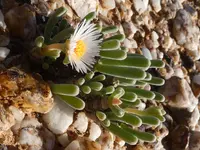
The species produces relatively large, daisy-like flowers compared to its small body size, a common trait in the ice plant family (Aizoaceae) that helps attract pollinators in its open, sparsely vegetated native habitat.

FAQs about Necklace Pearlfig

This species usually flowers in late winter to early spring after a cool, bright rest period. Lack of blooms often comes from too-warm winter conditions, insufficient light, or regular watering during dormancy, which disrupts its seasonal cycle.

Grow Healthy Plants with Botan Care

Keep your plants happy and healthy with plant identification, disease detection, and easy care guidance.

Botan plant care app — identify plants on mobile

Explore More Plants