Fruit load thinning
Remove some young fruits on heavily loaded branches soon after they set so that remaining berries size up better and branches are not stressed or broken by excess weight.

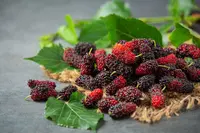
Black mulberry, Morus nigra, is a long-lived fruiting tree known for its dark, sweet berries and dense, rounded canopy. It is usually grown outdoors as a small to medium tree or large shrub with attractive, often heart-shaped leaves.
This species comes from southwestern Asia and the eastern Mediterranean but is now widely cultivated in mild to warm temperate regions. It is generally robust and forgiving once established, provided it receives full sun, reasonable moisture, and well-drained soil.
Its main challenges are its slow early growth and a strong root system that needs space, but healthy plants are long-lasting and productive. Gardeners often find that learning how to care for black mulberry is straightforward when its need for sun and space is respected.

Care Difficulty
Moderate Care

Light Preference
Full Sun

Water Requirements
Moderate Water

Temperature Preference
Cool Climate

Hardiness Zone
5–9

Soil Texture
Loamy, Sandy, Clay

Soil pH
Acidic (5.5–6.5), Slightly acidic (6.5–7.0)

Soil Drainage
Well-drained

Fertilization
Minimal (feed rarely)
Scan your plant to receive care tips personalized for your specific plant
Available on iOS and Android
Morus nigra needs abundant direct light for strong growth and fruiting.
Morus nigra prefers consistently moist but not saturated soil once established outdoors.
This mulberry is hardy but fruits best within a moderate temperature range.
Morus nigra handles a wide humidity range and usually does not need special humidity management outdoors.
Morus nigra prefers deep, well-structured loam that drains freely yet retains moderate moisture.
This species can be grown in large containers if root space and stability are carefully managed.
Morus nigra benefits from moderate feeding in containers and nutrient-poor soils, but established trees in fertile ground need little extra input.
Morus nigra responds well to thoughtful structural pruning that maintains size, light penetration, and fruiting wood.
This species is more often field-grown than container-grown, so focus on careful transplanting of young Morus nigra trees.
Morus nigra is commonly propagated from cuttings and layering, since seed-grown plants vary and take longer to fruit.
Morus nigra is fairly cold hardy once established, but young or potted plants benefit from some winter protection.

Plant Health Check
Not sure what's wrong with your plant? Check your plant's health inside the app.
Genetic and historical evidence indicates that this species originated in the region of present-day Iran and surrounding areas, and it has been cultivated there for many centuries for its richly flavored fruit.
Unlike many fruit trees, this species produces berries that ripen over several weeks on the same tree, so fully ripe, soft, almost black fruits often hang next to red or green immature ones.
Compared to many other mulberry species, it typically has short internodes (the stem sections between leaves), which contributes to its naturally dense, compact branching habit, especially noticeable on older trees.

This species is considered one of the longest-lived fruit trees; well-documented specimens in Europe are estimated, based on historical records and trunk structure, to be over 400 years old and can remain productive at advanced ages.
Yellowing leaves usually result from water stress, root problems, or nutrient imbalance, especially lack of nitrogen or iron. Check drainage, avoid waterlogging, adjust watering frequency, and consider a soil test before applying a balanced, slow-release fertilizer.
Keep your plants happy and healthy with plant identification, disease detection, and easy care guidance.