Burny bean Care (Mucuna gigantea)

Also known as: seabean
Burny bean

About Burny bean

Burny bean, Mucuna gigantea, is a vigorous tropical vine known for its long woody stems and large, glossy green leaves. It can climb high into trees or over strong supports, forming a dense curtain of foliage.

In suitable climates it produces striking hanging flower clusters followed by large pods covered in irritating hairs. It is native to coastal forests and thickets in parts of Asia and the Pacific, where it scrambles through warm, humid habitats.

This species grows fast and can become heavy, so it needs sturdy support and space. It suits experienced growers who can manage its size; understanding how to care for Burny bean helps keep it controlled and healthy.

Main Plant Requirements

Care Difficulty

Hard Care

Light Preference

Partial Sun

Water Requirements

Regular Water

Temperature Preference

Tropical / Frost Sensitive

Hardiness Zone

10–12

Soil Texture

Sandy, Loamy, Organic-rich

Soil pH

Acidic (5.5–6.5), Slightly acidic (6.5–7.0)

Soil Drainage

Moist but well-drained

Fertilization

Light (every 4–6 weeks)

Get Personalized Care Plan

Scan your plant to receive care tips personalized for your specific plant

Available on iOS and Android

How to Care for the Burny bean

This vigorous tropical climber prefers bright, warm conditions with filtered sun for strongest growth.

  • Provide 4–6 hours of direct morning sun with light afternoon shade; a high, bright canopy or trellis edge suits Burny bean well.
  • Tolerates partial shade, but dense shade leads to weak, stretched vines and fewer flowers; aim for dappled light under taller trees.
  • In hot summers, protect from harsh afternoon sun to prevent leaf scorch; in cooler months, slightly more direct sun supports flowering.

This robust vine prefers consistently moist but not waterlogged soil, especially during active growth.

  • Water when the top 3–5 cm of soil feels dry, then soak deeply so moisture reaches the root zone, especially for in-ground plants.
  • Use well-drained soil or a sloped site so excess water runs off; persistent puddling, yellowing leaves, and soft stems indicate overwatering.
  • In warm growing seasons increase frequency as evaporation rises; in cooler or dormant periods reduce watering, watching for wilting or crispy leaf edges as signs of underwatering in Mucuna gigantea.

This tropical liana thrives in warm, frost-free climates with stable temperatures.

  • Optimal growth occurs around 70–85°F (21–29°C), with strong vining and flowering in consistently warm, humid conditions.
  • Avoid temperatures below 50°F (10°C); brief dips to 45°F (7°C) may be tolerated but repeated chills slow growth and can damage foliage.
  • The plant handles short heat spikes up to about 95°F (35°C) if soil moisture is adequate, but any frost can kill young shoots and severely injure mature wood.

This vigorous tropical climber prefers moderately high humidity to maintain healthy foliage and flowering.

  • Aim for 50–70% humidity; it tolerates brief dips but prolonged very dry air slows growth and causes leaf edge browning.
  • In arid homes, especially when caring for Burny bean, group plants on a pebble tray or use a small room humidifier near the vine.
  • Watch for curled leaves, crisp tips, and stalled new shoots as signs of humidity stress and increase local moisture around the plant.

This species grows best in deep, loose, well-drained soil that still retains some moisture and organic matter.

  • Use a loamy mix of roughly 40% compost, 40% coarse materials (perlite, pumice, or pine bark), and 20% sand to balance moisture and drainage.
  • Keep pH slightly acidic to neutral, around 6.0–7.0, to support nutrient availability and healthy root development in Mucuna gigantea.
  • Improve aeration by incorporating chunky bark or coarse perlite, avoiding dense peat-heavy or clayey mixes that compact around the roots.
  • Avoid waterlogged or poorly drained sites, as persistent saturation encourages root rot and weak, elongated growth.

This large climbing vine can be grown in containers when given ample root space and strong structural support.

  • Choose a very large, deep, heavy container to prevent tipping as the vine gains height and mass.
  • Position a sturdy trellis or other fixed support anchored directly in the container to manage the vigorous climbing habit.
  • Select thicker-walled clay or concrete pots if outdoor, as these add stability and moderate moisture swings in hot conditions.

Mucuna gigantea is a vigorous climber that responds well to moderate feeding during the active growing season.

  • Use a balanced liquid fertilizer (around 10-10-10) at 1/2 strength every 4–6 weeks in spring and summer on container plants.
  • Apply a light layer of well-rotted compost or organic slow-release fertilizer around in-ground vines once each spring.
  • Avoid overfeeding; excess nitrogen can cause lush foliage with fewer flowers on the Burny bean.
  • Stop or greatly reduce fertilization in fall and winter when growth slows or temperatures drop below 60°F.

Pruning Mucuna gigantea helps manage its size and encourages better flowering on accessible growth.

  • Plan main pruning for late winter or very early spring before vigorous new shoots appear.
  • Remove dead, damaged, or crossing stems first, then thin congested vines to improve light and air flow.
  • Shorten overly long runners to keep the vine on its support and prevent it from smothering nearby plants.
  • Use clean, sharp bypass pruners and make cuts just above a healthy bud or side shoot to direct growth.

This large, fast-growing liana is better suited to in-ground planting, so focus on careful transplanting rather than frequent repotting.

  • Transplant young plants in late spring after frost risk, when soil is warm and stable.
  • Look for roots circling the pot, water draining too quickly, or slowed growth as cues to shift into the ground or a larger container.
  • Move to a hole or pot only 1–2 sizes larger, keeping the root ball intact and at the same depth as before.
  • Water thoroughly after transplanting, then shade lightly for 3–5 days to limit transplant shock and support root recovery.

Mucuna gigantea is most often propagated from seeds, which need help to break their hard coat and start germination.

  • Collect mature seeds and scarify them by lightly nicking or sanding the coat, or briefly pouring hot (not boiling) water over them.
  • Sow in late spring in a warm medium kept at 70–80°F with consistent, light moisture.
  • Place seeds 1–2 cm deep in a free-draining mix and provide bright, indirect light until seedlings establish.
  • Stem cuttings are possible in warm climates; use semi-ripe wood, rooting hormone, and high humidity to encourage rooting.

In warm climates this vine stays evergreen, but in cooler areas Mucuna gigantea needs protection from frost and prolonged cold.

  • It is frost-sensitive; growth is damaged below about 32°F and whole plants may die in hard freezes.
  • Apply 5–8 cm of organic mulch around the root zone in fall to buffer soil temperature and moisture.
  • For container plants in marginal climates, move pots indoors or into a heated greenhouse before the first frost.
  • Where in-ground plants face occasional light frost, cover the base and lower stems with breathable fabric on the coldest nights.

Care Tips

Robust trellis support

Install a heavy-duty trellis, pergola, or wire system before planting, as this vigorous liana quickly develops thick, woody stems that need strong, permanent anchoring points.

Encourage flowering wood

Allow mature stems to remain for several seasons and avoid cutting everything back hard each year, since flowers are typically produced on older, well-ripened wood.

Guide early vines

During the first 1–2 years, hand-wrap young shoots around the support weekly so the plant develops an organized framework that can carry the substantial weight of older growth and flower clusters.

Protect from wind rock

In exposed sites, secure main stems to multiple attachment points along the support to prevent wind rock, which can loosen roots and cause stress or breakage at the base.

Cold-season safeguarding

In marginal climates, mulch the root zone with a 5–10 cm layer of coarse organic material and tie in long vines to reduce wind damage, an important step when growing Burny bean near the edge of its hardiness range.

Common Pests and Diseases

Bean pod borer

This pest tunnels into flower buds and young pods, causing premature bud drop and deformed, aborted pods. Symptoms include small entry holes, frass (sawdust-like droppings), and poor pod set.

Solution

Remove and destroy infested pods and buds as soon as damage is noticed, and collect any affected material from the ground to break the life cycle. Use light traps or pheromone traps where available, and apply a targeted biological product containing Bacillus thuringiensis (Bt) to young flower clusters and pods in the evening, repeating as label directions indicate.

Leaf beetles

These insects chew holes or scalloped edges in leaves, sometimes skeletonizing foliage during peak feeding periods. Symptoms include irregular leaf notching and reduced leaf area, especially on young vines and new growth.

Solution

Hand-pick beetles in early morning and drop them into soapy water, and prune heavily damaged leaves if infestation is localized. Encourage natural predators by avoiding broad-spectrum insecticides, and if needed use a neem oil or spinosad-based spray focused on the undersides of leaves, repeating after rain and following label directions closely.

Pod anthracnose

This disease causes dark, sunken spots on pods and sometimes streaks on stems, which can lead to pod twisting, cracking, and seed loss. Symptoms include water-soaked lesions that darken with distinct margins, often starting on injured tissue.

Solution

Remove and discard infected pods and nearby stems, and avoid overhead watering so pods dry quickly after rain or irrigation. Improve air circulation by spacing and pruning vines, and in outdoor or production settings rotate away from legume crops and consider using a copper-based fungicide at early flowering if conditions stay humid.

Powdery mildew

This disease appears as white, powdery patches on upper leaf surfaces, which can spread to stems and flower stalks, causing yellowing and leaf drop. Symptoms include reduced vigor and poor flowering when coverage is heavy.

Solution

Increase sunlight and airflow around the vine by thinning dense stems and training it on a sturdy support, and avoid excessive nitrogen that drives soft, mildew-prone growth. Remove the worst-affected leaves and apply a sulfur, potassium bicarbonate, or neem-based fungicide according to label directions at the first sign of infection, repeating during warm, dry periods that favor powdery mildew.

Interesting Facts

Large maritime liana

This species is a vigorous woody vine that naturally occurs in coastal forests and beach scrub across the Indo-Pacific, often climbing high into trees and tolerating salty sea breezes better than many legumes.

Bat-pollinated flowers

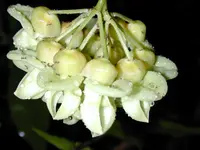
Its hanging clusters of pale green to cream flowers are primarily pollinated by bats, which visit at night and transfer pollen as they feed on nectar.

Buoyant sea-dispersed seeds

The large, hard seeds have waterproof, buoyant coats and are dispersed by ocean currents, which is why the species can occur on distant islands separated by long stretches of sea.

Botan icon

Did you know?

The seeds of Mucuna gigantea are classic drift seeds collected by beachcombers, and archaeological evidence shows that such seaworn seeds were carried and traded by Pacific island cultures long before modern botany described the species.

FAQs about Burny bean

This species is a vigorous woody vine that climbs by twining stems around supports. It does not naturally cling with tendrils or aerial roots, so it needs trellises, fences, or strong wires to guide and support its growth.

Grow Healthy Plants with Botan Care

Keep your plants happy and healthy with plant identification, disease detection, and easy care guidance.

Botan plant care app — identify plants on mobile

Explore More Plants