Use decomposing twigs
Place a thin layer of well-decayed hardwood twigs or bark over the substrate to provide natural micro-habitats where the fungus can fruit along cracks and edges.

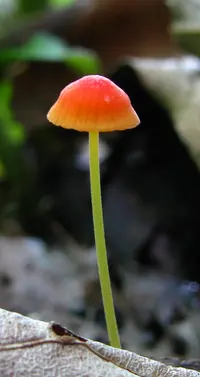
Orange bonnet (Mycena acicula) is a tiny woodland mushroom known for its bright orange, bell-shaped caps held on very slender, fragile stems. It is a saprotrophic fungus, meaning it feeds on decaying plant material and helps recycle nutrients in forest ecosystems.
This species typically appears on moist leaf litter, moss, or rotting twigs in temperate forests, often in shaded, humid microclimates. It is delicate and short-lived, which makes stable humidity and gentle air movement important if someone wants to care for orange bonnet in a controlled setup.
Because it depends on consistently damp, cool, and clean organic substrates, Mycena acicula is not as easy to maintain as common houseplants and suits more experienced fungus growers.

Care Difficulty
Hard Care

Light Preference
Shade

Water Requirements
Keep Soil Moist

Temperature Preference
Cool Climate

Hardiness Zone
Unknown

Soil Texture
Loamy, Silty, Organic-rich

Soil pH
Acidic (5.5–6.5)

Soil Drainage
Moist but well-drained

Fertilization
Minimal (feed rarely)
Scan your plant to receive care tips personalized for your specific plant
Available on iOS and Android
Mycena acicula thrives in cool, shaded woodland conditions with soft, indirect light.
Mycena acicula prefers consistently moist, never saturated, substrates rich in decaying wood or leaf litter.
This small woodland fungus favors cool to mild temperatures and suffers in extremes.
This fungus needs consistently moist, humid air to fruit well in cultivation.
Substrate for this saprophytic fungus must be loose, fine-textured, and rich in decomposing plant matter.
This species can be grown in shallow containers that simulate a stable, damp forest-floor microhabitat.
Mycena acicula, the orange bonnet, grows on nutrient-rich wood or leaf litter and generally needs no added fertilizer in cultivation.
Mycena acicula requires almost no structural pruning, only light hygiene work around its substrate.
This small wood-inhabiting fungus is not traditionally repotted; instead, its colonized substrate is refreshed or moved as needed.
Reproducing Mycena acicula relies on spore production and controlled spread of its mycelium rather than classic plant-style propagation.
This woodland fungus is cold tolerant and normally needs no special winter care outdoors in temperate climates.

Plant Health Check
Not sure what's wrong with your plant? Check your plant's health inside the app.
This species produces tiny orange caps typically only 2–7 mm wide on very slender stems, making entire fruiting bodies smaller than many common moss capsules that grow alongside them.
It most often fruits on decaying twigs, leaf litter, and especially among mosses in damp woodlands, playing a role in breaking down fine plant debris that larger decomposers often miss.
Under a microscope, its spores are smooth, elongated, and amyloid, meaning they turn blue-black in Melzer’s reagent, a reaction used by mycologists to reliably distinguish this species from similar tiny orange Mycena.

The bright orange pigment of its caps is so translucent that in strong backlighting the gills and cap surface can appear to glow, which makes it a favored subject for macrophotographers documenting small woodland fungi.
This tiny fungus develops quickly from pinhead to mature fruiting body, often within a few days under cool, moist conditions. Caps typically reach only 0.2–0.6 cm across on very slender stems, so it always stays miniature.
Keep your plants happy and healthy with plant identification, disease detection, and easy care guidance.