

Use local substrates
Prepare trays with locally collected, decaying hardwood leaf litter and well-rotted twigs from clean, pesticide-free woodland to provide the specific fungal food sources this species requires.

Mycena citrinomarginata is a small saprotrophic mushroom, not a typical houseplant, that lives on decaying plant material in forests, grasslands, and mossy areas. It is recognized by its delicate conical cap, often with yellowish margins, and slender stem that appears in clusters or scattered groups.
This species occurs widely in temperate regions, including parts of Europe and North America, usually emerging in damp, cool seasons. It is short-lived and strongly tied to moist, shaded, organic-rich substrates, which makes it challenging to cultivate deliberately.
For anyone exploring how to care for Mycena citrinomarginata, it is important to remember it behaves like a woodland fungus, relying on consistent humidity, shade, and decomposing plant matter rather than typical potting soil.

Care Difficulty
Hard Care

Light Preference
Shade

Water Requirements
Keep Soil Moist

Temperature Preference
Cool Climate

Hardiness Zone
Unknown

Soil Texture
Organic-rich, Peaty, Loamy

Soil pH
Strongly acidic (4.5–5.5), Acidic (5.5–6.5)

Soil Drainage
Moist but well-drained

Fertilization
Minimal (feed rarely)
Scan your plant to receive care tips personalized for your specific plant
Available on iOS and Android
This small woodland mushroom prefers low, filtered light similar to a shaded forest floor.
This fungus depends on consistently moist, not waterlogged, substrates to complete its life cycle.
This species fruits best in cool to mild temperatures typical of shaded woodland floors.
This woodland fungus requires consistently high humidity to fruit well in cultivation.
This species grows on very decayed plant matter, so the substrate must be loose, moist, and highly organic.
This fungus can be grown in containers, but the setup must maintain moisture while allowing gas exchange.
This woodland fungus naturally feeds from decaying organic matter and usually does not need added fertilizer in cultivation.
Pruning is generally unnecessary for Mycena citrinomarginata, as each fruiting body is short-lived and replaced naturally.
When cultured, this species is typically grown on sterile substrate rather than in standard pots, so focus on renewing substrate instead of classic repotting.
Propagation of this fungus is specialized and usually done only by experienced growers in controlled conditions.
Outdoor populations are cold hardy in their native range and generally need no deliberate winter care from gardeners.

Plant Health Check
Not sure what's wrong with your plant? Check your plant's health inside the app.
The species is named for its distinctly bright yellow gill edges, which sharply contrast with the otherwise grayish to brownish cap and are a reliable field character for identification in mixed Mycena populations.
It is strongly associated with mossy lawns, pastures, and grassy areas, often fruiting among short moss cushions rather than directly on wood or leaf litter, which helps separate it from many other Mycena species.
Although widely distributed across temperate regions of Europe and recorded in parts of North America, it is often overlooked due to its very small size and delicate fruiting bodies, which blend into grass and moss layers.
This species is considered inedible due to its very small size and insubstantial flesh, and it is not collected for food. Identification within the genus is difficult, so it should not be eaten or used culinarily.
Keep your plants happy and healthy with plant identification, disease detection, and easy care guidance.

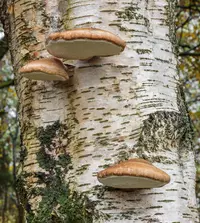
birch polypore
Fomitopsis betulina
Tiered tooth fungus
Hericium cirrhatum
landslide mushroom
Psilocybe caerulescens
stalked puffball-in-aspic
Calostoma cinnabarinum
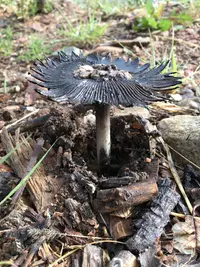
Star-capped Coprinus
Coprinus calyptratus
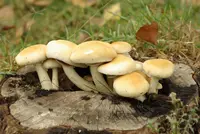
Poplar Fieldcap
Cyclocybe cylindracea
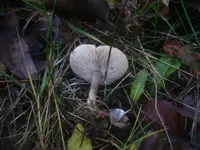
Common Cavalier
Melanoleuca polioleuca
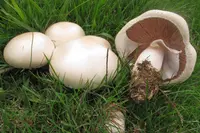
Horse Mushroom
Agaricus arvensis