Substrate layering
Create a 3–5 cm top layer of well-soaked, partially decomposed hardwood leaf litter over your main substrate to mimic forest floor microhabitats and extend fruiting duration.

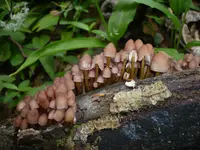
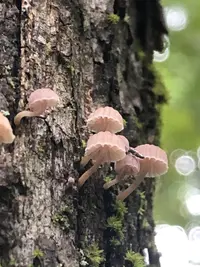
The beautiful bonnet (Mycena renati) is a small saprophytic mushroom that breaks down decaying wood in moist, shaded forests. It forms dense clusters of delicate, bell-shaped caps on rotting logs and stumps.
Caps are usually pale to pinkish with slender, fragile stems, giving the group a soft, luminous look on the forest floor. It occurs naturally across parts of Europe and some temperate regions, favoring cool, humid woodland habitats.
This species is not suited to typical home cultivation, as it depends on specific wood substrates and stable moisture outdoors. Anyone wanting to learn how to care for beautiful bonnet should understand that it behaves more like a wild forest decomposer than a garden plant.

Care Difficulty
Hard Care

Light Preference
Shade

Water Requirements
Keep Soil Moist

Temperature Preference
Cool Climate

Hardiness Zone
Unknown

Soil Texture
Loamy, Silty, Organic-rich

Soil pH
Acidic (5.5–6.5), Slightly acidic (6.5–7.0)

Soil Drainage
Moist but well-drained

Fertilization
Minimal (feed rarely)
Scan your plant to receive care tips personalized for your specific plant
Available on iOS and Android
Mycena renati, commonly called beautiful bonnet, is a shade-loving woodland fungus that avoids direct sun.
This woodland fungus depends on consistently moist, not waterlogged, substrates rather than direct watering.
This species fruits best in cool, moist conditions typical of temperate forests.
This wood-inhabiting mushroom requires very high humidity to fruit reliably.
This fungus grows on very decayed hardwood rather than in mineral soil, so the “substrate” must mimic rotting wood.
This species can be grown in containers only as a niche mushroom culture, not as a typical potted plant.
Mycena renati, often called beautiful bonnet, is a woodland fungus that does not need added fertilizer when grown on suitable decaying wood or leaf litter.
Pruning is not part of normal care for Mycena renati, since it is a small, short-lived woodland mushroom that completes its life cycle quickly.
Transplanting Mycena renati focuses on moving its colonized substrate rather than handling the delicate fruiting bodies.
Propagation of Mycena renati is specialized and usually left to experienced growers familiar with mushroom culture.
Specific winter care is generally unnecessary, as this woodland mushroom persists as mycelium in decaying wood or litter and not as visible fruiting bodies.

Plant Health Check
Not sure what's wrong with your plant? Check your plant's health inside the app.
This species typically fruits in dense, overlapping clusters on decaying hardwood, so many small caps can appear stacked and tiered along a single log or stump.
The caps range from pale pinkish or lilac tones when fresh to more beige or buff as they age, with a distinctly paler margin that helps separate it from closely related Mycena species.
Its caps are hygrophanous, meaning they change appearance depending on moisture; they look darker and more translucent when wet and become paler and more opaque as they dry.

Mycena renati is considered an indicator of relatively undisturbed, mature broadleaf woodland in parts of Europe, so its presence can help mycologists and ecologists assess local forest continuity and habitat quality.
This fungus grows rapidly once conditions are right. From a colonized substrate, small caps can appear within days after rain, then mature within 2–5 days before collapsing, so flushes are short-lived but can recur.
Keep your plants happy and healthy with plant identification, disease detection, and easy care guidance.