Wind-hardening young plants
Grow young plants in a slightly exposed but sheltered spot or use a fan for 1–2 hours daily for a few weeks so stems thicken and better tolerate natural wind on exposed sites.

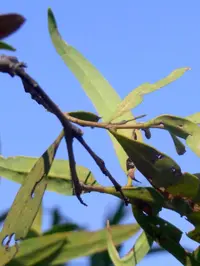
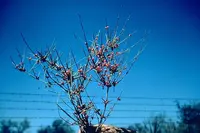
Small-fruited mock olive (Notelaea microcarpa) is an evergreen shrub or small tree in the olive family, native to dry woodlands and rocky slopes of eastern Australia. It typically has dense, narrow leaves and small, dark fruits that follow inconspicuous, pale flowers.
This species is slow to moderate in growth and can be pruned to form hedges, screens, or a compact garden specimen. It tolerates poor, stony soils and seasonal dryness once established, which makes it relatively low-maintenance in suitable climates.
It prefers sun to light shade and benefits from well-drained soil, which helps simplify how to care for small-fruited mock olive in home landscapes.

Care Difficulty
Moderate Care

Light Preference
Partial Sun

Water Requirements
Moderate Water

Temperature Preference
Warm Climate

Hardiness Zone
9–11

Soil Texture
Sandy, Loamy, Rocky

Soil pH
Slightly acidic (6.5–7.0), Neutral (7.0)

Soil Drainage
Well-drained

Fertilization
Minimal (feed rarely)
Scan your plant to receive care tips personalized for your specific plant
Available on iOS and Android
This Australian native shrub prefers bright outdoor positions with moderate sun exposure.
This drought-tolerant shrub prefers deep but infrequent watering once established.
This shrub thrives in mild to warm temperate climates with moderate seasonal variation.
Humidity is rarely a limiting factor for this shrub in typical home or garden conditions.
Notelaea microcarpa prefers well-drained, moderately fertile mineral soils that do not stay waterlogged.
This species can adapt to container growing when provided with stable, free-draining conditions.
This hardy Australian shrub needs modest feeding, especially when grown in poor soils or containers.
Pruning is mainly used to maintain shape and remove problem wood on Notelaea microcarpa.
This species is more often planted in the ground, so focus on careful transplanting and occasional container adjustment.
Propagation of this shrub is achievable but somewhat slow, using both seeds and semi-hardwood cuttings.
This shrub is reasonably cold hardy in mild climates and generally needs limited winter attention outdoors.

Plant Health Check
Not sure what's wrong with your plant? Check your plant's health inside the app.
This species occurs as two recognized subspecies, subsp. microcarpa and subsp. velutina, which differ mainly in leaf texture and hairiness, reflecting adaptation to slightly different habitat conditions in eastern Australia.
In many dry sclerophyll woodlands this shrub can resprout from protected buds after bushfire, allowing it to persist in fire-prone landscapes where less-adapted species may be eliminated.
The plant produces small, olive-like drupes that are eaten by birds, which then disperse the seeds through their droppings and help maintain genetic exchange between scattered populations.

This species is a native member of the Australian olive family (Oleaceae) and is considered an important understorey component in several threatened woodland and forest ecological communities, contributing to habitat structure and food resources for wildlife.
This species is evergreen, keeping its narrow, leathery leaves year-round. In mild climates it provides constant foliage and shelter, though older leaves are shed gradually and may be more noticeable after stress, pruning, or seasonal changes.
Keep your plants happy and healthy with plant identification, disease detection, and easy care guidance.