Containment barriers
Install deep, solid root barriers or use large, bottomless containers sunk into wet ground to prevent this highly vigorous plant from spreading into natural waterways or neighboring planting areas.

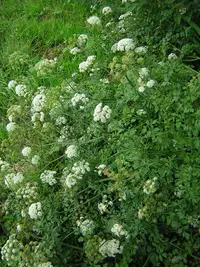
Hemlock water-dropwort (Oenanthe crocata) is a highly toxic, herbaceous perennial from wet habitats such as stream margins, ditches, and marshy fields. It forms hollow, grooved stems with divided, glossy green leaves that can resemble large parsley or celery foliage.
The plant spreads by thick, tuberous roots and can form dense clumps in consistently damp or waterlogged soil. It bears clusters of small white flowers in umbrella-like heads during the warmer months.
Because of its extreme toxicity and vigorous growth, it is not recommended for home gardens, and any decision to care for hemlock water-dropwort requires strict safety precautions and expert knowledge.

Care Difficulty
Hard Care

Light Preference
Partial Shade

Water Requirements
Aquatic

Temperature Preference
Cool Climate

Hardiness Zone
6–9

Soil Texture
Loamy, Silty, Organic-rich

Soil pH
Slightly acidic (6.5–7.0), Neutral (7.0)

Soil Drainage
Waterlogged tolerant

Fertilization
Minimal (feed rarely)
Scan your plant to receive care tips personalized for your specific plant
Available on iOS and Android
This moisture-loving perennial prefers bright, soft light rather than intense sun exposure.
This species is adapted to very wet ground and needs consistently saturated conditions.
This hardy wetland plant tolerates cool conditions but grows best in mild, frost-free periods.
This species prefers consistently high humidity similar to wetlands and reacts poorly to dry air.
This wetland species needs saturated, organic-rich substrate rather than standard potting soil.
This species can be grown in containers if the setup allows permanently waterlogged conditions without overflow problems.
This vigorous wetland perennial usually needs little feeding when grown in nutrient-rich, natural soils.
Pruning Oenanthe crocata is mainly done for safety, containment, and plant tidiness.
This species is usually grown in the ground or naturalized in wet areas, so focus on careful transplanting rather than frequent repotting.
Propagation of Oenanthe crocata is possible but should be approached cautiously due to its extreme toxicity.
This hardy perennial tolerates typical temperate winters with minimal intervention once established in wet ground.

Plant Health Check
Not sure what's wrong with your plant? Check your plant's health inside the app.
This species, also called hemlock water-dropwort, is regarded as one of the most poisonous native plants in Europe, with all parts toxic, especially the thick, tuberous roots that can be mistaken for edible vegetables.
It is strongly associated with permanently wet habitats such as stream margins, ditches, marshy fields, and wet woodland, often forming dense stands that signal nutrient-rich, waterlogged soils.
The plant contains oenanthotoxin, a potent neurotoxin that over-stimulates the nervous system and has historically been linked to severe convulsions and rapid fatal poisoning in humans and livestock.

Historical descriptions link this species to so-called sardonic grin poisoning, where strong muscle spasms distort the face into a fixed grimace, and some researchers have suggested it as a possible botanical source behind ancient references to the lethal “sardonic herb.”
All parts are extremely poisonous to humans, dogs, cats, and livestock, both fresh and dried. Very small amounts can be fatal if eaten. Handling requires care: avoid ingestion, keep away from children and animals, and use gloves when removing.
Keep your plants happy and healthy with plant identification, disease detection, and easy care guidance.