Mimic stream edges
Plant in a shallow, wide container or in a garden depression lined with organic matter to mimic natural stream margins and keep the root zone consistently cool and evenly moist.

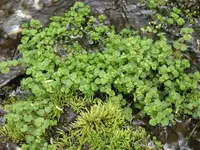
American golden saxifrage, Chrysosplenium americanum, is a low-growing perennial herb native to moist forests, stream banks, and wetlands in eastern North America. It often forms soft, green mats that hug the ground, with small rounded leaves and tiny yellow-green flowers clustered along its stems.
This plant prefers cool, shaded, and consistently damp conditions, which reflects its typical woodland and riparian habitats. Its spreading habit and modest size make it useful as a groundcover in shaded, moist garden areas.
Because it dislikes drying out and strong sun, it can be somewhat demanding outside its natural habitat. Gardeners who want to care for American golden saxifrage should focus on recreating its cool, moist, and sheltered conditions.

Care Difficulty
Moderate Care

Light Preference
Partial Shade

Water Requirements
Keep Soil Moist

Temperature Preference
Cold Hardy

Hardiness Zone
3–8

Soil Texture
Loamy, Silty, Organic-rich

Soil pH
Acidic (5.5–6.5), Slightly acidic (6.5–7.0)

Soil Drainage
Waterlogged tolerant

Fertilization
Minimal (feed rarely)
Scan your plant to receive care tips personalized for your specific plant
Available on iOS and Android
This shade-loving native groundcover thrives in cool, low-light woodland conditions with brief gentle sun.
This plant prefers consistently moist to wet soil that never fully dries out, reflecting its natural streamside habitat.
This species is a cool- to mild-climate perennial that tolerates winter cold but dislikes strong heat and drying conditions.
This species prefers consistently moist air similar to streamside habitats, so humidity matters.
Chrysosplenium americanum grows best in consistently moist, organic-rich substrates that mimic wet woodland soils.
This species can grow in containers if moisture levels are carefully controlled.
This native woodland groundcover usually needs little feeding in rich, moist soil, but light fertilization can support patch establishment.
Chrysosplenium americanum needs minimal pruning, mainly to maintain a tidy, healthy groundcover mat.
This species is usually grown in the ground, so care focuses on gentle transplanting rather than frequent repotting.
Chrysosplenium americanum is commonly propagated by division, with seed used mainly for larger restoration or naturalistic plantings.
This woodland perennial is cold hardy in much of its native range and usually needs little specific winter care in the ground.

Plant Health Check
Not sure what's wrong with your plant? Check your plant's health inside the app.
This species is tightly associated with cool, constantly moist habitats such as groundwater seeps, shaded streambanks, and wet ravine bottoms in eastern North America, forming low mats right at the water’s edge.
Its small yellowish “flowers” lack true petals; the showy yellow color comes mainly from enlarged, leaflike floral bracts and sepals that attract pollinators in early spring.
The plant reproduces both by seed and by creeping stems that root at the nodes, allowing it to slowly spread into dense patches in stable, undisturbed wet areas.

This species is considered an indicator of relatively undisturbed, high-quality headwater and seepage habitats in parts of its range, so its presence is often used by field botanists to help assess the ecological integrity of small streams and forested wetlands.
This species spreads slowly to moderately by short creeping stems and self-seeding, forming low mats over time. It is usually not aggressive, but in consistently moist, shaded spots it can gradually fill available ground as a soft groundcover.
Keep your plants happy and healthy with plant identification, disease detection, and easy care guidance.