Naked-man Orchid Care (Orchis italica)

Naked-man Orchid

About Naked-man Orchid

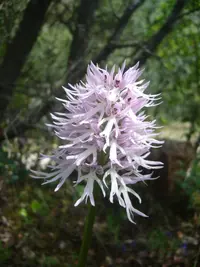
The naked-man orchid, Orchis italica, is a terrestrial orchid known for its dense spikes of pale pink to purple flowers with a distinctive human-like shape. It grows from underground tubers and forms compact clumps of narrow, lance-shaped leaves at the base.

In nature it occurs across the Mediterranean region, often in open grasslands, light woodland, and rocky slopes with good drainage. It prefers bright light with some protection from harsh midday sun, moderate moisture, and a gritty, low-fertility soil.

This species can be moderately challenging to grow, mainly due to its need for a cool dry rest period and sensitivity to overwatering. Understanding these seasonal cycles is essential to how to care for Naked-man Orchid.

Main Plant Requirements

Care Difficulty

Hard Care

Light Preference

Partial Shade

Water Requirements

Moderate Water

Temperature Preference

Cool Climate

Hardiness Zone

7–9

Soil Texture

Sandy, Loamy, Rocky

Soil pH

Acidic (5.5–6.5), Slightly acidic (6.5–7.0)

Soil Drainage

Well-drained

Fertilization

Minimal (feed rarely)

Get Personalized Care Plan

Scan your plant to receive care tips personalized for your specific plant

Available on iOS and Android

How to Care for the Naked-man Orchid

Orchis italica prefers bright, open conditions that mimic sunny meadows with some protection from harsh midday sun.

  • Provide 4–6 hours of direct morning sun, then light or dappled shade after midday, especially in warmer regions.
  • Tolerates partial shade (around 3–4 hours of sun), but flowering of the Naked-man Orchid may decrease if light is too low.
  • In hot summers, protect from intense afternoon sun to prevent leaf scorch; in early spring, allow more direct light to support strong growth.

This terrestrial orchid needs moisture during active growth but benefits from drier conditions when dormant.

  • During spring growth and flowering, water when the top 2–3 cm of soil feel dry, ensuring excess water drains freely to protect the bulbs from rot.
  • In late summer to autumn dormancy, reduce watering sharply, allowing the soil to dry almost completely between light waterings.
  • Wilting, shriveled leaves, or dry, cracking soil indicate underwatering, while yellowing, mushy bulbs or a sour smell suggest overwatering in Orchis italica.

This species is adapted to mild, Mediterranean-type climates with cool, moist winters and warm, dry summers.

  • Active growth is best at 50–68°F (10–20°C), with cool nights that support root and shoot development.
  • Dormant bulbs tolerate down to about 23°F (-5°C) if soil drains well, but prolonged hard freezes below this can cause damage.
  • In summer, plants handle 77–86°F (25–30°C) if the soil does not stay wet; sustained extreme heat above 95°F (35°C) stresses the bulbs and reduces vigor next season.

This orchid prefers moderate humidity but copes with typical indoor levels if watering is well managed.

  • Aim for 40–60% humidity, avoiding both very dry heated rooms and persistently damp, stagnant air.
  • Dry, papery leaf tips and shriveling pseudobulbs indicate humidity is too low for Naked-man Orchid.
  • Increase humidity locally by grouping plants or placing the pot near, not on, a pebble tray with water.

This terrestrial orchid needs light, airy soil that drains quickly yet holds some moisture around the roots.

  • Use a loose mix of 40% fine bark, 30% perlite, and 30% coarse sand or gritty loam to mimic its native mineral soils.
  • Keep pH slightly alkaline to neutral, around 7.0–7.5, by avoiding highly acidic peat-heavy mixes.
  • Ensure very rapid drainage so water runs through in seconds and the mix never compacts into a dense mass.
  • For Orchis italica grown outdoors, raise the planting level slightly or use a gritty top layer to keep the root zone ventilated.

This species can be grown in containers if the pot and medium are managed to stay free-draining.

  • Choose a pot slightly deeper than the tubers so they sit 3–5 cm below the rim, leaving space for a gritty top layer.
  • Use rigid plastic or glazed ceramic rather than unglazed clay in hot climates to reduce rapid moisture loss from the mix.
  • Elevate the pot on feet or mesh so drainage holes stay clear and water cannot pool under the container after rain or watering.

This terrestrial orchid benefits from light, targeted feeding but is sensitive to excess nutrients.

  • Use a balanced, low-strength NPK orchid fertilizer at 1/4–1/2 label dose during active spring growth.
  • Apply every 3–4 weeks only while leaves are present; stop once flowering finishes and foliage starts to yellow.
  • Avoid fertilizing dormant tubers in summer; dry rest periods for Naked-man Orchid should stay unfertilized.
  • In poor soils, a very thin top-dressing of well-aged compost in early spring can support flowering without burning roots.

Pruning needs for Orchis italica are minimal and mainly focus on spent flowers and dead material.

  • Cut flower spikes at the base with clean scissors or pruners after seed pods mature or if not saving seed.
  • Remove yellowed or dead leaves at ground level, taking care not to damage the tuber or new shoots.
  • Avoid shaping or heavy pruning, as this orchid dies back naturally and stores energy in underground tubers.
  • Disinfect tools before and after use to reduce the risk of fungal or bacterial infections entering fresh cuts.

This species is usually grown in the ground, so focus on careful transplanting of its tubers rather than frequent repotting.

  • Transplant only when clumps become crowded or flowering declines, usually every 3–5 years.
  • Move Orchis italica in late summer to early fall, once foliage has fully died back and tubers are dormant.
  • Lift tubers gently, keep roots shaded and slightly moist, and replant at the same depth in well-drained, gritty soil.
  • Water lightly after transplanting, then reduce watering to avoid rot while tubers resettle and form new roots.

Propagation is possible but somewhat specialized, relying mainly on division of tubers rather than seed at home.

  • Divide dormant tubers in late summer to early fall, when foliage has fully withered.
  • Select firm, healthy tubers with visible buds and replant each into well-drained, low-nutrient substrate.
  • Space divisions to allow air flow and future clump expansion, keeping buds just below soil level.
  • Seed propagation requires symbiotic fungi and controlled conditions, so it is usually left to specialist growers.

This hardy terrestrial orchid tolerates typical mild to moderately cold winters when planted in suitable ground conditions.

  • In regions with freezing winters, apply a light mulch layer (2–5 cm) over the dormant area after the ground cools.
  • Avoid waterlogged soils in winter, which increase tuber rot risk under cold conditions.
  • Container-grown plants in very cold climates can be overwintered in a cold, frost-free, bright but not sunny space.

Care Tips

Mark Dormant Spots

Use small, durable labels to mark the exact spots of the underground tubers in late summer so you do not disturb or dig them up by mistake during the long dormant period.

Lift And Divide

Every 3–4 years, lift the clump after foliage dies back, gently separate offsets with clean hands or tools, and replant the firm, healthy tubers at the same depth to maintain vigor and flowering.

Fine Grit Mulch

Top-dress the planting area with a thin layer of 3–5 mm mineral grit or coarse sand to improve surface drainage, keep the neck of the tuber dry, and discourage slug damage to emerging shoots.

Controlled Pot Culture

For containers, grow plants in tall, free-draining orchid or alpine pots and move them under cover in very wet winters to prevent waterlogging while still keeping them cool and bright.

Targeted Pest Patrol

In early spring, inspect young shoots at least weekly for slugs, snails, and aphids, removing pests by hand or using physical barriers so that flower spikes are not distorted or eaten before they develop fully when growing Naked-man Orchid.

Common Pests and Diseases

Spider mites

This pest often appears on stressed plants grown in warm, dry indoor or greenhouse conditions, causing fine stippling and a dull, dusty look on leaves. Symptoms include very fine webbing on leaf undersides and along the stems.

Solution

Increase humidity, gently rinse foliage with lukewarm water, and wipe leaf surfaces to remove mites and webbing. For persistent issues, use a horticultural soap or neem oil spray directed at leaf undersides, repeating every 5–7 days until new growth appears clean.

Aphids

These insects feed on young shoots and flower spikes, sucking sap and causing distorted growth, sticky honeydew, and sometimes sooty mold on leaves and stems. Infestations are most common on Orchis italica grown in pots or in sheltered garden microclimates.

Solution

Wash affected areas with a firm stream of water to dislodge colonies, then spot-treat remaining insects with insecticidal soap, ensuring full coverage of buds and undersides of leaves. In outdoor plantings, encourage natural predators such as lady beetles by avoiding broad-spectrum insecticides nearby.

Slugs and snails

This pest is a serious problem for outdoor clumps, feeding on emerging shoots, buds, and flowers and leaving large irregular holes and slime trails. Damage is often worst in cool, wet weather when new growth is tender.

Solution

Hand-pick slugs and snails in the evening, use physical barriers such as copper tape or sharp grit around pots, and remove nearby hiding places like dense debris. If needed, apply an iron phosphate-based slug bait around but not on the plants, following label directions carefully.

Viral mosaic

This disease can cause mottled, streaked, or distorted leaves and flowers, with color breaking in the petals and uneven growth. Symptoms include plants that stay weak over several seasons despite correct care.

Solution

Remove and destroy any plant that shows consistent mosaic or streaking symptoms and does not improve, as virus infections are not curable. Disinfect tools between plants, avoid reusing potting media, and only divide or trade healthy, symptom-free Orchis italica to reduce spread.

Botrytis blight

This disease develops in cool, damp, stagnant air, leading to brown spots on flowers and leaves that may develop a gray, fuzzy mold. Symptoms include premature flower drop and soft, water-soaked lesions on petals and bracts.

Solution

Improve air circulation around the plant, avoid overhead watering, and remove any affected flowers or leaves promptly. In persistent or severe cases, apply a labeled fungicide for botrytis on ornamental plants and reduce moisture on foliage, especially during cool evenings, as part of Orchis italica care instructions.

Interesting Facts

Human-like flower shape

The labellum, or central petal, of this species is deeply lobed and resembles a tiny stylized human figure, which is why it is commonly called the naked-man orchid or Italian orchid.

Mediterranean specialist

This orchid is naturally found in sunny, rocky habitats across the Mediterranean Basin, often in calcareous soils rich in calcium carbonate and in open scrub or light woodland margins.

Complex pollination strategy

The flowers produce a mild scent and visual cues that attract bees and other insects, and the intricate petal shape helps guide visiting pollinators into the right position to contact the reproductive structures.

Botan icon

Did you know?

This species has been documented in archaeological and historical sources as part of the broader Orchis group whose underground tubers were collected and dried to make salep, a traditional thickening drink ingredient in parts of the eastern Mediterranean and Middle East, although modern wild collection is now restricted or discouraged in many regions due to conservation concerns.

FAQs about Naked-man Orchid

Lack of flowering usually comes from insufficient winter chill, too little light, or overfeeding with nitrogen. Ensure a cool dormant period, bright conditions in spring, and use a low-nitrogen fertilizer suited to terrestrial orchids.

Grow Healthy Plants with Botan Care

Keep your plants happy and healthy with plant identification, disease detection, and easy care guidance.

Botan plant care app — identify plants on mobile

Explore More Plants