


Seasonal dormancy care
After flowering, gradually reduce watering and allow the foliage to yellow and die back naturally so the tubers can store energy for the next growth cycle.

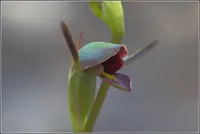
Horned orchid (Orthoceras novae-zeelandiae) is a terrestrial orchid native to New Zealand, usually found in open tussock grassland, scrub, and light forest margins. It grows from underground tubers and produces slender stems with narrow leaves and distinctive dark, horn-like flowers. The flowers appear in loose spikes and are often green to purplish-brown, helping the plant blend into its surroundings. This species has a seasonal growth cycle, dying back to its tubers in the off-season and re-sprouting under suitable conditions. It can be challenging to grow in cultivation, as it dislikes disturbance and needs well-drained, low-nutrient substrates with consistent moisture. Gardeners who care for Horned orchid must closely match its cool, bright, and naturally airy habitat.

Care Difficulty
Hard Care

Light Preference
Partial Shade

Water Requirements
Keep Soil Moist

Temperature Preference
Cool Climate

Hardiness Zone
8–10

Soil Texture
Sandy, Loamy, Organic-rich

Soil pH
Acidic (5.5–6.5)

Soil Drainage
Moist but well-drained

Fertilization
Minimal (feed rarely)
Scan your plant to receive care tips personalized for your specific plant
Available on iOS and Android
This terrestrial orchid prefers bright but gentle light that mimics open scrub or grassland conditions.
This species prefers steadily moist but airy soil that never stays waterlogged.
This orchid is adapted to mild, temperate climates with cool winters and moderate summers.
This terrestrial orchid tolerates a broad humidity range but performs best with moderately moist air.
Orthoceras novae-zeelandiae prefers free-draining, light, mineral-influenced soil that never stays waterlogged.
This species can be grown in containers if the pot closely mimics its shallow, free-draining natural substrate.
This terrestrial orchid is adapted to low-nutrient habitats and needs only minimal feeding in cultivation.
Orthoceras novae-zeelandiae needs only light pruning focused on plant hygiene rather than shaping.
This species is usually short-lived in pots and is better managed with infrequent, careful transplanting than frequent repotting.
Propagation of Orthoceras novae-zeelandiae is technically challenging and seldom attempted by home growers.
In mild coastal climates this orchid is fairly cold tolerant and usually needs little specific winter care outdoors.

Plant Health Check
Not sure what's wrong with your plant? Check your plant's health inside the app.
This terrestrial orchid is naturally restricted to New Zealand but occurs in both the North and South Islands, as well as on Chatham, Stewart, and Auckland Islands, showing an unusual distribution for a single small ground orchid species.
The flowers are distinctly narrow and tubular with horn-like lateral lobes on the labellum, an adaptation that guides small insect visitors toward the reproductive structures in a very specific way compared with broader-lipped orchids.
The plant survives seasonal stress via an underground tuber that becomes dormant outside the growing and flowering season, allowing it to persist in open, often exposed habitats where above-ground parts would not survive year-round.

Historical herbarium and field records show that this species was once more widespread in lowland areas of New Zealand, but it has declined in many sites and is now considered naturally uncommon, surviving mainly in scattered, often coastal or subalpine habitats.
This terrestrial orchid usually flowers in late spring to early summer. Individual blooms are short-lived, often 5–10 days, but multiple buds open in sequence, so a well-grown plant can display flowers over several weeks.
Keep your plants happy and healthy with plant identification, disease detection, and easy care guidance.

Siberian bugloss
Brunnera macrophylla
Abutilon angulatum
Abutilon angulatum
firecracker penstemon
Penstemon eatonii
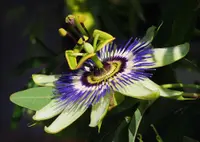
Blue Passion Flower
Passiflora caerulea
Pygmy tree orchid
Bulbophyllum pygmaeum
plateau false foxglove
Agalinis edwardsiana
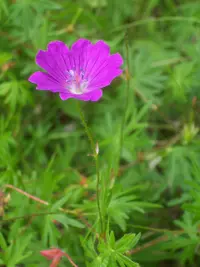
bloody geranium
Geranium sanguineum
Persian Candytuft
Aethionema grandiflorum